How to Spot-and-Stalk Montana Black Bear
Hunting black bears in Montana, especially with a spot-and-stalk approach, is one of the most physically demanding yet incredibly rewarding experiences you can have in the backcountry. It's not just about pulling a trigger; it's a true test of patience, observation, and skill, pushing you to understand the animal and its environment on a much deeper level. This guide will walk you through everything you need to know to successfully spot-and-stalk a black bear in the rugged landscapes of Big Sky Country.
Understanding Montana Black Bear Behavior and Habitat
Before you even think about hitting the mountains, you need to immerse yourself in the world of Montana's black bears. Their movements, feeding habits, and preferred hangouts are dictated by the seasons, the weather, and what nature provides. Without this foundational knowledge, you're essentially just wandering around.
Seasonal Movements and Food Sources
Black bears are incredibly intelligent and opportunistic feeders, and their location throughout the spring and fall hunting seasons is almost entirely driven by food availability.
In the spring, when bears emerge from their dens, they're focused on replenishing lost weight. This means they’ll gravitate towards the first green-up. Think south-facing slopes, lower elevations where the snow melts earliest, and areas freshly exposed to the sun. You'll often find them grazing on tender, new grasses, clover, dandelions, and emerging forbs. They’re essentially big, furry vegetarians in the spring, keen on easily digestible calories. Sometimes, they'll also scavenge winter-killed carcasses, so keep an eye out for areas where elk or deer might have perished over the winter. As spring progresses and temperatures rise, they might move up in elevation as the green-up follows the melting snowline. Understanding these patterns is critical for pinpointing where bears will be. If you're planning a trip, be sure to check the specific Montana Black Bear Season Dates for your area of interest, as these can vary slightly.
Come fall, the diet shifts dramatically. Bears are in hyperphagia, meaning they're eating almost constantly to pack on fat reserves for the coming winter hibernation. This is when they become much more focused on high-calorie foods like berries (huckleberries, serviceberries, chokecherries), acorns, and other mast crops. Their range might expand, or they might concentrate in specific drainages where these food sources are abundant. Hunters often report seeing bears in heavily timbered areas with dense berry bushes during this time. The fall hunt can offer a different dynamic, as bears might be more secretive, less visible on open hillsides, and more reliant on dense cover. The difference between a Montana Spring vs Fall Bear Hunting strategy can be significant.
Prime Bear Habitat in Montana
Montana offers a vast array of habitats, and black bears utilize a diverse patchwork of it. You won't typically find them in wide-open plains (though they will travel through them), but rather in areas that offer a combination of food, water, and cover.
Look for a mosaic of dense timber, open clear-cuts, rocky slides, and riparian areas along creeks and rivers. Dense timber provides bedding cover, security, and escape routes. Clear-cuts and natural openings, especially those on south-facing slopes, are magnets for bears in the spring because they offer sunlight and early green-up. These areas are also great for glassing. Rocky slides or avalanche chutes, particularly those with pockets of vegetation, can also hold bears, as these areas often have unique microclimates and specific food sources. In places like the Kootenai National Forest or the Flathead National Forest in western Montana, these features are abundant. Areas with a good mix of conifer forests (fir, spruce, pine) interspersed with deciduous trees like aspen and cottonwood, especially along waterways, are prime territory. Knowing the general Montana Black Bear Population and Range can help narrow down your focus to regions known for healthy bear numbers.
Essential Gear and Scouting for Spot-and-Stalk
Spot-and-stalk bear hunting isn't a casual stroll in the park. It demands specific gear that will enhance your success and, more importantly, ensure your safety in the backcountry. You need to be prepared for everything from long-range glassing to close-quarters encounters.
Optics, Footwear, and Safety Essentials
Your optics setup is arguably the most critical component for a successful spot-and-stalk bear hunt. You'll spend hours, if not days, behind glass, meticulously searching for that telltale black blob. A high-quality spotting scope, something in the 20-60x range with a large objective lens (e.g., 60-85mm), mounted on a sturdy tripod, is non-negotiable. Pair this with a good set of 10x or 12x binoculars. Brands like Vortex, Leupold, and Swarovski are popular choices among serious hunters for their clarity and durability. You'll want to think about how you're using your optics in conjunction with your movements. Many experienced hunters rely on the field-proven quality of optics mentioned frequently by platforms like GoHunt for their comprehensive gear reviews, which can help narrow down your choices when selecting the best optics for Montana big game.
Next up: footwear. You’re going to be covering serious ground, often on steep, uneven, and potentially slippery terrain. Invest in a pair of high-quality, broken-in hiking boots with excellent ankle support and a stiff sole. Waterproofing is also crucial, especially during spring hunts when snowmelt and wet conditions are common. Layering socks can help prevent blisters.
Finally, safety essentials. Bear spray is not optional; it’s an absolute must-have. Carry it in an easily accessible holster on your chest or hip. A high-quality first-aid kit, a reliable navigation device (GPS, satellite messenger like a Garmin inReach, or a fully charged phone with a reliable app like onX Hunt), and a headlamp are also non-negotiable. Always let someone know your hunting plan, including your intended area and return time. When you’re deep in the wilderness, safety always comes first. This advice is critical for any extended venture into the wild, much like preparing for a Montana Backcountry Hunting Guide.
E-Scouting and Pre-Season Field Recon
Modern technology has revolutionized how we approach hunting, and e-scouting is your first step to an informed bear hunt. Before you ever leave your house, fire up your computer and dive into mapping software. Look for south-facing slopes at various elevations, especially those adjacent to dense timber. Identify clear-cuts from satellite imagery; these areas often regenerate with tender vegetation that bears love. Mark potential bedding areas, water sources, and likely travel corridors. Consider using tools to analyze historical weather patterns or snowpack data, as this can give you clues on when specific slopes might green up. While planning your e-scouting, also consider strategies outlined in How to E-Scout Montana Hunting Units to maximize your time before you even hit the road.
Once you’ve identified some promising spots on your maps, it’s time for pre-season field recon. This might involve a drive through the area, stopping at overlooks to glass potential feeding slopes, or even a hike into a promising drainage. You're looking for fresh sign: scat, tracks, rubbed trees, and overturned rocks. Pay attention to how the terrain actually looks on the ground versus what the map shows. Are there hidden benches? More dense timber than you expected? Identifying natural travel corridors, funnels, and escape routes can be invaluable. Even if you're not seeing bears, you're learning the lay of the land, which is critical for planning a successful stalk. A good pack is essential for carrying your gear during these scouting trips, much like what you'd consider for the Best Backpack for a Montana Elk Hunt.
The Art of Spot-and-Stalking Black Bears
Spot-and-stalk hunting for black bears is a delicate dance of patience, observation, and calculated movement. It’s about being invisible in their world, reading the landscape, and exploiting every advantage the terrain and wind can offer. This isn't just about finding a bear; it's about getting within striking distance.
Effective Glassing Techniques
This is where the "spot" in spot-and-stalk truly shines. You will spend the majority of your time glassing, so make sure you're comfortable and methodical. Find a good vantage point that allows you to see a large expanse of prime bear habitat – those greening slopes, clear-cuts, and timber edges. Set up your spotting scope and binoculars on a tripod.
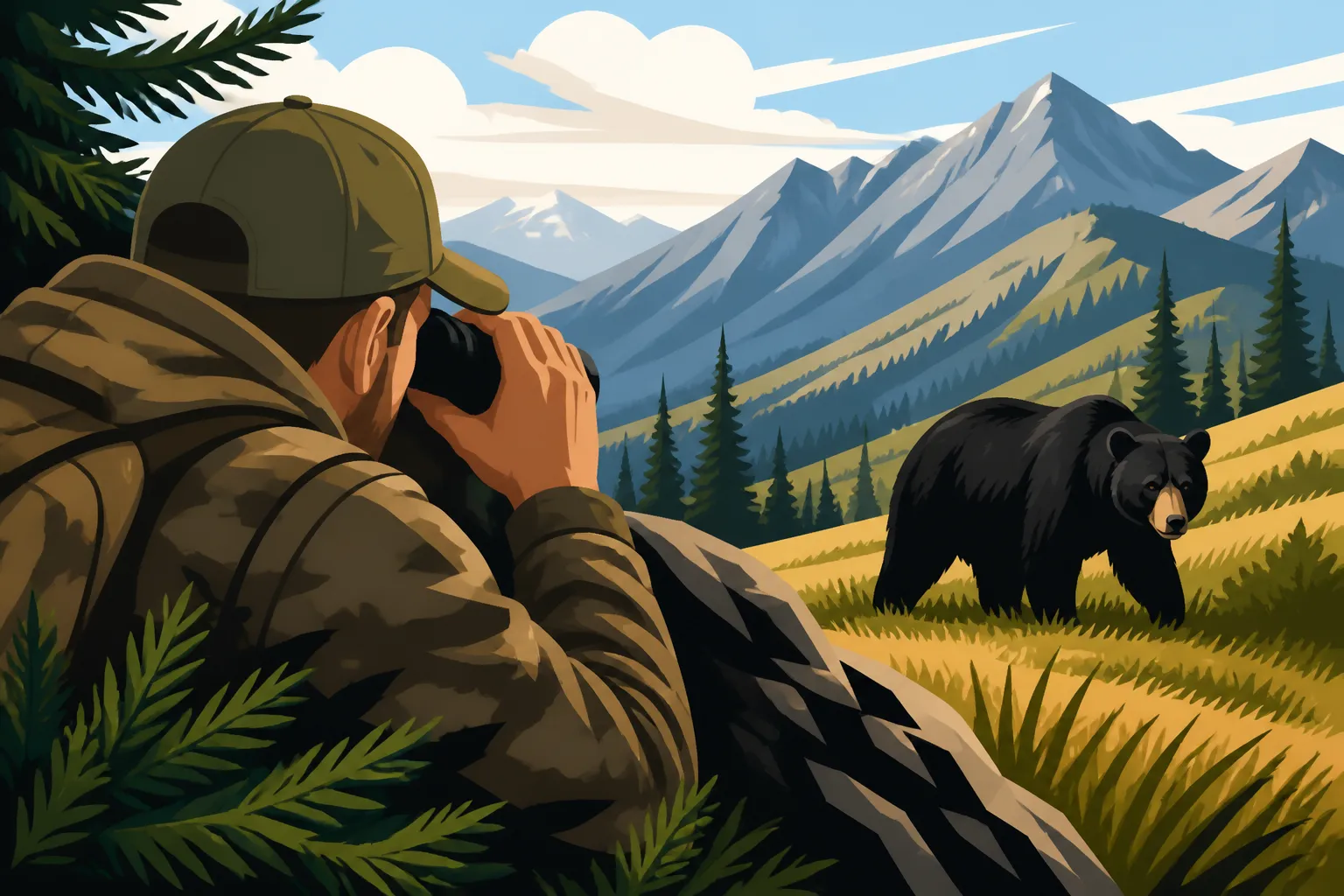
Start by systematically grid-searching an area. Pick a section, then slowly, meticulously, scan every inch, working from one side to the other, then moving your glass down and repeating. Don't just look for an entire bear; often, you'll pick up a subtle detail first: a dark patch that seems out of place, a flicker of movement, or the distinctive sheen of a black bear's coat. Pay extra attention to shadowed areas and timber fringes where bears might emerge. The sun’s angle can significantly impact visibility, so try to position yourself so the sun is not directly in your eyes. This also means understanding how the sun hits the slopes throughout the day. A good strategy is to glass sunlit slopes in the morning and evening, then focus on shaded areas during midday. Persistence is key; bears can be incredibly still, and what looks like a stump might just be a bruin soaking up the sun. For an even more detailed approach to covering vast landscapes, you can refer to tips on How to Glass Montana's Big Country.
Planning Your Stalk and Wind Considerations
Once you spot a bear, the real work begins. Before you make a single move, take a deep breath and observe. How is the bear behaving? Is it feeding, bedding, or moving? Which direction is it heading? Most importantly, assess the wind. Wind is your absolute number one priority. A bear’s sense of smell is legendary, far superior to its eyesight, and if it catches your scent, your hunt is over. Always, always, always approach from downwind. This can mean taking a much longer, more circuitous route, but it’s essential.
Now, plan your route. Use the terrain to your advantage: ridges, draws, timber pockets, and anything that can conceal your approach. Avoid skylining yourself on ridgetops. Move slowly, deliberately, and quietly. If you’re hunting with a partner, communicate silently with hand signals. Stop frequently to re-evaluate the bear's position and the wind. If the wind shifts unexpectedly, you might need to back out and restart your stalk, or even abandon it if the conditions become unfavorable. Sometimes, the best move is no move at all, waiting for the bear to move into a more favorable position for a stalk. The behavior of bears, particularly Montana Black Bear Behavior, can often be predictable if you observe long enough.
Closing the Distance and Shot Opportunity
As you get closer, every step becomes even more critical. Keep your binoculars handy to confirm the bear's position and to identify any other bears in the vicinity (especially if you're looking for a specific size or a boar). Minimize noise and movement. If the bear looks up, freeze. It might be looking in your direction, but often they’re just being vigilant. Wait for it to resume feeding or move on before continuing.
When you’ve closed the distance to your comfortable shooting range – which should be determined by your weapon, skill, and ethical considerations – it’s time to prepare for the shot. Find a stable shooting position, whether prone, kneeling, or using a shooting stick. Take your time. Black bear vitals can be tricky; they’re often deeper and further forward than deer, tucked under their shoulder. Aim for the crease behind the shoulder, slightly lower than you might think. Wait for the bear to present a broadside or slightly quartering-away shot. Double-check your surroundings, ensuring a safe backdrop. Patience is paramount here; rushing the shot can lead to a wounded animal and a difficult, potentially dangerous, tracking job.
Post-Shot Procedures and Safety
Taking a shot at a black bear is a moment of intense adrenaline, but the work is far from over. What you do immediately after the shot and in the hours that follow is crucial for a successful and ethical recovery, as well as for preserving your hard-earned meat and hide.
Tracking and Recovery
After the shot, resist the immediate urge to rush to the spot. While your instincts might scream at you to run to the bear, giving it time is often the best course of action. If you believe it was a good shot, wait at least 30 minutes, sometimes an hour or more, especially if the bear was hit in the vitals. This allows the animal to lay down and expire, preventing it from running further or getting into thicker cover. If you suspect a marginal hit, a longer wait, even several hours, might be necessary. This waiting period is standard practice in big game hunting and very similar to what you'd do for How to Pack Out an Elk in Montana if you were hunting elk.
Begin tracking at the last place you saw the bear. Look for signs of impact: disturbed ground, broken branches, and, most importantly, blood. Follow the blood trail meticulously. If the blood trail peters out, expand your search in concentric circles from the last known sign. Look for tracks, overturned leaves, and any indication of the bear's path. If darkness approaches and you haven't recovered the bear, mark the last blood trail spot carefully with GPS and bright flagging tape. It's often safer and more effective to retreat and return with fresh eyes and possibly more help in the morning. Be extremely cautious during tracking; a wounded bear can be dangerous.
Field Dressing and Meat Care
Once the bear is recovered, the clock starts ticking, especially if you're hunting in warmer spring conditions. The goal is to cool the meat as quickly as possible. This means field dressing immediately. Remove all internal organs. If possible, split the sternum and pelvis to allow for maximum airflow. For black bears, it’s often best to skin the animal as soon as possible, especially if you plan to keep the hide for a rug or mount. The hide insulates the meat significantly.
After field dressing, quarter the bear and get the meat off the bone if you're in the backcountry. Place the quarters in game bags to protect them from dirt and insects. Hang the meat in a shady, airy spot off the ground to continue cooling. If you're near a vehicle and can transport it quickly, get it to a cooler with ice or a processor. In early season conditions, managing meat cooling can be challenging, a lot like practices for How to Keep Elk Meat Cool in Montana's Early Season. Pay close attention to the skull and hide if you plan to taxidermy. Make sure to cape it properly, leaving plenty of hide, and cool it as quickly as the meat. The fat layer on bears can be thick and needs to be handled to prevent spoilage of the hide.
Here’s a quick comparison of key considerations for spring versus fall black bear hunting:
| Feature | Spring Black Bear Hunting | Fall Black Bear Hunting |
|---|---|---|
| Primary Food | Green-up (grass, forbs, dandelions), winter kill | Berries (huckleberries, serviceberries), acorns, mast crops |
| Typical Habitat | South-facing slopes, lower elevations, clear-cuts | Denser timber, areas with abundant berry patches |
| Bear Visibility | Often more visible on open, green slopes | Can be more secretive, staying in cover with food sources |
| Hide Quality | Varies; bears can be patchy from denning | Generally prime, dense, and full-furred (depends on rut/rubbing) |
| Weather | Unpredictable; snow, rain, warm days, mud | Cooler, drier; can have early snow, pleasant fall days |
| Meat Care | Critical due to potentially warmer temperatures | Easier to cool meat due to generally cooler temps |
| Tactics | Focus on glassing open, sun-exposed areas | Focus on glassing food sources within timbered areas |
Disclaimer
Hunting is an inherently risky activity. This guide provides general information for educational purposes only. Always consult current Montana Fish, Wildlife & Parks regulations before hunting. Proper training, safety equipment, and adherence to all laws are essential for a safe and ethical hunt. The author and publisher are not responsible for any accidents, injuries, or legal issues that may arise from using this information.