Public vs Private Land Hunting in Montana
Figuring out where you can actually hunt in Montana can feel like navigating a maze, especially with all the different land classifications and rules. Many aspiring hunters, both residents and nonresidents, wrestle with the fundamental question: what's the real difference between hunting on public land versus private land, and which one is truly right for your next adventure? This comprehensive guide will break down the intricacies of both public and private land hunting opportunities in Big Sky Country, helping you understand the pros, cons, and essential strategies for each.
Understanding Montana's Land Access: Public vs. Private Basics
Montana is a vast state, and understanding its diverse landscape—how it's owned and managed—is the absolute first step to becoming a successful hunter here. It's not just about knowing where the animals are; it's about knowing where you're legally allowed to be when you're pursuing them. This distinction between public and private land isn't just a formality; it dictates your approach, your strategy, and even the type of experience you'll have in the field.
Defining Public Land in Montana
When we talk about public land in Montana, we're referring to land managed by federal and state agencies, open for recreational use, including hunting. This is the land that belongs to all of us, funded by taxpayers, and it's a huge part of what makes hunting in Montana so special and accessible. The sheer scale of it is what draws so many people here.
Federally managed lands make up a significant portion, primarily in the form of National Forests and Bureau of Land Management (BLM) acreage. These vast tracts, often found in the western mountainous regions and across the eastern plains, are typically characterized by rugged terrain, dense timber, expansive prairies, and remote wilderness areas. You'll find designations like the Custer Gallatin National Forest near Bozeman or extensive BLM lands in central and eastern Montana. State lands, often called State Trust Lands, are managed by the Montana Department of Natural Resources and Conservation (DNRC). These lands are typically leased for agriculture or timber, but many parcels are also open for hunting with the purchase of a State Land Use License. The beauty of public land is the freedom it offers; you can often roam for miles, employing strategies like those found in our Montana Backcountry Hunting Guide, without worrying about crossing a property line, as long as you respect the regulations for the specific management agency.
Defining Private Land in Montana
Private land, on the other hand, is just that: property owned by individuals or private entities. This includes everything from vast cattle ranches and wheat fields stretching for miles across eastern Montana to smaller homesteads, timber company lands, and family properties nestled against the mountains. The critical distinction here is access. Unlike public land, you do not have an inherent right to hunt on private land.
Access to private land is granted at the landowner's discretion. This can take many forms: explicit verbal permission for a day hunt, a written agreement for a season, or a paid lease arrangement. Many outfitters operate exclusively on large private ranches, offering guided hunts for a fee. The thought of navigating private land can be daunting, especially for nonresidents, but it opens up different hunting opportunities, often with less pressure and potentially higher game populations dueating to land management practices. Understanding the rules for How to Get Landowner Permission in Montana is crucial if this is a path you wish to explore.
The Allure and Challenges of Montana Public Land Hunting
Public land hunting in Montana is often romanticized, conjuring images of rugged DIY adventures and vast, untouched wilderness. For good reason, it’s a cornerstone of the Montana hunting experience, offering unparalleled freedom and breathtaking scenery. However, it's also where many hunters face their steepest learning curves and frustrations due to increasing pressure and competition.
Advantages of Public Land Access
The most obvious advantage of public land is simply its existence and accessibility. No permission needed, no hefty fees (beyond your license), just you and the wilderness. This makes it an incredibly appealing option for budget-conscious hunters or those who cherish the challenge of a true do-it-yourself hunt. Montana boasts millions of acres of public land, including National Forests, BLM lands, and State Trust Lands, providing an enormous canvas for exploration.
On these lands, you can truly put your skills to the test, learning to E-Scout Montana Hunting Units and adapting to the constantly changing environment. It fosters self-reliance and grit. For many, the reward of harvesting an animal on public land, knowing you scouted, planned, and executed the hunt entirely on your own terms, is incredibly fulfilling. You're part of a tradition that runs deep in the West, where access to wild spaces for hunting is a cherished right. It’s also where you can find some of the most remote and physically demanding hunts, often in areas that feel truly wild and untamed.
Disadvantages and Hunter Pressure
While the vastness of Montana's public land is a huge draw, it doesn't mean it's devoid of challenges. The biggest hurdle, especially for big game like elk and deer, is hunter pressure. Popular areas, or those easily accessible by road, can see significant numbers of hunters, particularly during the general rifle season. This competition can push animals into dense cover, make them nocturnal, or simply make locating and pursuing them much harder.
Finding solitude and undisturbed game often requires venturing further off the beaten path, demanding significant physical exertion and navigational skills. This is where a good pair of boots and a solid Montana Elk Hunt Fitness Plan become non-negotiable. Another challenge is dealing with checkerboard land ownership, where public and private parcels are intertwined. Navigating these boundaries without trespass is paramount, and it requires diligent map work. Tools like onX Hunt have become indispensable for identifying property lines in real-time, helping hunters avoid accidental trespass and ensuring they stay on legal ground.
Tactics for Public Land Success
To consistently find success on Montana public land, you need a different mindset than hunting manicured private properties. It's less about sheer numbers of animals and more about strategy, persistence, and often, outworking other hunters. A key tactic is to seek out remote, hard-to-access areas that deter others. This might mean long hikes, packing into the backcountry, or focusing on terrain that demands a high level of physical fitness.
Another effective strategy is to hunt during less popular times or seasons. Consider archery season, which generally sees fewer hunters than rifle season, or focusing on late-season hunts when snow may concentrate animals. Understanding how to use natural features like timber, drainages, and north-facing slopes to your advantage, especially when animals are pressured, is also critical. Utilizing methods like still-hunting timber or ambushing animals along travel corridors becomes crucial when dealing with heavy pressure. Consulting resources like the Montana Public Land Hunting Strategy can provide deeper insights into these tactics.
Navigating Montana Private Land Hunting
While public land offers a certain romance, private land hunting in Montana presents a different set of opportunities, often characterized by more controlled environments, potentially higher success rates, and specific rules set by landowners. For many, especially those seeking a more predictable or less physically demanding hunt, private land is an attractive option.
Gaining Private Land Access
The most common way to hunt private land is by obtaining permission directly from the landowner. This process can range from simply knocking on doors or making phone calls to establishing long-term relationships. Honesty, respect, and a willingness to adhere to the landowner's rules are paramount. Often, offering to help with chores, fencing, or pest control can go a long way in building trust and securing access. Remember, landowners are often inundated with requests, so being polite, prepared, and offering something in return can set you apart.
Another significant avenue for private land access is through Montana's Block Management Program. This is a voluntary program where private landowners open their land to public hunting for free, and in return, the state manages hunter access, patrols, and compensates landowners. These areas are incredibly popular and provide excellent opportunities, especially for mule deer and antelope on the plains, as well as some elk and whitetail. Understanding Montana Block Management Areas Explained is essential for any hunter looking to utilize this fantastic resource. Be prepared to obtain a Block Management Area (BMA) access slip, as some BMAs have sign-in rosters or limited hunter numbers.
Types of Private Land Opportunities
Private land hunting opportunities vary widely across Montana. On large agricultural properties, especially in eastern Montana, you might find excellent populations of whitetail deer in river bottoms or mule deer and antelope grazing in vast prairie landscapes. These hunts can often be less physically demanding than mountain hunts and more focused on glassing and stalking.
Conversely, some private lands border national forests or wilderness areas, acting as crucial winter range or travel corridors for elk and deer. Hunting these transition zones can be incredibly productive, especially during migration periods or late season. Many landowners in these areas might run cattle or hay operations, and deer or elk can cause agricultural damage, making them more amenable to allowing hunters. Finally, for those who prefer an all-inclusive experience, many outfitters, like those listed in our Montana Elk Hunting Outfitters Guide, operate on vast private ranches, offering guided hunts where access, lodging, food, and often higher success rates are part of the package. These hunts usually come at a significant cost but provide a curated experience.
Ethical Considerations on Private Land
Hunting on private land comes with a heightened level of ethical responsibility and respect. You are a guest on someone else's property, and your actions directly reflect on all hunters. Always follow the landowner's specific rules, which might include restrictions on vehicle use, hunting only certain species, or specific access points. Always close gates, avoid driving off established roads, and leave no trace.
Damage to fences, gates, or crops can quickly lead to revoked permission for you and potentially for other hunters in the future. Respecting livestock, avoiding unnecessary noise, and communicating openly with the landowner are non-negotiable. If you're fortunate enough to gain private land access, treat it as a privilege, not a right. Building a good relationship with a landowner can secure hunting opportunities for years to come, benefiting both you and the landowner.
Key Differences: Public vs. Private Land Hunting Considerations
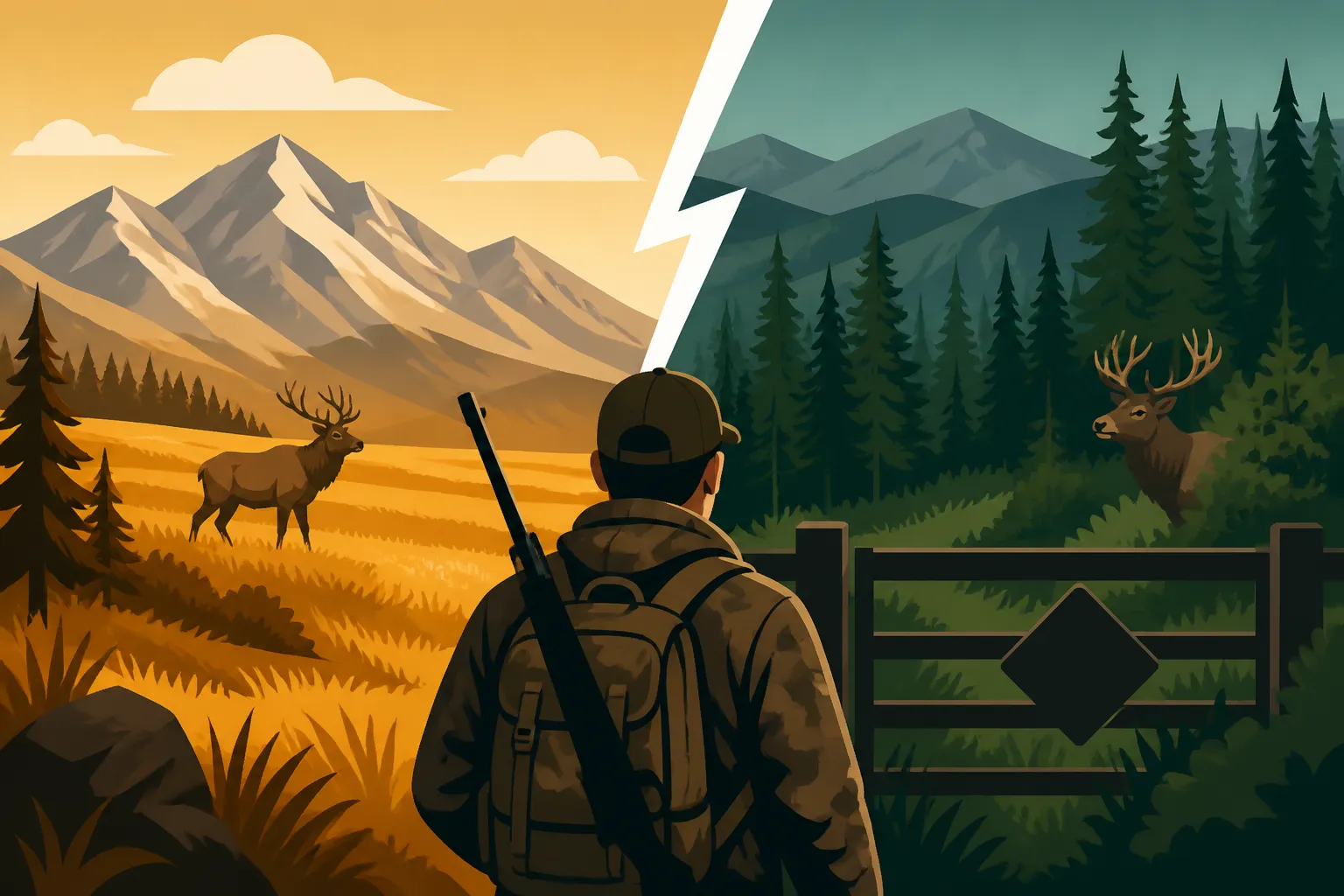
When weighing your options for hunting in Montana, it's crucial to understand the fundamental distinctions between public and private land. These differences impact everything from your hunting strategy to your budget and overall experience. It's not just about where the animals are, but also about the atmosphere and logistics of the hunt itself.
Hunter Pressure and Solitude
This is arguably the most significant differentiator. Public lands, by their very nature, are open to everyone. This means that during peak seasons, popular districts, particularly those with good road access, can experience substantial hunter pressure. Finding solitude and unpressured game often requires going further, deeper, and higher into the backcountry. You might share a ridge with another hunter, or find fresh boot tracks in a drainage you thought was remote. It's part of the public land experience; you're competing for space and opportunities.
| Factor | Public Land | Private Land |
|---|---|---|
| Hunter Pressure | High, especially in accessible areas; requires extra effort for solitude. | Low to moderate, depending on landowner management; potential for exclusive access. |
| Access Costs | Base license + stamps; no land access fees. | Permission often free (if granted); leases, outfitter fees can be substantial. |
| Flexibility | High; freedom to roam vast areas (within regulations). | Moderate to low; restricted to specific property, adherence to landowner rules. |
| Game Quality | Variable; often requires more effort to find unpressured, mature animals. | Potentially higher quality due to managed herds, less pressure. |
| Preparation | Extensive e-scouting, physical fitness, navigation skills. | Focus on landowner relations, understanding property boundaries. |
| Ethical Focus | Respecting public land rules, other hunters. | Respecting landowner property, rules, and privacy. |
Private land, particularly properties with limited access or those managed by outfitters, generally offers a much lower hunter-to-acre ratio. This can translate to more relaxed animals, less competition, and a greater sense of solitude. On a private ranch, you might be the only hunting party for miles, which drastically changes animal behavior and your hunting strategy. This difference can be a game-changer for those who find the crowds of public land frustrating. However, even on private land, if it's not well-managed or if multiple parties are allowed to hunt, pressure can still be a factor.
Cost and Logistics
The financial aspect is another stark contrast. Hunting public land in Montana primarily involves the cost of your hunting licenses, tags, and conservation stamps. For nonresidents, these costs can be substantial, especially for the coveted Montana Nonresident Combination License Guide, but they don't include an additional land-use fee beyond what might be required for State Trust Lands. Beyond that, your costs are dictated by your gear, travel, and personal expenses. A DIY public land hunt can be done relatively economically if you're willing to rough it.
Private land hunting, while it can be free if you secure permission, often comes with a price tag. Leasing land for hunting rights is a common practice, with costs varying wildly based on acreage, game populations, and location. Guided hunts on private ranches are significantly more expensive, often thousands or tens of thousands of dollars, covering not just access but also lodging, food, guiding services, and game retrieval. This higher cost often translates to a more comfortable experience, expert guidance, and potentially higher success rates. When deciding, consider your budget and what level of investment you're willing to make in the overall hunting experience.
Game Quality and Management
Game quality and populations can differ between public and private lands, though there are always exceptions. Public lands, especially remote wilderness areas, can hold truly giant animals that have lived a long life away from human pressure. However, these animals are often harder to locate and pursue, requiring significant effort. In more accessible public areas, consistent pressure can make mature animals warier and harder to find during daylight hours. Public land wildlife management is typically broad, aiming for sustainable populations across large landscapes.
Private lands, especially those managed with wildlife in mind, can sometimes offer more consistent opportunities for mature animals. Landowners might implement management practices like habitat improvement, selective harvesting, or simply limiting hunting pressure, which can result in larger trophy potential or more stable populations. For example, some large ranches near areas known for Montana Trophy Elk Districts might actively manage their herds for quality. This isn't universally true, of course, as some private lands are heavily hunted or provide only marginal habitat. However, the potential for targeted wildlife management on private parcels can sometimes yield impressive results for hunters seeking specific quality animals.
Making Your Choice: When to Hunt Public, When to Consider Private
The decision to hunt public or private land in Montana isn't about one being inherently "better" than the other. It's about matching the type of hunt to your personal goals, budget, skills, and the experience you're seeking. Both offer incredible opportunities, but they demand different approaches and preparations.
DIY Public Land Strategy
For many hunters, the ultimate Montana experience is a do-it-yourself public land hunt. This is for the hunter who craves independence, the challenge of self-reliance, and the satisfaction of earning their animal through grit and determination. If you're a hunter who enjoys extensive pre-season e-scouting using tools like onX Hunt, spending hours studying topo maps, and getting in shape for long days in rugged terrain, public land is your arena.
A successful public land strategy often involves scouting during the off-season, learning How to Find Elk in Montana Dark Timber, and understanding animal movement patterns. It means being prepared to hike miles away from roads to escape pressure, setting up a remote spike camp, and being self-sufficient in potentially harsh conditions. This approach thrives on flexibility and adaptability – if one area is too crowded, you need to be ready to pivot to another. It's less about guaranteed success and more about the journey, the challenge, and the deep connection to wild places. Resources like the Montana DIY Elk Hunting Guide are invaluable for planning such an adventure.
When Guided Private Land Hunts Shine
If your priorities lean towards a higher likelihood of success, comfort, expert guidance, and a less physically demanding experience, a guided private land hunt might be the perfect fit. This is often the choice for hunters with limited vacation time, those who prefer not to deal with the extensive logistics of a DIY hunt, or those who simply want a focused, professional experience. Nonresidents, in particular, often gravitate towards guided private land hunts because it can simplify the complex Montana draw system, with some outfitters offering outfitter-sponsored tags that circumvent the general nonresident drawing odds.
Guided hunts are also ideal for beginners looking to learn the ropes from experienced professionals, or for seasoned hunters specifically targeting a trophy animal with a higher chance of success. When considering a guided hunt, thorough research is key. Ask detailed questions about success rates, what's included, references, and the specific property you'll be hunting. Understanding What to Expect on a Guided Montana Elk Hunt will help you set realistic expectations and choose the right outfitter.
Hybrid Approaches to Montana Hunting
It's important to remember that the choice isn't always black and white. Many hunters successfully employ hybrid strategies. For instance, you might focus your primary efforts on public lands but utilize Block Management Areas for a day or two, especially for specific species like antelope on the plains. Or, you might combine a public land elk hunt with a separate private land whitetail hunt, taking advantage of different opportunities each offers.
Another hybrid approach involves hunting public land that borders private land. Elk, in particular, are notorious for moving between public feed and private sanctuary during hunting season. Understanding these transition zones and how animals use them can be a highly effective strategy. This might mean patiently waiting near a public/private boundary or setting up on public land to intercept animals moving to or from private agricultural fields. This requires diligent mapping and careful attention to property lines, but it can yield great results for those willing to put in the effort.
Tools and Resources for Accessing Both Land Types
Regardless of whether you choose public or private land, or a combination of both, successful hunting in Montana demands thorough preparation and the intelligent use of available tools and resources. Technology has revolutionized how we scout and navigate the landscape, making access more transparent than ever before.
Digital Mapping Tools for Land Navigation
In today's hunting world, digital mapping applications are no longer a luxury—they are a necessity. Programs like onX Hunt have transformed how hunters identify land ownership, navigate vast landscapes, and avoid unintentional trespass. With detailed parcel data, color-coded public/private land boundaries, and GPS capabilities, you can know exactly where you stand in real-time. This is absolutely critical when dealing with complex land ownership patterns, such as the checkerboard layouts found in many parts of Montana.
Beyond simply showing property lines, these apps allow you to mark waypoints, track your movement, create custom maps, and even download offline maps for areas without cell service, which is common in Montana's wilder regions. Another valuable tool is GoHunt, which focuses on providing extensive information on draw odds, unit breakdowns, and harvest data, often incorporating mapping features to help you narrow down potential hunting units. These platforms empower hunters to do meticulous e-scouting from home, saving valuable time and effort in the field. Understanding how to use these tools effectively is key to mastering How to E-Scout Montana Hunting Units and ensuring you are always hunting legally.
FWP Resources and Regulations
The Montana Fish, Wildlife & Parks (FWP) website is an indispensable resource for all hunters. It's where you'll find the official hunting regulations, season dates, draw deadlines, and detailed information on hunting districts. The FWP website also hosts the Block Management Program maps and rules, which are updated annually. Ignoring these official resources is a recipe for disaster, as regulations can change year to year, and ignorance is no excuse for violations.
Beyond regulations, FWP provides valuable data on game populations, harvest statistics, and management plans for various species. These reports can give you insights into herd health, population trends, and which districts might offer better opportunities for specific animals. Subscribing to FWP newsletters or following their social media can also keep you informed about important updates, emergency closures, or significant policy changes, like any potential Montana 2026 Hunting Regulation Changes. Always review the current year's regulations thoroughly before heading afield.
Leveraging Local Knowledge and Community
While digital tools are powerful, they can't replace boots-on-the-ground experience or local knowledge. Connecting with experienced local hunters, outfitters, or even sporting goods store employees can provide invaluable insights that aren't found on any map. These individuals often have a nuanced understanding of animal behavior in specific areas, seasonal patterns, or unwritten rules of local etiquette.
Joining online hunting forums focused on Montana, attending local chapter meetings of conservation groups like the Rocky Mountain Elk Foundation, or visiting a small-town diner can open doors to conversations and advice that significantly enhance your planning. Just remember to be respectful, share your own experiences, and not expect anyone to give away their "secret spots." Building relationships within the hunting community not only enriches your experience but can also provide crucial information, such as the best methods for How to Call Elk in Montana in your chosen hunting area or tips for accessing difficult terrain.
Disclaimer
Please remember that hunting regulations, land access policies, and wildlife populations in Montana can change frequently. Always consult the most current Montana Fish, Wildlife & Parks (FWP) regulations and maps before planning any hunt. This guide is for informational purposes only and should not be considered legal advice or a substitute for official FWP resources.