Montana Mountain Goat Habitat and Access
Hunting mountain goats in Montana is often described as a hunt of a lifetime, and it’s not hard to see why. These magnificent animals live in some of the most unforgiving, breathtaking terrain on Earth, making finding them—let alone reaching them—an enormous challenge. This guide is here to demystify the rugged world of Montana mountain goat habitat and provide practical advice on how to navigate the complex access requirements to pursue these iconic high-country dwellers.
Understanding Montana Mountain Goat Habitat
Montana's mountain goats thrive in an environment that would send most other species, and many humans, scrambling for cover. Their habitat is defined by extreme elevation, precipitous cliffs, and an unforgiving climate. If you're going to pursue these incredible animals, understanding their preferred stomping grounds is the first, most crucial step.
High-Altitude Domain and Alpine Ecosystems
When we talk about mountain goats in Montana, we're talking about the high country, pure and simple. These aren't creatures of the gentle rolling hills; they are masters of the vertical world. You’ll find them predominantly in the state’s western and southwestern mountain ranges, often above the tree line, in what’s known as the alpine and subalpine zones. This means elevations typically ranging from 7,000 feet all the way up to the highest peaks, sometimes even over 11,000 feet.
Their preferred terrain includes steep, rocky cliffs, scree slopes, and rugged ridges. They utilize these precarious landscapes for safety from predators, but also because their diet consists primarily of alpine forbs, grasses, and shrubs that thrive in these harsh environments. Think of areas like the Beartooth Mountains, the Spanish Peaks, or the Crazy Mountains – these are classic goat country. The very steepness that deters most other animals is what provides them sanctuary and sustenance. When you’re scouting, look for those impossible-looking rock faces and benches; that’s where the goats are likely to be. They’re built for this, with their incredible agility and specialized hooves that act like natural climbing shoes, giving them traction on seemingly smooth rock.
Seasonal Movements and Preferred Terrain
While mountain goats are certainly creatures of the high country, their specific locations can shift depending on the season, weather, and availability of forage. During the warmer summer months, you'll often find them at the highest elevations, enjoying lush alpine meadows and cooler temperatures. This is when their coats are thinnest, and they're shedding winter hair, often rubbing on rocks and trees.
As fall approaches and hunting seasons open, goats might still be found high up, but they can also start to move to slightly lower elevations or more sheltered south-facing slopes. These areas might offer patches of persistent green forage, or simply provide some thermal advantage as temperatures drop. Snow accumulation plays a significant role; fresh snow can push them down to timberline, but they are incredibly resilient and will often quickly return to higher, wind-swept ridges where snow is scoured away, exposing forage. During the rut, typically in November, billies will actively seek out nannies, covering significant ground in pursuit, often making them slightly more visible, though still in their characteristically challenging habitat.
Understanding these subtle seasonal shifts is critical for planning a successful hunt. A goat that was at 10,000 feet in August might be found a thousand feet lower, or simply on a different aspect of the mountain, in October. Knowing the nuances of Montana Mountain Goat Behavior and Biology can significantly aid your scouting efforts.
Navigating Access to Montana Mountain Goat Country
Once you have a handle on where mountain goats live, the next hurdle is figuring out how to get there. This is where the rubber meets the road, or more accurately, where your boots meet some seriously steep and remote terrain. Access for mountain goat hunting in Montana is rarely easy, often requiring significant physical effort and careful planning.
Public Land Challenges and Opportunities
Montana boasts an incredible amount of public land, which is fantastic for hunters. However, mountain goat habitat typically falls within some of the most rugged and remote corners of these public lands. The vast majority of mountain goat hunting takes place on National Forest lands, particularly within designated wilderness areas, and sometimes on Bureau of Land Management (BLM) land that shares similar characteristics.
The challenge isn’t necessarily a lack of public land, but rather the sheer difficulty of reaching the habitat. Most goat units have limited road access, meaning you'll be hiking, often for miles, and gaining thousands of feet in elevation. This can be a huge deterrent for many hunters, but for those willing to put in the work, it’s also what keeps hunter pressure relatively low compared to more accessible species. You might find goats in areas like the Bob Marshall Wilderness, the Absaroka-Beartooth Wilderness, or portions of the Beaverhead-Deerlodge National Forest. These are vast, roadless areas where proper backcountry navigation and self-sufficiency are paramount. When considering Montana Backcountry Hunting Areas, remember that mountain goat country takes "backcountry" to a whole new level.
Access opportunities on public land often involve finding trailheads that lead into the high country. Sometimes these trails are well-maintained, but just as often, they might be faint game trails or require true cross-country travel over boulder fields and through dense timber. It's crucial to thoroughly research your hunting district and understand the specific access points. While some areas might have designated horse trails, the truly steep and rocky goat terrain often requires hoofing it on foot.
Wilderness and Roadless Area Access
Many of Montana's prime mountain goat habitats are nestled deep within wilderness areas, which come with specific regulations. For example, mechanized vehicles (including ATVs, e-bikes, and even mountain bikes) are strictly prohibited. This means access is limited to foot or horseback. This restriction further ensures the wild character of these areas and contributes to the strenuous nature of a goat hunt. For insights on navigating these challenging environments, refer to a comprehensive Montana Backcountry Hunting Guide.
Reaching these remote locales often involves multi-day expeditions. You might hike in 5-10 miles just to get to the edge of prime habitat, then spend days exploring and climbing to locate goats. This requires excellent physical conditioning, a robust gear list, and serious backpacking skills. Forget about quick day hunts in most goat units; you'll be setting up spike camps or moving with all your gear to stay close to the animals. Understanding the unique rules and considerations for How to Hunt Elk in Montana's Wilderness can offer transferable insights for goat hunting in similar environments.
Utilizing E-Scouting and Mapping Tools
In the modern age, e-scouting has become an indispensable tool for any serious big game hunter, and for mountain goats, it’s absolutely critical. Before you even set foot in Montana, you should be pouring over digital maps like those offered by GoHunt or OnX Hunt. These platforms allow you to analyze terrain features, identify potential travel corridors, locate likely bedding areas, and pinpoint areas with good forage, all from the comfort of your home.
When e-scouting for mountain goats, focus on:
- Contour Lines: Look for incredibly tight contour lines indicating steep cliffs and rocky outcrops. Goats prefer slopes of 40-70 degrees.
- Elevation Bands: Target the alpine and subalpine zones.
- Vegetation Layers: Identify areas above timberline with sparse vegetation, rocky terrain, and patches of alpine meadows.
- Satellite Imagery: Zoom in on high-resolution satellite imagery to identify specific benches, bowls, and drainage features that might hold goats. Look for established game trails on more traversable slopes, or distinctive white spots against dark rock.
- Access Points: Pinpoint trailheads, forest roads, and potential routes to navigate the terrain. Pay close attention to public land boundaries.
Using a tool like GoHunt can also provide crucial information on draw odds and unit breakdowns, helping you decide which units to apply for. Their Insider platform, for example, offers detailed unit data, including harvest statistics and success rates, which can be invaluable when applying for a limited entry tag. Knowing How to E-Scout Montana Hunting Units is fundamental to narrowing down your search in such vast and rugged landscapes.
| Montana Mountain Goat Region | Characteristic Terrain | Typical Access Difficulty | Potential for Permits | Key Considerations |
|---|---|---|---|---|
| Beartooth Mountains | Extreme alpine, large rock fields, high elevation plateaus | Very Difficult (long hikes, high elevation gain) | Moderate to High | Highest peaks, unpredictable weather, remote |
| Bitterroot Mountains | Steep, heavily timbered slopes transitioning to rocky alpine | Difficult (dense timber, challenging navigation) | Moderate | Mix of timber and rock, significant elevation changes |
| Absaroka Range | Rugged peaks, open basins, some wilderness | Difficult (multi-day treks, river crossings) | Moderate to High | Vast wilderness, diverse goat habitat |
| Crazy Mountains | Isolated, jagged peaks, limited roads | Difficult (steep, off-trail travel) | Moderate | Self-sufficient, strong navigation skills needed |
| Spanish Peaks | Steep, rocky, popular hiking areas | Moderate to Difficult (can encounter hikers) | Lower | Good populations, but proximity to human activity |
Planning Your Montana Mountain Goat Hunt Logistics
Drawing a Montana mountain goat tag is a significant achievement, often requiring years of applying for special permits. But the tag is just the beginning. The real work starts with the meticulous planning and physical preparation needed to hunt these formidable animals in their native element. Understanding Montana Moose Sheep Goat Season Dates is just one piece of the puzzle; the logistics are where most hunts are won or lost.
Physical Preparation and Gear Essentials
Hunting mountain goats is arguably one of the most physically demanding big game hunts you can undertake. You'll be climbing, often at high altitudes, with a heavy pack, sometimes for multiple days. If you're not in peak physical condition, you're not just risking failure; you're risking your safety. Your fitness plan should focus on endurance, strength (especially leg and core), and acclimation to altitude if possible. Think steep trail hiking with a weighted pack, stair climbing, and general cardiovascular conditioning. Don't underestimate this aspect – it's more crucial than almost any other hunt. To truly prepare, consider developing a robust Montana Elk Hunt Fitness Plan, which provides an excellent baseline for the demands of goat hunting.
Your gear list needs to be robust, lightweight, and absolutely reliable. Every item in your pack should serve a purpose and be able to withstand extreme conditions. Here's a quick rundown of critical gear:
- Boots: High-quality, stiff-soled mountaineering boots are non-negotiable for ankle support and traction on steep, rocky terrain. Break them in well!
- Layered Clothing: Alpine weather is unpredictable. You need moisture-wicking base layers, insulating mid-layers (puffy jacket, fleece), and a bombproof waterproof/windproof shell.
- Backpack: A large, comfortable backpack capable of carrying 60+ pounds for multi-day trips, and ideally able to haul meat. Brands like Mystery Ranch or Kifaru are often favored for their durability and load-carrying capabilities. You can get more details from a comprehensive Montana Backcountry Hunting Gear List.
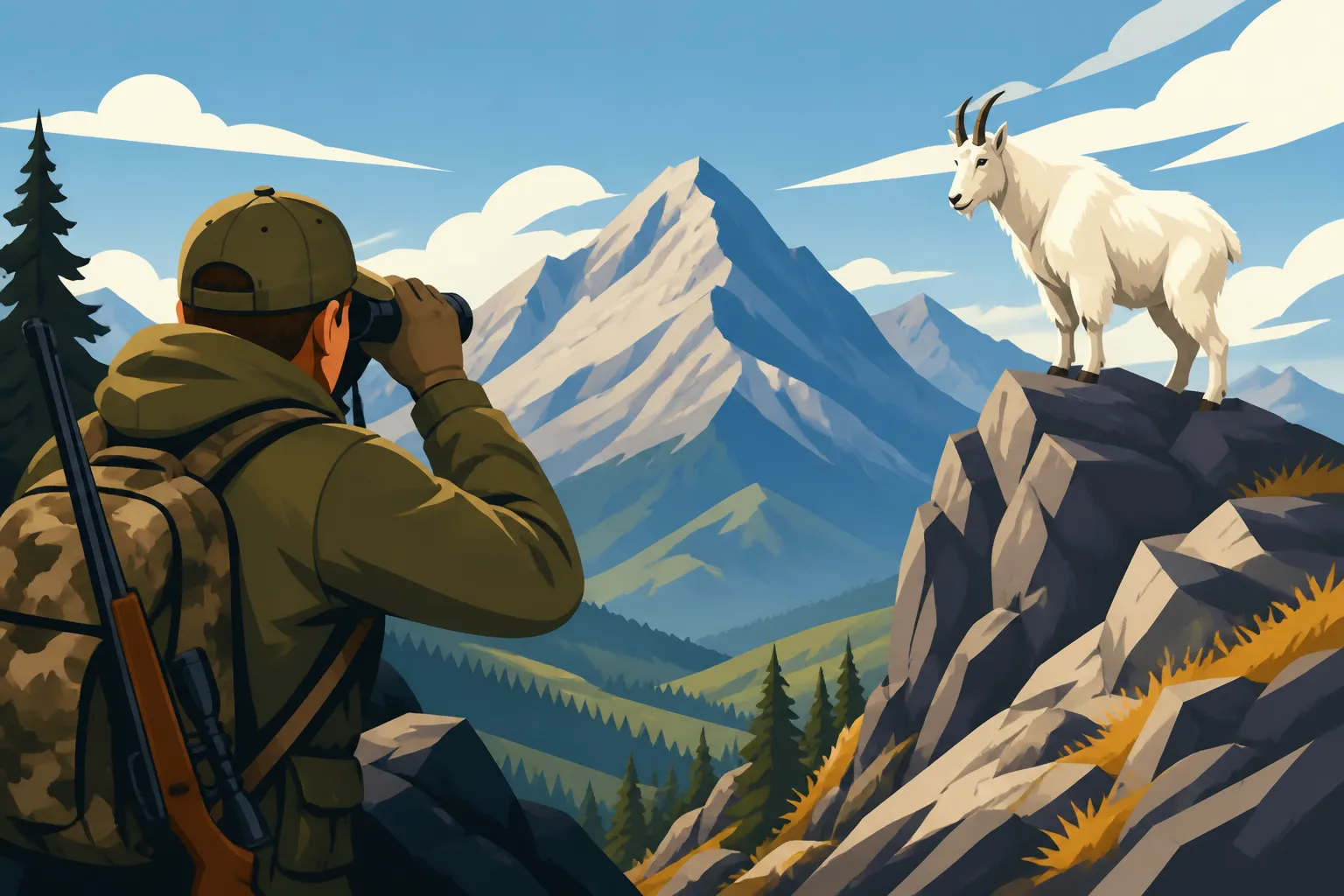
- Optics: High-quality binoculars (10x-15x) and a spotting scope (20-60x or 20-70x) on a sturdy tripod are essential for glassing vast expanses and identifying goats from a distance, avoiding unnecessary climbing.
- Navigation Tools: GPS device, satellite communication device (Garmin InReach, Zoleo), map, and compass are vital. Don't rely solely on your phone.
- Shelter: A lightweight, durable tent or bivy sack suitable for alpine conditions.
- Cooking System: Jetboil or similar lightweight stove, fuel, and dehydrated meals.
- Water Filtration: A reliable water filter (Sawyer Squeeze, Katadyn BeFree) and hydration bladder.
- First-Aid: Comprehensive first-aid kit, including blister care and emergency supplies.
- Weapon: Rifle or bow, appropriately sighted in for mountain conditions and potential longer shots.
- Trekking Poles: Invaluable for stability, especially on steep ascents and descents with a heavy pack.
Safety Considerations in Extreme Terrain
Hunting mountain goats isn't just physically taxing; it comes with inherent dangers that demand respect and careful planning. The terrain itself is the primary hazard. Loose rock, steep drops, and exposure to the elements are constant companions.
Key Safety Considerations:
- Weather: Alpine weather can change in an instant. Sunshine can turn to blizzard conditions with lightning and freezing rain in minutes. Always check the forecast, but be prepared for anything. Hypothermia is a real threat.
- Navigation: Getting lost in vast, rugged country can quickly become a life-threatening situation. Always know your location, mark your camps and waypoints, and have multiple navigation methods.
- Falling Rock: Be aware of your surroundings and avoid dislodging rocks, especially when hunting with partners below you. Goats themselves can kick down rocks.
- Altitude Sickness: If you're not accustomed to high altitudes, plan for acclimatization time. Stay hydrated.
- Solo Hunting: While some experienced hunters do it, solo goat hunting significantly increases risk. Having a partner is highly recommended for safety.
- Communication: A satellite communication device like a Garmin inReach is not optional; it's a necessity for emergency contact in areas without cell service.
- Shot Placement: Ethical shot placement is critical. A wounded goat can easily get into an unrecoverable position or fall into an inaccessible ravine. Wait for a solid, broadside shot.
- Meat Care: Once down, processing and packing out a goat in steep, high-altitude terrain is extremely difficult. Be prepared for a long, arduous pack out. Knowing How to Quarter an Elk in the Montana Backcountry can give you a starting point, but goats often require even more precarious maneuvering.
Hunting Montana mountain goats is an extraordinary experience that tests physical and mental limits. With careful planning, a solid understanding of their habitat, and respect for the mountain, you can significantly increase your chances of a safe and successful adventure.
Disclaimer
Please be aware that hunting regulations, season dates, and access rules in Montana can change annually. It is your responsibility to consult the latest official Montana Fish, Wildlife & Parks (FWP) regulations and maps before planning or undertaking any hunting activity. This guide provides general information and should not be considered a substitute for official FWP resources.