Best Method to Hunt Montana Bighorn Sheep
Drawing a Montana bighorn sheep tag is often the culmination of a lifetime of applying, a dream hunt that many hunters will never even get the chance to experience. The sheer difficulty of drawing a tag is only matched by the challenge of the hunt itself, taking place in some of the most rugged, unforgiving terrain Montana has to offer. This guide is dedicated to breaking down the absolute best method for pursuing these incredible animals in the Big Sky Country, equipping you with the knowledge needed to maximize your slim chance at success should that coveted tag ever land in your hand.
Understanding Montana Bighorn Sheep Behavior and Habitat
Before you can even begin to think about a hunting method, you absolutely must understand the animal itself. Bighorn sheep are creatures of the high country, incredibly adapted to their harsh, vertical world. Knowing their habits, preferred terrain, and seasonal movements is the bedrock upon which any successful hunt is built. Without this foundational knowledge, you're just wandering through their home, hoping to get lucky, and that’s a poor strategy when a tag can take decades to draw.
High-Country Adaptations and Terrain Preferences
Montana's bighorn sheep thrive in the steepest, most broken, and often most remote mountain ranges. Think jagged peaks, sheer cliffs, and rocky outcroppings that would make a mountain goat blush. They prefer open, alpine and subalpine areas that offer excellent visibility for spotting predators, but always with immediate access to escape terrain—those impossible cliffs and ledges where few other animals can follow. This means you'll rarely find them in dense timber, though they may occasionally duck into sparse pines for cover during extreme weather or to move between ranges. Their incredible agility and specialized hooves allow them to navigate terrain that is simply impassable for most other big game, making them truly unique adversaries. When you're scouting or on the hunt, focus your attention on areas that have these characteristics: steepness, rockiness, and open visibility, often above treeline. They need these features not just for safety, but for bedding and finding mineral licks.
Seasonal Movements and Rut Behavior
Like all big game, bighorn sheep have seasonal patterns that influence their whereabouts. In the summer, rams and ewes often segregate, with rams forming bachelor groups that frequent the highest, most remote basins, sometimes above 10,000 feet. Ewes, lambs, and younger rams might stick to slightly lower, but still steep, elevations that offer more accessible forage. As fall progresses and hunting seasons open, rams typically remain high until the pre-rut and rut kick in, usually from late October through December. During the rut, rams become far more active, ranging wider to find ewes. This is a crucial time for hunters, as their increased movement and distraction can present opportunities. However, they're still bound by their need for steep escape cover. Post-rut, deep snow can push sheep down to lower, south-facing slopes, but again, they will always seek out the most secure, rugged areas available at those elevations. Understanding these shifts is vital for knowing where to focus your efforts throughout the various Montana Bighorn Sheep Season Dates and Tags that might be available.
Diet, Water Sources, and Mineral Licks
Bighorn sheep are primarily grazers, feeding on grasses, forbs, and shrubs found in their alpine and subalpine environments. While they don't require daily water like some other species, they do need access to it, especially during hotter months or when forage is dry. Natural springs, snowfields, and small alpine tarns become key focal points. Perhaps even more critical are mineral licks. Bighorns actively seek out areas rich in minerals, which are essential for their health, especially for antler growth in rams and for lactating ewes. Identifying these mineral licks, often characterized by chewed soil or a distinct salty taste (yes, sheep taste it!), can be a huge clue to finding their core areas and movement patterns. Always look for game trails leading to or from these areas, as they can be major thoroughfares.
The Dominant Method: Spot-and-Stalk
For hunting Montana bighorn sheep, there is one method that reigns supreme above all others: the spot-and-stalk. This isn't just a suggestion; it's practically the only viable and consistently successful approach for these wary, high-country dwellers. Tree stands are useless, ground blinds are impractical, and calling is generally ineffective for sheep. You must find them, evaluate them, and then make a strategic, often grueling, move to get within shooting range. This method demands patience, physical prowess, and meticulous attention to detail.
Gear Essentials for Spot-and-Stalk Success
A successful spot-and-stalk hunt for bighorn sheep hinges heavily on having the right gear. This isn't a place to skimp, as inferior equipment can easily cost you an opportunity that you might never get again. Your optics are paramount. A high-quality spotting scope (20-60x or 25-75x) on a sturdy tripod is non-negotiable for picking apart distant mountainsides and judging rams. Complement this with top-tier binoculars (10×42 or 12×50 are common choices) for scanning closer terrain and quick checks. You'll also need a reliable rangefinder that can accurately measure distances in steep, broken country.
Here's a quick comparison of essential optics:
| Optic Type | Primary Use | Key Features | Considerations |
|---|---|---|---|
| Binoculars | Wide area scanning, quick target acquisition | Good field of view, ergonomic, durable | Essential for general glassing, often worn on a bino harness |
| Spotting Scope | Detailed long-range observation, ram evaluation | High magnification, clear resolution, sturdy tripod | Critical for judging horn size and identifying legal rams |
| Rangefinder | Accurate distance measurement | Angle compensation, fast readings, compact | Indispensable for calculating shots in mountainous terrain |
Beyond optics, your physical gear must be up to the task. Lightweight yet durable mountaineering boots with excellent ankle support are crucial for navigating rocky scree and steep ascents. A comfortable backcountry pack, like those offered by Mystery Ranch or Kifaru, is essential for carrying your heavy optics, water, food, and emergency supplies, especially since you'll be spending long hours glassing and moving. Layered clothing that allows for rapid temperature changes from freezing dawn to midday sun, and sudden storms, is also a must. Think Merino wool base layers, a good mid-layer fleece, a puffy jacket, and a bombproof rain shell. Don't forget a GPS device or a smartphone with a reliable mapping app like OnX Hunt, as getting lost in sheep country is a serious hazard. For a deeper dive into what to pack, check out our Montana Backcountry Hunting Gear List.
Effective Glassing Techniques
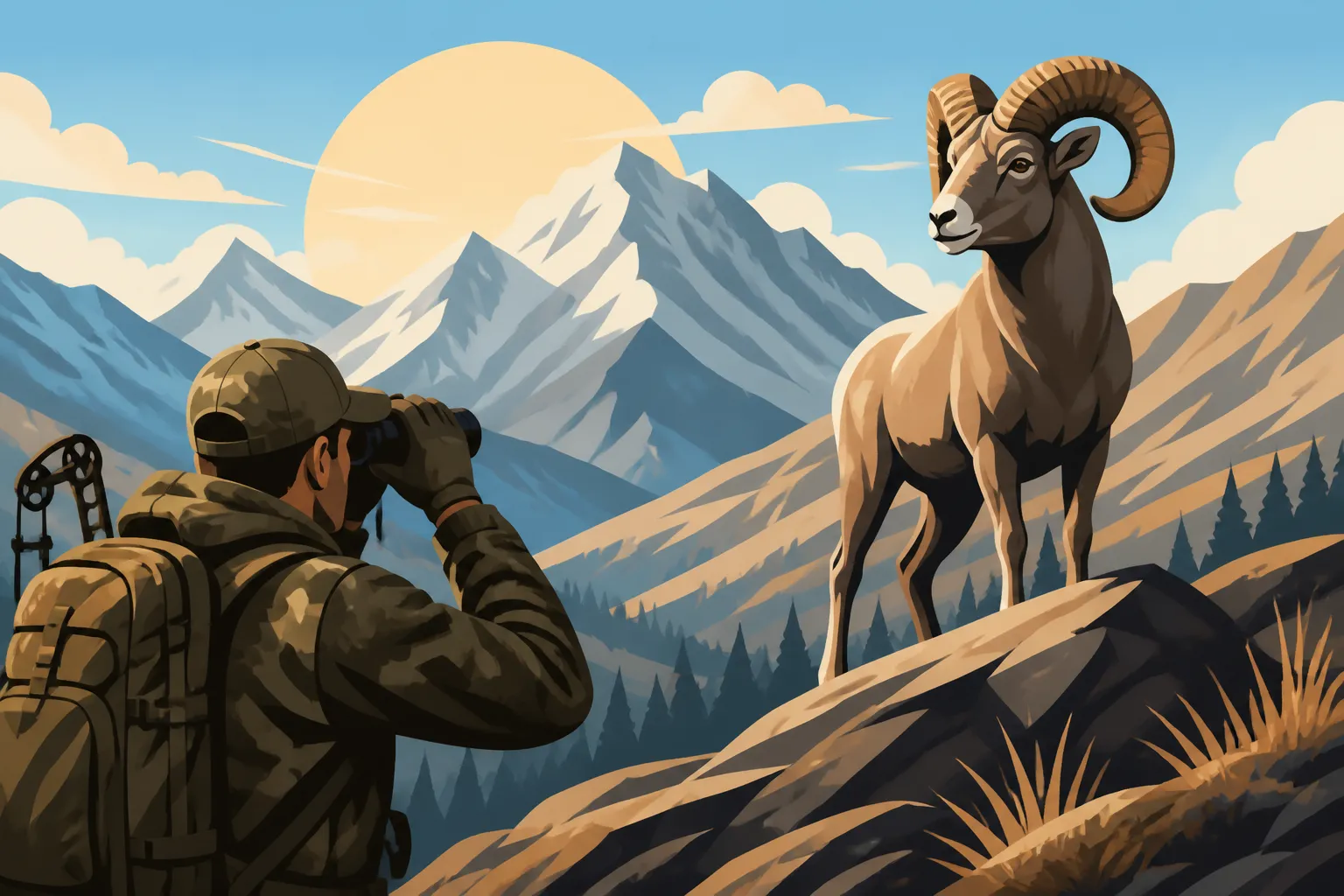
Glassing is not just looking; it's an art form when it comes to bighorn sheep. You'll spend 80-90% of your time glassing, painstakingly dissecting every rock, shadow, and patch of scrub brush. Start by finding a high vantage point that offers a panoramic view of the sheep's likely habitat. Use your binoculars to scan broad areas, looking for any anomaly—a patch of white, a horizontal line in a vertical world, or movement. Once you spot something intriguing, switch to your spotting scope.
Set your spotting scope on a tripod and grid the mountain. Start at one side of your chosen area and slowly, methodically, scan in small increments, overlapping each pass. Look for rams bedded on ledges, moving across a rock slide, or silhouetted against the sky. Pay close attention to shaded areas and transitions where rocks meet sparse vegetation. Sheep blend in incredibly well, so you're often looking for a part of a sheep, not the whole animal. Think ears, a curve of a horn, or the white rump patch. The more time you spend behind glass, the better your eyes will become at picking out subtle details. This is especially true in Montana's vast, open landscapes. Our guide on How to Glass Montana's Big Country offers more detailed strategies for covering ground effectively.
The Stalk: Strategy and Execution
Once a ram is spotted and evaluated, the real chess match begins. The stalk is where many hunts fall apart. Bighorns have incredible eyesight, and their habitat offers very little cover. You need to plan your route meticulously, considering wind direction, terrain features that offer concealment, and the sheep's likely escape routes. Your goal is to get within comfortable shooting distance, typically 300-400 yards or less, if possible.
- Wind is King: Always approach with the wind in your face or quartering. Sheep will bust you by scent long before they see you if the wind is wrong.
- Use the Terrain: Identify draws, ridgelines, and rock formations that can hide your movement. Move slowly, deliberately, and stay low. Think like a predator, using every scrap of cover. This often means taking a long, circuitous route that adds miles and elevation, but minimizes your visibility.
- Patient Movement: Sheep are masters of their environment. They can disappear in seconds. Be prepared to crawl, army-crawl, or move at a snail's pace for extended periods. If they look up, freeze. Wait until they settle back down before moving again.
- Final Approach: As you get closer, every step matters. Ensure your rifle is ready, and minimize any noise. If you're hunting with a partner, communicate silently through hand signals. Remember that in some of Montana’s more famous sheep units, like those in the Tendoy or Beaverhead Mountains, the terrain is unforgiving and requires absolute focus during the final moments of a stalk.
Physical and Mental Preparation
Hunting bighorn sheep in Montana is not for the faint of heart, nor for the out-of-shape. The physical demands are immense, and the mental fortitude required to endure brutal conditions, long days, and the constant threat of failure can be just as taxing. Don't underestimate this aspect of the hunt; it's as critical as your gear or your glassing skills.
Building Mountain Endurance
You are going to be climbing. A lot. Often with a heavy pack, at high altitudes, across unstable ground. There's no way around it. Your fitness level will directly impact your ability to get to sheep, stay with them, and then pack out an animal. Start your physical preparation months in advance. Focus on cardiovascular endurance (running, hiking, stair climbing), strength training (especially legs, core, and back), and, crucially, hiking with a weighted pack on steep terrain. Mimic hunting conditions as much as possible. If you live at sea level, find the steepest hills you can and climb them repeatedly. Carry 40-50 pounds in your pack to simulate carrying your gear and potentially meat. Our comprehensive guide on How to Physically Prepare for a Montana Elk Hunt offers excellent advice that can be directly applied to sheep hunting, as the demands are very similar. Being fit isn't about being a bodybuilder; it's about having the stamina to hike all day, climb thousands of feet, and then execute a precise stalk when the opportunity arises.
Acclimatization and Altitude Sickness
Many of Montana's prime bighorn sheep units are found at elevations ranging from 7,000 feet to well over 10,000 feet. If you're coming from lower elevations, altitude sickness can quickly derail your hunt. Symptoms can range from headaches and nausea to severe fatigue and impaired judgment. The best way to combat this is to arrive a few days early, if possible, and slowly acclimatize. Spend the first day or two at a moderate elevation, taking it easy and staying hydrated. Avoid alcohol and heavy meals. Gradually increase your activity level. Proper hydration is also incredibly important at altitude. Even a mild headache can severely impact your focus and ability to make critical decisions during a hunt. Knowing your body and its limits is paramount.
Key Considerations for Success
Beyond the method and the physical grind, there are several other critical factors that often separate a successful Montana bighorn sheep hunter from one who goes home empty-handed. These involve preparation before you even step foot in the field, as well as crucial skills for when the moment of truth arrives.
The Role of E-Scouting and Local Knowledge
Modern hunting is significantly aided by technology, and e-scouting is an indispensable tool for bighorn sheep. Platforms like GoHunt, or even just detailed satellite imagery on Google Earth, allow you to pore over terrain, identify potential bedding areas, escape routes, water sources, and access points from the comfort of your home. You can mark waypoints, measure distances, and plan potential stalk routes long before you hit the trail. For example, looking at the Bob Marshall Wilderness or the Tendoy Mountains, you can visually map out key ridgelines and bowls. GoHunt's detailed unit statistics and draw odds data are particularly invaluable for understanding the unique challenges and opportunities within specific Montana Hunting Districts Explained.
However, e-scouting is only one piece of the puzzle. Local knowledge, whether from Montana Fish, Wildlife & Parks (FWP) biologists, game wardens, or other successful sheep hunters, can provide invaluable insights that no map can replicate. They might know about specific historical sheep migration routes, late-season congregation areas, or unique features of a particular drainage. Don't be afraid to make phone calls and ask respectful questions. Combining your e-scouting with boots-on-the-ground preseason scouting, if possible, creates the most robust strategy. Our guide on How to E-Scout Montana Hunting Units dives deeper into this essential preparation.
Shot Placement and Recovery in Steep Terrain
When you finally get within range of a Montana bighorn ram, the shot itself presents unique challenges. You'll likely be shooting uphill or downhill, potentially at significant angles, and often after an exhausting stalk. Understanding how uphill/downhill shots affect bullet trajectory and using a rangefinder with angle compensation is critical. Practice shooting from awkward positions, off a pack, or even prone on an incline. A solid rest is essential for precise shot placement on a relatively small vitals area.
Perhaps even more challenging than the shot is the recovery. Sheep often inhabit incredibly precarious terrain. A ram hit cleanly may still drop onto a ledge that is impossible to access or tumble down a cliff face, making recovery dangerous or impossible. Aim for a solid double-lung or shoulder shot that anchors the animal quickly. If possible, consider shot angles that might send the animal into more accessible, flatter terrain, though this is often a luxury in sheep country. Always have a plan for how you will safely approach and retrieve the animal. Never put yourself in a dangerous position during recovery. Our guide on How to Quarter an Elk in the Montana Backcountry offers transferable advice for handling game in rough terrain, emphasizing safety and efficiency.
Navigating Draw Odds and Limited Entry
The single biggest hurdle for most hunters dreaming of a Montana bighorn sheep hunt isn't the physical demand or the difficulty of the stalk—it's drawing a tag. Montana has some of the most sought-after and limited bighorn sheep tags in North America. The draw odds for non-residents are notoriously low, often in the single-digit percentages, and even residents can wait many years, accumulating Montana Bonus Points for a chance at specific districts.
Montana's bighorn sheep tags are allocated through a lottery system, often requiring years of accumulating points. While there are a few general units, the most coveted units, especially for trophy rams, are permit-only with incredibly low odds. You need to understand the application process intimately, including deadlines, point systems, and specific hunt codes for each district. Using tools like GoHunt's Insider service can help you analyze past draw statistics and make informed choices on which districts to apply for, maximizing your long-term strategy. For a comprehensive look at the odds and process, review our guide on Montana Bighorn Sheep Draw Point Requirements. Patience and persistence in the draw are just as important as your hunting skills when it comes to bighorn sheep.
Disclaimer
Please remember that hunting regulations, seasons, and draw processes can change. Always consult the official Montana Fish, Wildlife & Parks (FWP) regulations for the current year before planning any hunting trip. Safety in the backcountry is paramount; hunt responsibly and ethically.