Montana Bighorn Sheep Hunting for Beginners
Dreaming of drawing a Montana bighorn sheep tag is a powerful ambition for any hunter, but the reality can be incredibly daunting. The draw odds are notoriously long, the application process feels like navigating a labyrinth, and the physical demands of chasing sheep in rugged mountain terrain are no joke. It's easy to feel overwhelmed before you even start. This comprehensive guide is here to demystify Montana bighorn sheep hunting for beginners, walking you through everything from understanding the complex draw to preparing for the hunt of a lifetime.
Understanding the Montana Bighorn Sheep Draw
Let's be completely honest: drawing a bighorn sheep tag in Montana is a long shot. It's often called a "once-in-a-lifetime" opportunity, and for good reason. The limited number of tags issued each year, coupled with immense demand from both residents and non-residents, makes it one of the toughest draws in the West. But don't let that discourage you! Understanding the system is the first step, and every journey starts with a single application.
The Rarity and Value of a Bighorn Tag
A Montana bighorn sheep tag isn't just a license; it's a golden ticket to an experience few hunters ever get to have. These magnificent animals inhabit some of the most breathtaking, yet challenging, landscapes the state has to offer. The very rarity of the tag means that when you do draw one, you're entering an exclusive club, entrusted with the privilege of pursuing a truly iconic species. Many hunters will apply for decades without ever seeing their name on the draw list, which only adds to the immense value and reverence given to a successful applicant. It's a testament to patience, persistence, and a bit of plain old luck.
The demand for these tags creates significant competition. Montana manages its sheep herds very conservatively, ensuring sustainable populations. This means biologists carefully set tag quotas based on herd health, population trends, and ram ratios. These quotas are often very small, sometimes just one or two tags for an entire hunting district. This strict management, while frustrating for hunters eagerly waiting for their chance, is crucial for the long-term health and viability of Montana's bighorn sheep. You can find more specific information on these challenges in a guide like Montana Bighorn Sheep Hunting Explained.
Navigating Montana's Complex Draw System
Montana's big game draw system can feel like a maze, and bighorn sheep are no exception. Unlike some states that use a pure preference point system where the hunter with the most points always draws, Montana employs a bonus point system. This means that for every year you apply for a sheep permit and are unsuccessful, you accrue a bonus point. When the draw happens, your application (and all your accumulated bonus points) is entered, essentially giving you more chances in a random drawing. For example, if you have 10 bonus points, your name goes into the hat 11 times (your current application plus 10 points). The maximum number of bonus points you can earn for bighorn sheep is 15.
It's crucial to understand that even with a significant number of bonus points, a draw is never guaranteed. Someone with zero points could theoretically draw a tag over someone with many points, purely by chance. This aspect of the system adds an element of hope for new applicants but also demands continuous participation for those committed to the long game. The application timeline is critical; generally, applications for sheep permits are due in the spring, often around May 1st, so keep a close eye on the FWP website for exact dates. Resources like GoHunt's Insider service are invaluable here, providing tools to help hunters track draw odds and deadlines, making the complex process much more manageable.
Building Bonus Points vs. Applying for Permits
For many beginners, the immediate question is whether to simply build bonus points or apply for a permit outright each year. The answer often depends on your long-term strategy and patience. If you're serious about hunting bighorn sheep in Montana, accumulating bonus points is a non-negotiable part of the process. You can purchase a bonus point for a relatively small fee each year without applying for an actual tag, ensuring you're increasing your odds for future draws. This is often the recommended path for those just starting out, as it allows you to consistently build points while you learn more about different hunting districts.
However, if you don't apply for a tag in a given year, you don't get a chance to draw that year. So, most dedicated sheep hunters opt to apply for a permit every year and simultaneously purchase a bonus point (if they haven't already maxed out their points). This gives them the maximum number of entries into the draw for that season while still accruing another point for the next. Deciding which district to apply for is another critical component. Some districts have slightly better odds but might offer less "trophy" potential, while others are incredibly difficult to draw but are known for larger rams. Researching Montana Elk Draw Odds by District (though for elk, the principles of researching districts for specific goals apply to sheep too) can offer insights into how to approach this analysis.
Here's a simplified look at how the Montana bighorn sheep bonus point system generally works:
| Action | Result in Draw System | Cost (Approx. 2024, non-resident) |
|---|---|---|
| Purchase Bonus Point Only | Accumulates 1 bonus point for future draws, no permit application | ~$15 |
| Apply for Permit + Purchase Bonus Point | Application entered with (current bonus points + 1) chances; if unsuccessful, 1 new bonus point is added for next year | ~$1250 (license) + ~$15 (point) |
| Apply for Permit Only (No points purchased) | Application entered with 1 chance (plus existing points); no new point added if unsuccessful | ~$1250 (license) |
Note: Costs are approximate and subject to change. Always check the Montana FWP website for the most current fees and regulations.
Essential Preparations for a Montana Bighorn Sheep Hunt
Even if you're years away from drawing a tag, preparing for a bighorn sheep hunt should begin now. This isn't just about dreaming; it's about building the skills, fitness, and knowledge that will make you a successful and safe hunter when your number finally comes up. This species demands more from a hunter than almost any other.
Physical Conditioning and Mountain Readiness
Bighorn sheep live in incredibly steep, rocky, and often high-altitude terrain. A sheep hunt is a true test of physical endurance, mental toughness, and sure-footedness. You can't just decide to get in shape a month before the season; this needs to be a lifestyle commitment. Your fitness regimen should focus on building cardiovascular endurance, leg strength, core stability, and balance. Think hiking with a heavy pack (30-50 lbs) on steep, uneven trails, step-ups, lunges, and plenty of core work. Simulating the hunt by carrying your full pack, including optics, rifle, and water, up and down hills is the best way to train.
Beyond physical fitness, mental readiness is equally important. The mountains will challenge you with variable weather, dizzying heights, and the sheer effort required to navigate. Being comfortable in these environments, knowing your limits, and understanding basic mountain safety are critical. Don't underestimate the impact of elevation if you're coming from a lower altitude; spending a few days acclimatizing before the hunt can make a huge difference. For a deeper dive into getting ready for the mountains, check out How to Prepare for High-Country Montana Hunting.
Optics and Gear for Steep Terrain
Your optics setup is arguably as important as your rifle for a bighorn sheep hunt. Quality binoculars (10×42 or 10×50 are standard) and a powerful spotting scope (20-60x or 20-70x with a large objective lens like 80mm or 95mm) are non-negotiable. You'll spend hours, even days, behind glass, picking apart distant rock slides and peaks for the tell-tale white rump patch or distinct curl of a ram. A sturdy tripod is essential for holding your spotting scope steady in windy conditions and for comfortable, long glassing sessions. Rangefinders capable of accurately reading steep angles are also critical for ethical shot placement in mountain environments.
Beyond optics, the rest of your gear needs to be top-tier and meticulously chosen for lightweight performance and durability. A comfortable, well-fitting backpack capable of carrying heavy loads is paramount, as you'll be packing in and out your gear, and hopefully, meat and a skull. Layered clothing that can adapt to rapid temperature changes, waterproof outerwear, robust hiking boots with excellent ankle support, and trekking poles for stability on steep descents are just a few key items. Every ounce counts when you're gaining thousands of feet in elevation. A comprehensive resource like Montana Backcountry Hunting Gear List can provide a solid foundation for your packing.
E-Scouting and Understanding Sheep Habitat
Long before you ever set foot in a bighorn unit, you need to become an expert on its terrain and the specific habitat preferences of sheep. This is where e-scouting comes into play. Utilize satellite imagery, topographic maps, and public land ownership layers to identify potential sheep country: steep, rugged slopes, cliff bands, open alpine bowls, and areas with good escape cover. Bighorn sheep prefer areas with excellent visibility to spot predators, often grazing in open meadows adjacent to steep escape routes.
Platforms like onX Hunt and GoHunt's Maps are invaluable tools for this kind of reconnaissance. You can identify potential access points, water sources, bedding areas, and historical sheep locations. Pay attention to north-facing slopes in early season for shade and cooler temperatures, and south-facing slopes later in the season for sun exposure and snow melt. Understanding Montana Bighorn Sheep Habitat is key to narrowing down your search areas. While specific draw units are kept private by FWP, general sheep ranges are well-known, and careful e-scouting can reveal hidden gems within these areas, helping you plan your approach months, or even years, in advance.
Hunting Strategies for Bighorn Sheep
The moment you've been dreaming of arrives: you've drawn a tag. Now the real work begins. Hunting bighorn sheep is a relentless game of glassing, hiking, and meticulous stalking. It demands patience, acute observation skills, and the ability to adapt to unforgiving mountain conditions.
Spotting and Stalking Bighorn Sheep
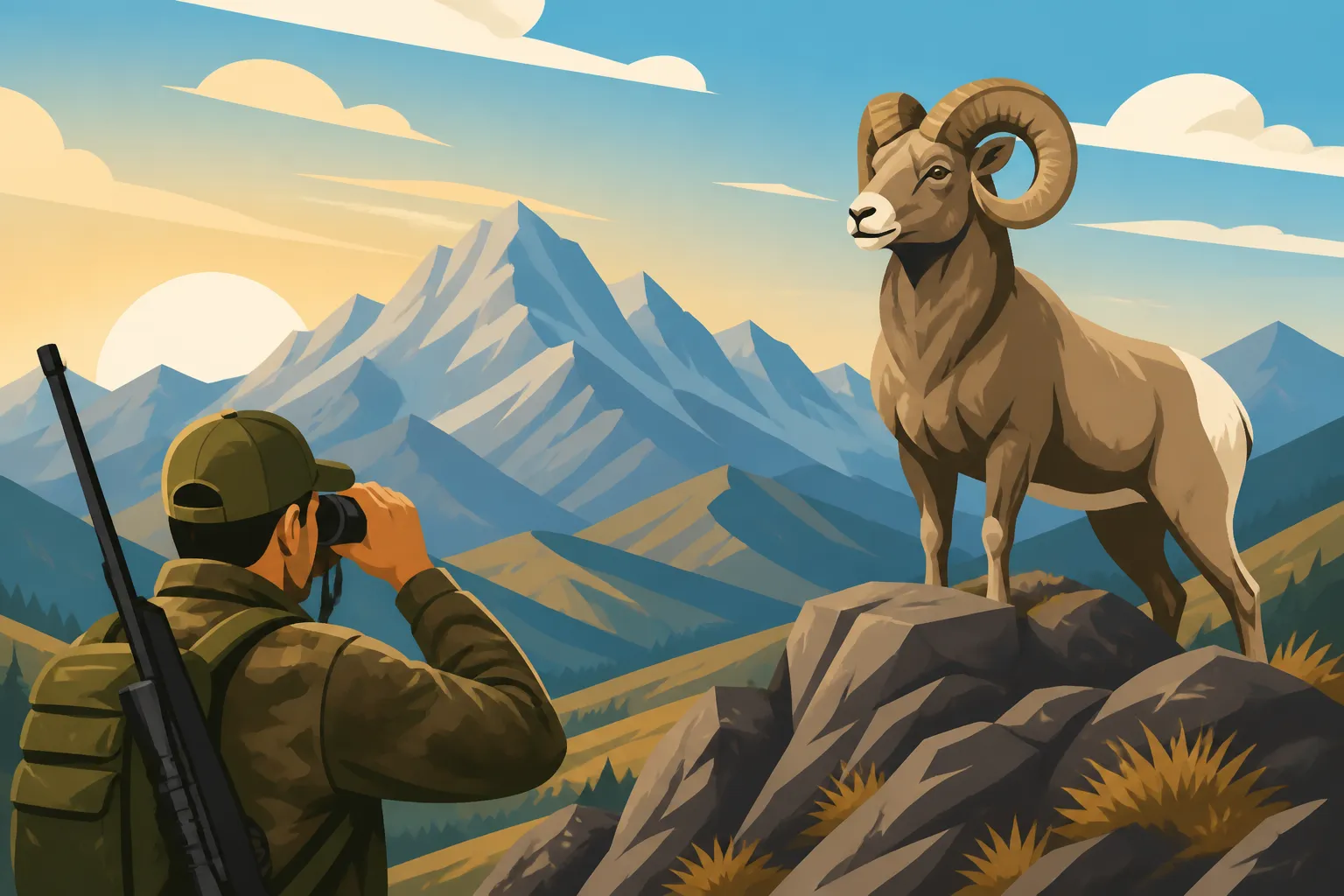
The vast majority of bighorn sheep hunting success comes down to effective glassing. You simply cannot walk up on these animals. They have incredible eyesight and prefer terrain that offers them a commanding view of their surroundings. Find a high vantage point that allows you to safely and comfortably scan large swaths of sheep habitat. Set up your spotting scope on a tripod and systematically grid-search the mountainsides. Look for anything out of place: a patch of white contrasting with the grey rock, a subtle movement, or the distinct shape of a ram's curl.
Once you spot sheep, the real challenge of the stalk begins. This is where the physical conditioning and gear choices you made years ago truly pay off. A sheep stalk is often characterized by extreme elevation changes, loose rock, and unpredictable wind. The goal is to close the distance without being seen, using terrain features for cover. This might involve descending thousands of feet only to climb them again, or navigating treacherous rock slides. Knowing How to Glass Montana's Big Country is fundamental to finding your ram before ever taking a step. Remember, the sheep always have the home-field advantage.
Understanding Sheep Behavior and Movement
Successful sheep hunting hinges on understanding their daily and seasonal behaviors. Bighorn sheep are generally most active during the cooler parts of the day, grazing in the mornings and evenings. During midday, they often bed down on ledges or steep slopes, where they can chew their cud and watch for predators. Their movements are often predictable, especially if you can locate their bedding and feeding areas. They typically follow established trails along cliff bands and through saddles.
During the rut (generally late fall to early winter), rams can become more focused on ewes, sometimes making them slightly less cautious, but this is still a high-stakes game. Rams will often challenge each other, and you might witness spectacular head-butting clashes. Paying attention to weather patterns is also crucial. A fresh snowfall can sometimes push sheep to lower elevations temporarily or highlight their tracks, but it also makes travel and glassing incredibly difficult. Understanding these nuances can significantly improve your chances, which is why reading up on specific animal behaviors, much like learning Montana Elk Behavior During the Rut, can provide valuable cross-species insights.
Approaching the Shot in Rugged Country
When you finally get into position for a shot, the adrenaline will be pumping, but maintaining composure is absolutely critical. Mountain hunting presents unique challenges for shot placement. You'll often be shooting at steep uphill or downhill angles, which can drastically affect bullet trajectory. Using a rangefinder with angle compensation is essential, and practicing shooting at these extreme angles is paramount before your hunt. Ensure you have a stable shooting platform, whether it's a backpack, trekking poles, or natural terrain.
Wind is another major factor in sheep country, often swirling and unpredictable in canyons and across open slopes. Take your time, assess the wind, and wait for the ram to offer a broadside, ethical shot opportunity. Remember, packing out a sheep from steep, remote terrain is an immense task, often involving quartering the animal and making multiple trips. Be prepared for this physically demanding conclusion to your hunt. Always prioritize safety, and never take a shot that puts you or your hunting partners in a precarious position or risks wounding an animal in unrecoverable terrain.
Disclaimer
The information provided in this guide is for general informational purposes only and is not intended as professional advice. Hunting regulations, seasons, and draw odds in Montana are subject to change by Montana Fish, Wildlife & Parks (FWP). Always consult the official Montana FWP regulations and current year's hunting proclamations before planning any hunting activity. Hunting involves inherent risks, and safety should always be your top priority.