How Far Montana Districts Are from Bozeman
Planning a Montana hunting trip can feel like trying to map out a small country, especially when you're looking at a big state like ours and trying to figure out logistics from a central hub like Bozeman. The sheer size of the state and the varied, often rugged, terrain can make it tough to estimate how long it'll actually take to get from your comfortable base in Bozeman to that prime hunting district you've been e-scouting. This guide is going to break down realistic travel times and distances from Bozeman to popular hunting areas, helping you plan your journey with confidence and minimize those unwelcome surprises on the road.
Understanding Montana's Hunting Districts and Bozeman's Location
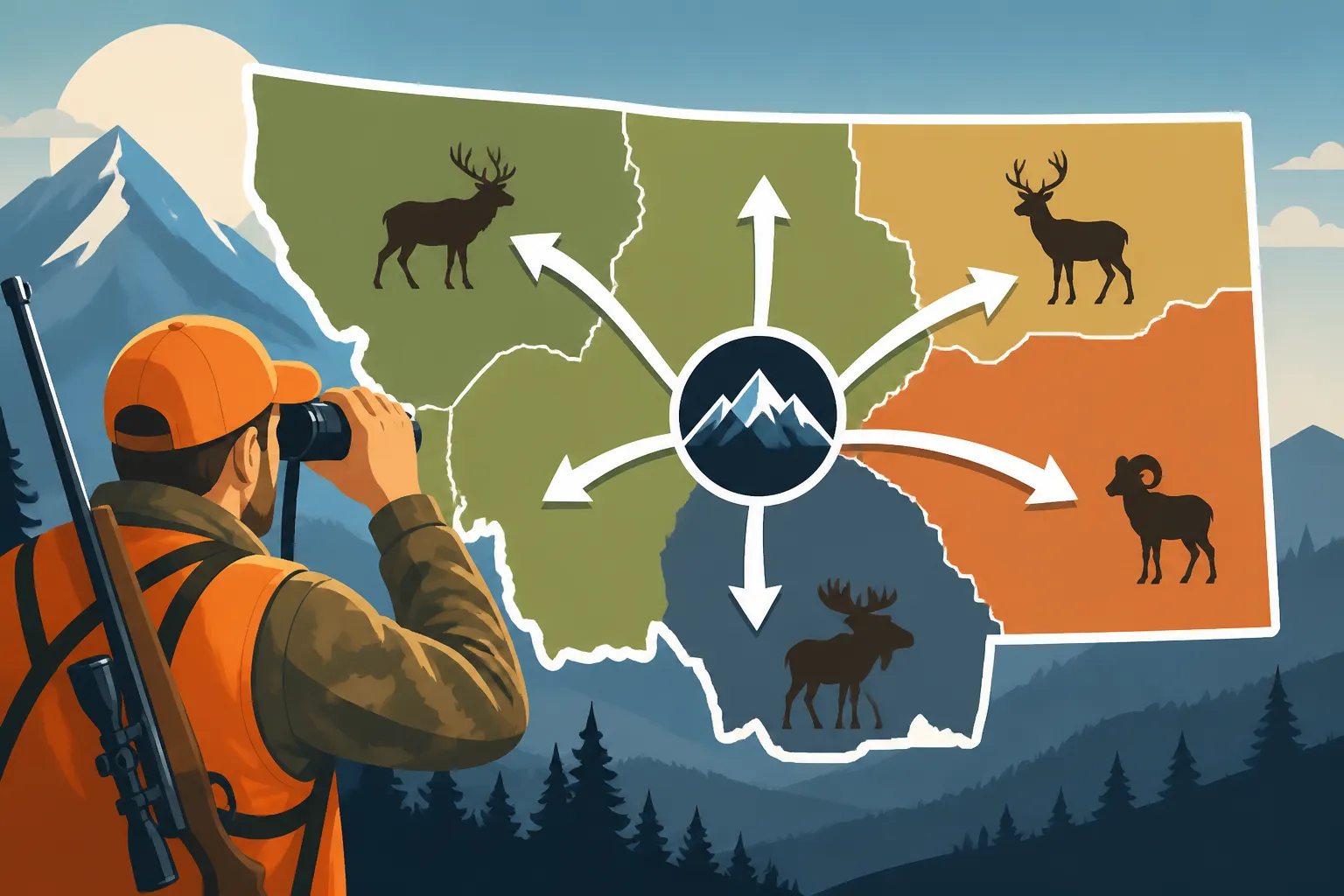
Montana is a vast state, and its hunting opportunities are incredibly diverse, from the high, rugged peaks of the Rockies to the sprawling plains of Eastern Montana. For hunters, understanding the layout of hunting districts (HDs) and the role of major towns like Bozeman as logistical hubs is crucial. Bozeman, nestled in southwestern Montana, offers excellent access to a variety of prime hunting grounds, making it a natural starting point for many adventures.
Bozeman: A Gateway to the Greater Yellowstone Ecosystem
Bozeman is more than just a college town; it's a vibrant hub situated in the heart of what many consider some of the best big game country in the lower 48. It sits within Montana Fish, Wildlife & Parks (FWP) Region 3, which is renowned for its abundant elk, deer, and other species. This strategic location means you’re not just close to one type of hunting experience but a multitude. Think about it: within an hour or two, you can be in the mountains chasing elk, or heading towards more open country for mule deer or pronghorn. It's a fantastic base because it offers modern amenities, gear shops, and plenty of places to grab a hearty breakfast before a long day afield.
Being centrally located in a major FWP region means hunters have a shorter drive to many coveted HDs. The proximity to numerous wilderness areas, national forests like the Custer Gallatin National Forest, and vast tracts of public land means less time commuting and more time scouting or hunting. This accessibility is a huge draw for both residents and nonresidents alike who might be flying into Bozeman Yellowstone International Airport (BZN) and need to quickly transition to their hunting grounds.
Decoding Hunting Districts and Their Geographic Spread
Montana's FWP hunting districts are administrative boundaries that help manage wildlife populations and hunting pressure. They don't always align perfectly with geographical features like mountain ranges, but they give hunters a specific area to research and apply for tags. When you're looking at a map, you'll see Bozeman is surrounded by HDs like 301, 311, 312, 331, and many others, all offering different seasons, species, and terrain types. For instance, HDs in the nearby Bridger Mountains might offer steep timbered slopes for elk, while those extending into the Madison Valley could present opportunities for deer in more open areas.
The critical thing to remember is that while a district might look close on a regional map, the actual drive time can be affected by the specific access points, the quality of roads, and whether you're trying to reach a trailhead deep in a national forest. Using tools like onX Hunt, you can overlay these district boundaries directly onto topographic maps, allowing you to identify roads, trails, and potential access points, which is invaluable when figuring out your approach and travel time. This foresight can be the difference between a successful start to your hunt and wasting precious hours on unexpected detours. Learning How to Choose a Montana Hunting District is an essential first step in this process.
Realistic Driving Times to Key Hunting Regions from Bozeman
Let's get down to the brass tacks: how long does it really take to get where you're going from Bozeman? Montana is famous for its "five-hour tours" that end up being eight hours because of an unforeseen gravel road or mountain pass. Understanding these realistic driving times is vital for proper trip planning, especially for hunters new to the state or those attempting a Montana DIY Elk Hunting Guide.
The Gallatin Valley and Nearby Front Ranges: Your Close-In Options
For those looking to stay relatively close to Bozeman, there are fantastic opportunities within an hour or two's drive. These areas are often popular, but with good scouting and a willingness to walk, you can still find solitude and success.
- The Bridger Mountains (e.g., HD 311, 312): North of Bozeman, these mountains are practically in your backyard. You can be at a trailhead in 30-45 minutes. These are steep, timbered mountains known for elk and mule deer. Access often involves well-maintained forest service roads, but elevation gain starts quickly.
- The Madison Range (e.g., HD 360, 362): West and southwest of Bozeman, towards Ennis or Big Sky, this range offers diverse terrain. Driving to the lower Madison Valley (near Ennis) might take an hour, while heading up to Big Sky and further into the high country could be 1 hour to 1 hour 30 minutes. Here, you'll find excellent opportunities for both deer and elk, with a mix of forested slopes and open parks.
- The Gallatin Range (e.g., HD 301, 302): South of Bozeman, extending into Yellowstone National Park boundaries, this is rugged, beautiful country. Driving into the heart of the Gallatin National Forest for hunting access points can take anywhere from 45 minutes to 1 hour 15 minutes, depending on your specific destination. This area is classic elk country, often requiring significant physical exertion.
These "close-in" options are perfect for day hunts or short overnight trips, allowing you to maximize your hunting time without spending half your day in the truck.
Further Afield but Still Accessible: Expanding Your Radius
Venturing a bit further out from Bozeman opens up even more diverse hunting experiences, though it means a longer commute to the trailhead. These are often great for weekend trips or longer excursions where you set up a base camp.
- Elkhorn Mountains (e.g., HD 340, 341): North and west of Bozeman, near Helena, these mountains are a renowned elk destination. The drive to the primary access points takes approximately 1 hour 30 minutes to 2 hours. The Elkhorns are known for their picturesque landscapes and healthy elk herds, though hunting pressure can be high.
- Tobacco Root Mountains (e.g., HD 331, 332): West of Bozeman, towards Sheridan and Twin Bridges, this range is another fantastic option for elk and deer. Expect a drive of about 1 hour 15 minutes to 1 hour 45 minutes to reach accessible trailheads or public land access. These mountains offer a good mix of timber and open slopes.
- Crazy Mountains (e.g., HD 510): East of Bozeman, past Livingston, these iconic peaks offer serious backcountry hunting. The drive to the closest access points near Clyde Park or Wilsall is roughly 1 hour to 1 hour 30 minutes, but getting deep into the range will involve more time on gravel roads and then foot travel. If you're looking for a true Montana Backcountry Hunting Guide, these mountains are a prime candidate.
- Beaverhead-Deerlodge National Forest (various HDs): Extending southwest of Bozeman, this massive national forest offers vast tracts of public land. Driving to areas near Dillon or Twin Bridges would take about 1 hour 15 minutes to 1 hour 45 minutes, with further drives into the forest adding more time. This area is fantastic for both elk and mule deer.
These destinations require a more dedicated plan, often involving overnight stays, but they offer the chance to escape some of the immediate pressure found closer to Bozeman.
Distant Destinations for Multi-Day Adventures: The Far Reaches of Montana
Sometimes, the best hunting means putting in some serious miles. While these locations are a significant drive from Bozeman, they offer unique opportunities and different landscapes. These are generally multi-day endeavors, often involving setting up a robust camp.
- Missouri Breaks (e.g., HD 622, 631, 680): Northeast Montana. Known for its rugged, remote beauty and world-class mule deer and elk, the Breaks are a serious commitment. Driving to central access towns like Lewistown is about 2.5 hours, but getting into the heart of the Breaks, near Fort Peck or Winifred, can push the total drive to 4-5 hours. This is truly remote country, demanding thorough preparation and self-sufficiency.
- Eastern Plains (various HDs for antelope, whitetail, mule deer): East of Bozeman, beyond Billings, lies the vast expanse of the Eastern Plains. Areas for antelope or whitetail near Miles City or Glendive can be a 4 to 6-hour drive. While flat, these drives are long and can be monotonous, but the rewards of abundant game in a different landscape are significant.
- Western Montana Wilderness (e.g., Bob Marshall, Great Bear Wilderness): Northwest Montana, near Missoula or Kalispell. These areas offer unparalleled wilderness experiences for elk and bear, but they are a long haul. Driving to Missoula alone is about 3 hours, and then you're looking at another 1-2 hours to reach major trailheads on the perimeter of these vast wilderness areas. This type of hunting often requires horses or extended backpacking trips.
Here's a quick reference table for estimated driving distances and times from Bozeman to some key towns or general hunting regions:
| Destination (General Area) | Estimated Driving Distance from Bozeman | Estimated Driving Time from Bozeman (Paved Roads) | Primary Species & Notes |
|---|---|---|---|
| Close-In (0-2 hrs) | |||
| Livingston (Paradise Valley) | ~25-30 miles | 30-40 minutes | Elk, Deer. Eastern Gallatin Range, Absaroka-Beartooth access. |
| Ennis (Madison Valley) | ~50-60 miles | 1 hour | Elk, Deer. Madison, Gravelly Ranges. |
| Big Sky (Gallatin Canyon) | ~50-60 miles | 1 hour 15 minutes | Elk, Deer. Gallatin Range high country. |
| Mid-Range (2-3 hrs) | |||
| Helena (Elkhorn Mountains) | ~90-100 miles | 1 hour 30 minutes | Elk, Deer. Elkhorn and Big Belt Mountains. |
| Dillon (Beaverhead Valley) | ~70-80 miles | 1 hour 15 minutes | Elk, Mule Deer. Pioneer Mountains, Beaverhead-Deerlodge NF. |
| White Sulphur Springs | ~80-90 miles | 1 hour 30 minutes | Elk, Deer. Castle and Little Belt Mountains. |
| Lewistown (Judith Basin) | ~150-160 miles | 2 hours 30 minutes | Elk, Mule Deer. Gateway to Little Belt, Snowy Mountains, Judith Basin. |
| Distant (3+ hrs) | |||
| Missoula (Western MT) | ~180-200 miles | 3 hours | Elk, Deer, Bear. Bitterroot, Sapphire NF access. |
| Great Falls | ~150-160 miles | 2 hours 30 minutes | Eastern Front, Highwood Mountains. |
| Billings | ~140-150 miles | 2 hours 15 minutes | Breaks access, Custer Gallatin NF eastern portion. |
| Glasgow (Missouri Breaks) | ~280-300 miles | 4 hours 30 minutes | Mule Deer, Elk. Remote, rugged country. |
Note: These are estimated driving times on paved roads under good conditions. Actual travel time may vary significantly.
Factors Influencing Travel Time Beyond Miles
While Google Maps is a great starting point, the reality of Montana hunting travel often involves more than just calculating highway miles. There are several crucial factors that can dramatically impact how long it takes you to get from Bozeman to your chosen hunting spot. Ignoring these can lead to frustration and lost hunting time.
Road Conditions and Rugged Terrain
The vast majority of Montana's prime hunting land is public, often accessed via gravel forest service roads, two-track trails, or even no roads at all, requiring foot or horseback travel. A 20-mile stretch of well-maintained gravel can take 30-45 minutes, but 20 miles of rutted, rocky, or muddy two-track in the backcountry might take hours, even with a capable 4×4.
- Mountain Passes: Even on paved roads, high mountain passes can slow you down, especially if you're pulling a trailer. In late fall, snow or ice can shut down passes or make them treacherous, adding significant detours. Always check road conditions before you head out, especially for higher elevations.
- Gravel and Dirt Roads: Many of the best spots are miles off the pavement. These roads can be washboarded, dusty in dry conditions, or slick and muddy after rain or snow. Your speed will drop dramatically, and you'll need to pay close attention to avoid damaging your vehicle. A flat tire in the middle of nowhere is not how you want to start your hunt.
- Seasonal Closures: Forest service roads, especially those leading to higher elevations, are often closed seasonally due to snow or to protect wildlife during migration. These closures are typically marked, but relying solely on older maps could lead to a dead end. Always check current FWP and Forest Service regulations and road statuses.
Understanding that distance is not the only metric for travel time is crucial for successful trip planning in Montana. A local might tell you a spot is "just 30 miles" away, but those 30 miles could be on a remote, unmaintained track that takes twice as long as 60 miles on pavement.
Utilizing Mapping and Scouting Tools for Accurate Estimates
In today's age, technology is your best friend when planning a hunt in Montana. Digital mapping applications have revolutionized how hunters research and navigate the backcountry, making it much easier to gauge realistic travel times.
- onX Hunt: This app is practically indispensable for Montana hunters. Not only does it show property boundaries (public vs. private), but it also displays an incredible amount of detail on roads, trails, and topography. You can pinpoint specific trailheads or access points, measure distances, and even get an approximate elevation profile for your route. When planning, zoom in on your potential access roads on onX Hunt. Does it look like a well-used road, or a faint two-track disappearing into the timber? This visual information, combined with satellite imagery, can give you a much better sense of the actual drive than a simple mileage number. You can also drop pins at different points along a route and get turn-by-turn directions, which will give you a more accurate time estimate than just a straight-line distance. In fact, many hunters use the tool to help them with How to Use onX for Montana Hunting well before they ever step foot in the state.
- GoHunt's Filtering System: Websites like GoHunt provide draw odds, harvest statistics, and a filtering system for hunting units that can give you insights into access. While not a navigation tool itself, knowing that a certain unit is largely roadless or requires special access can inform your travel time estimates. If a unit is known for its remoteness, you can bet that the "last mile" will take longer than expected. They often have community forums where hunters share real-world experiences, offering invaluable context that general maps can't.
Before you leave Bozeman, take the time to map out your entire route, from pavement to the specific trailhead you plan to use. Don't just look at the major highway segment. Account for the slower speeds, potential stops, and unknown variables of Montana's backcountry roads. This diligent e-scouting, covered more in-depth in our guide on How to E-Scout Montana Hunting Units, will save you headaches and precious hunting daylight.
Planning Your Logistics: Making Bozeman Your Base Camp
When planning a Montana hunt, Bozeman truly shines as a strategic base camp. Its amenities, central location, and access to services make it an ideal starting point for many hunting expeditions. But successfully utilizing Bozeman means thinking through your logistics for a smooth, efficient trip.
Overnight Stays vs. Day Trips from Bozeman
One of the first decisions you'll make when planning your hunting forays from Bozeman is whether to return to town each night or commit to an overnight stay closer to your hunting grounds. Both have their pros and cons.
- Day Trips: If your chosen hunting district is within a 1-1.5 hour drive (like many areas in the Bridgers, Gallatins, or Madison Range), a day trip from Bozeman is entirely feasible. You can enjoy a comfortable bed, hot showers, and a variety of dining options or groceries. This works well for shorter, more casual hunts or scouting missions. However, remember that sunrise and sunset dictate legal shooting light, so those travel times need to be factored into your day. You might be leaving Bozeman well before dawn and returning after dark, making for long days.
- Overnight Stays/Camping: For districts that are 2 hours or more away, or for any serious multi-day hunt, staying closer to your hunting area is almost always a better choice. This could mean booking a motel in a smaller town like Ennis, Dillon, or Lewistown, or more commonly, setting up a camp. Whether you opt for a wall tent in a designated campground, a primitive spike camp deep in the backcountry, or even a camper trailer, staying on location maximizes your time afield. Our Montana Backcountry Hunting Gear List can help you plan what to bring for these extended stays. It significantly reduces daily driving, allowing you to be in the woods earlier and stay later, often the most productive times for big game. It also means you're not battling fatigue from driving after a strenuous day of hiking and hunting.
Consider the trade-offs: comfort vs. efficiency. For a once-in-a-lifetime elk hunt, sacrificing some comfort for more time in the field is usually the right call. For shorter, less intense hunts, Bozeman's amenities are a welcome luxury.
Packing and Prep Considerations for Remote Travel
Regardless of whether you're coming back to Bozeman or staying out in the field, proper packing and preparation are paramount, especially when traveling to remote Montana hunting districts. The farther you venture from town, the more self-reliant you need to be.
- Fuel Management: Always top off your fuel tank in Bozeman or the last major town before heading into remote areas. Many small towns along the way may have limited hours or no fuel available, and running out of gas deep in a national forest is a serious problem. Carry a spare fuel can if you're venturing really far.
- Emergency Gear: Even for day trips, a robust emergency kit is non-negotiable. This includes extra layers, a first-aid kit, fire-starting supplies, a headlamp, food, water, and communication devices (like a satellite messenger, as cell service will be non-existent in many areas). A spare tire, a jack, and tools for basic vehicle repairs are also crucial, especially on rough gravel roads.
- Food and Water: While Bozeman has plenty of grocery stores, once you leave town, options diminish rapidly. Plan and pack all your food and water needs. For longer trips, consider a water filter or purification tablets.
- Meat Care: If you're fortunate enough to harvest an animal, especially in early archery season, keeping meat cool is a huge concern. Have plenty of game bags and coolers packed with ice ready. This is where a return to Bozeman for a walk-in freezer or butcher shop might be part of your plan, but often, the initial breakdown and cooling happens right in the field, as discussed in our guide on How to Pack Out an Elk in Montana.
- Vehicle Readiness: Before you embark on your Montana hunting adventure from Bozeman, ensure your vehicle is in top shape. Check tire pressure, fluids, brakes, and lights. A breakdown hundreds of miles from home or assistance can derail your entire trip. If you're tackling truly rugged terrain, a lifted 4×4 with good tires is often a necessity, not a luxury.
By meticulously planning your routes, understanding the true nature of Montana's roads, and preparing for self-sufficiency, you can transform Bozeman from just another city into your perfect logistical command center for an unforgettable hunting experience. Whether you're chasing Montana Elk Hunting Guide or focusing on Montana Mule Deer Hunting Guide, smart planning from Bozeman makes all the difference.
Disclaimer
Please remember that hunting regulations, seasons, and access can change. Always consult the official Montana Fish, Wildlife & Parks (FWP) regulations and district maps before planning any hunt. Road conditions and public land access should be verified with the appropriate land management agency (e.g., US Forest Service, BLM) for the most current information. Safety in the field is your responsibility.