Hunting the Montana Missouri Breaks for Elk
Hunting elk in Montana's Missouri Breaks is an experience unlike almost any other, yet it often comes with a significant dose of frustration for hunters who aren't prepared for its unique challenges. The sheer scale, rugged isolation, and complex topography can make finding and pursuing elk feel like an impossible task. This guide is designed to demystify the Missouri Breaks, providing you with a thorough understanding of its landscape, elk behavior, and the essential strategies you'll need to successfully hunt this iconic region.
Understanding the Missouri Breaks Landscape
The Missouri Breaks is not just a place; it's a feeling – a vast, wild, and incredibly remote expanse of central Montana that will test every ounce of your resolve. Formed by the erosive power of the Missouri River and its tributaries, this region is characterized by an intricate network of steep, crumbling hills, deep coulees, and exposed badlands. It's a land that chews up boots and spits out unprepared hunters, but for those who learn its rhythm, it holds incredible opportunities for truly wild elk.
Geographic Features and Habitat
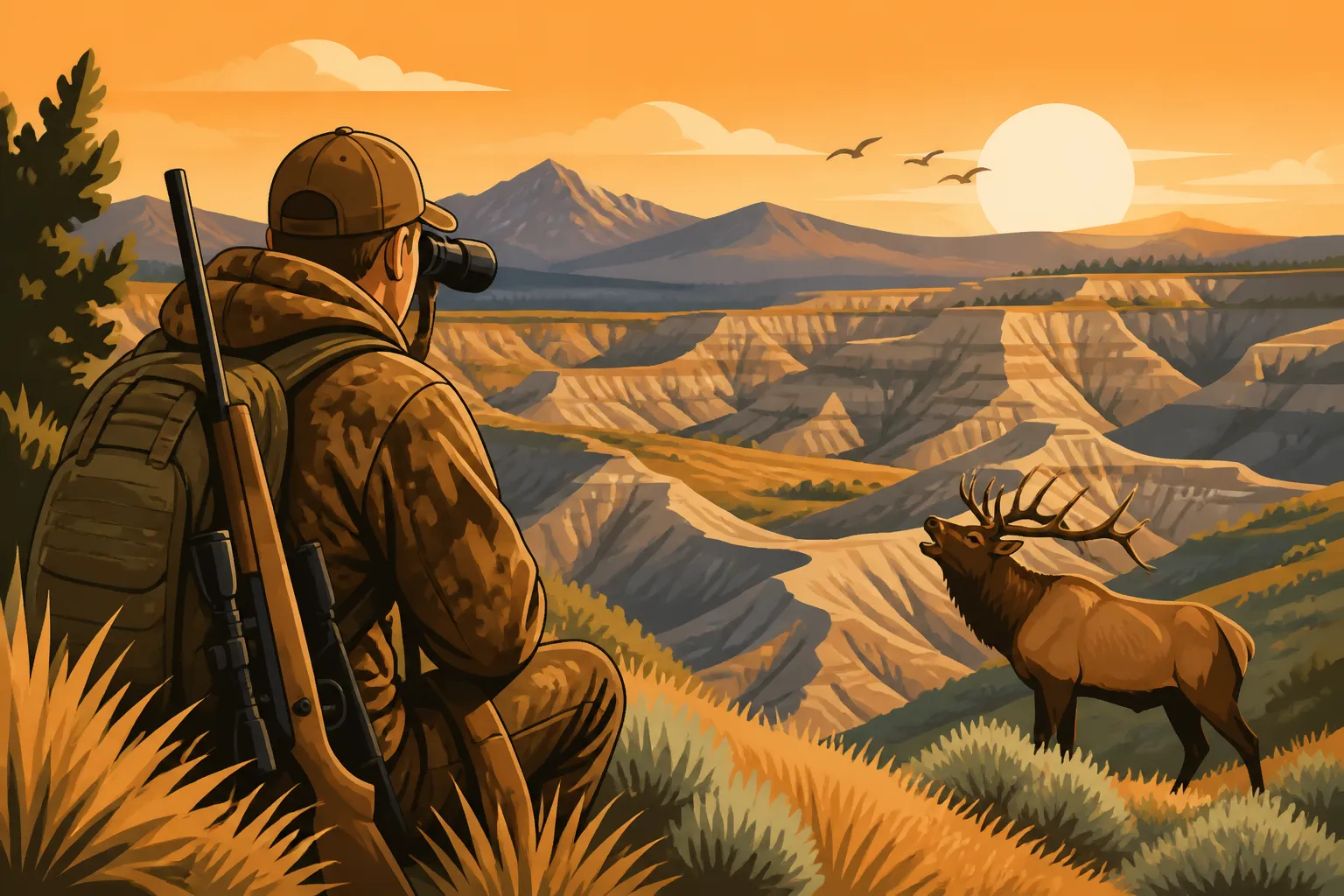
Imagine a landscape painted in shades of tan, grey, and green, constantly shifting with the light. That's the Missouri Breaks. The terrain here is incredibly broken, defined by countless washes, dry creek beds, and steep, brush-choked draws that lead down to the Missouri River itself. The term "breaks" perfectly describes the abrupt changes in elevation and the fragmented nature of the land.
The dominant vegetation includes sagebrush, greasewood, and various grasses on the open slopes, interspersed with pockets of juniper, ponderosa pine, and cottonwoods along the river bottoms and within the deeper coulees. This diverse habitat provides elk with everything they need: food in the form of browse and grasses, water in the river and scattered springs, and, most critically, incredibly dense thermal and security cover within the coulees and timber patches. During the heat of the day or when hunter pressure is high, elk will disappear into these seemingly impenetrable breaks, making them incredibly difficult to locate. The sheer amount of ground and the visual obstructions make traditional timber hunting strategies less effective; instead, you'll need to adapt to a landscape that constantly reveals and conceals.
Navigating the Remote Terrain
One of the biggest hurdles in the Missouri Breaks is simply getting around. Roads are few and far between, often unmaintained, and can become impassable with even a little rain or snow. Many areas are only accessible by foot, horseback, or boat on the Missouri River itself. This remoteness is a double-edged sword: it keeps pressure relatively low in many areas, but it also demands a high level of self-sufficiency and navigational skill.
Modern GPS units and mapping applications like onX Hunt are absolutely indispensable here. You'll want to pre-download maps for offline use because cell service is virtually nonexistent across much of the Breaks. Understanding contour lines, identifying potential travel corridors, and marking water sources are critical before you even set foot on the ground. When planning your route, remember that a mile in the Breaks is rarely a straight line; you'll be constantly climbing in and out of drainages, adding significant time and effort to any movement. For more on preparing for such rugged hunts, consider our guide on Montana Backcountry Hunting Guide.
Elk Behavior and Patterns in the Breaks
Elk in the Missouri Breaks are creatures of habit and necessity, adapting their movements and daily routines to the unique demands of their environment. Unlike elk in dense mountain timber, these animals often travel vast distances across open country to reach pockets of cover or water, making them appear and disappear with frustrating regularity. Understanding their seasonal patterns and how they utilize the broken terrain is key to successful hunting.
Seasonal Movements and Rutting Activity
Elk behavior in the Breaks is heavily influenced by the seasons, especially the availability of food and water, and the demands of the rut. In early archery season, typically late August into September, bulls are often starting to bugle, and herds are gathering. They'll be feeding heavily in grassy areas, but quickly retreating to the thickest coulees or the limited timber patches for security during the day. Water sources, especially secluded ones, become critical focal points.
As the rut intensifies through late September and early October, the sounds of bugling bulls echo across the draws. During this time, elk might be more visible as bulls are actively seeking cows. However, they are still incredibly wary and will vanish into the breaks at the slightest disturbance. The general rifle season, which usually starts in late October and runs through November, often coincides with colder weather and potential snow. This can push elk into lower elevations or deeper into sheltered areas, making them slightly more predictable. Hunting elk after the rut can present different challenges, as their focus shifts from breeding to simply feeding and surviving the coming winter. For deeper insights into this, check out our guide on How to Hunt Elk After the Rut.
Missouri Breaks Elk Behavior by Season
| Season | Primary Focus | Typical Location | Key Hunting Tip |
|---|---|---|---|
| Early Archery | Feeding, establishing pre-rut territories | Grassy slopes, near secluded water, dense coulee bottoms | Focus on morning/evening feeding, find water sources, listen for early bugles. |
| Peak Rut | Breeding activity, challenging rivals | Throughout draws and coulees, more visible due to activity | Use calling aggressively, target travel corridors between bedding and feeding. |
| General Rifle | Feeding, seeking security cover, migration | Dark timber, thick coulees, lower elevations (with snow) | Cover ground, glass extensively, look for fresh sign in transition areas. |
| Late Season | Winter range migration, survival | South-facing slopes (snowmelt), sheltered valleys | Target food sources and thermal cover, often in larger herds. |
Locating Elk in Diverse Cover
Finding elk in the Missouri Breaks requires a different approach than what many hunters are accustomed to. Instead of vast, uniform forests, you're dealing with a landscape that offers incredible broken cover. Elk will use the deepest, most inaccessible coulees for bedding during the day, often moving out to feed on the sagebrush flats or grassy benches in the early morning and late evening. They are masters of using topography to their advantage, often disappearing behind a single ridge or into a dense juniper patch in seconds.
Your best bet for locating elk involves a combination of extensive glassing and careful foot travel. From high vantage points, use powerful binoculars and a spotting scope to systematically pick apart the opposing slopes and draws, especially those with good feed or dark timber. Look for subtle movements, a flick of an ear, or the distinct shape of an elk against the landscape. Once located, planning your approach requires extreme patience and an intimate understanding of the wind and thermals, which can be notoriously tricky in this undulating terrain. The ability to effectively How to Glass Montana's Big Country is a crucial skill here.
Effective Hunting Strategies for the Missouri Breaks
Hunting the Missouri Breaks successfully demands a blend of patience, physical endurance, and adaptive tactics. This isn't a place for one-trick ponies; you'll need a diverse skillset and a willingness to change your approach based on what the elk and the landscape are telling you.
Spot-and-Stalk Tactics
Given the open nature of many parts of the Breaks, spot-and-stalk is arguably the most effective method, especially for those pursuing a mature bull. This involves finding a high vantage point before first light and patiently glassing every inch of the surrounding country. Use your optics to locate elk as they move from feeding areas back to bedding cover, or as they emerge in the evening.
Once you spot elk, the real work begins. You'll need to carefully plan your stalk, utilizing every fold in the terrain, every patch of brush, and every drainage to remain unseen. The wind is paramount, as swirling thermals in the coulees can betray your position instantly. You might have to make wide detours, sometimes several miles, just to get into position. This is where a good mapping app like onX Hunt shines again, allowing you to plot a concealed route on the fly. The principles are similar to How to Spot-and-Stalk Antelope in Montana, just on a grander, more rugged scale. This method demands incredible patience and the ability to accurately judge distances, as shots can often be long.
Utilizing Calling and Ambush Techniques
While glassing and stalking are primary, calling can be a powerful supplementary tool, especially during the peak rut. Locator bugles can help you pinpoint a bull's general location, but be prepared for them to be evasive. Elk in the Breaks are often heavily pressured and can be call-shy. Once you've located a bull, a more subtle approach with cow calls and soft chuckles can sometimes draw them in, particularly if you can set up with good cover and have a shooting lane ready. For detailed calling advice, check out How to Call Elk in Montana.
Ambush techniques can also be highly effective, especially around known water sources, pinch points in drainages, or along frequently used travel corridors between feeding and bedding areas. E-scouting can help you identify these natural funnels before your hunt. Setting up a ground blind or finding natural cover near these spots, especially in the afternoon as elk begin moving out to feed, can offer a close-range shot opportunity. This requires diligent scouting, either physically or via digital tools, to identify these high-traffic zones.
Physical Preparation and Gear Essentials
You cannot overstate the physical demands of hunting the Missouri Breaks. The constant up-and-down hiking in uneven, often slippery terrain will test your conditioning. This isn't a casual stroll; it's a marathon that might involve packing out heavy loads over multiple miles. A robust Montana Elk Hunt Fitness Plan is highly recommended.
Your gear needs to be up to the challenge. Durable, broken-in hiking boots with excellent ankle support are non-negotiable. A high-quality backpack capable of carrying heavy loads, water, and essential survival gear is crucial. Reliable optics – binoculars (10x-15x) and a spotting scope (20x-60x) with a tripod – are your eyes in this vast landscape. Plenty of water or a reliable filtration system is also vital, as water sources can be scarce. Always carry emergency supplies, including a first-aid kit, fire starter, and satellite communication device, as you'll often be hours from any help. Having a detailed Montana Backcountry Hunting Gear List will ensure you don't forget anything critical.
Licenses, Access, and E-Scouting the Breaks
Before you even dream of spotting that bull in a deep coulee, you need to understand the nuts and bolts of hunting in Montana, especially for a specific area like the Missouri Breaks. This involves navigating the licensing system, understanding access, and leveraging technology for intelligent pre-season planning.
Draw Odds and Tag Considerations
Montana's elk hunting opportunities are highly sought after, especially for non-residents. While the Missouri Breaks offers general elk tags in many districts, the state's licensing system can be complex. Non-residents typically apply for the highly competitive Big Game Combination or Elk Combination licenses through a draw process. Building preference points can increase your odds over time, but it's not a guarantee. You can find detailed information about the process in our Montana Nonresident License Draw Explained guide.
Some districts within the Missouri Breaks might have specific permit draws for either-sex or antlerless tags, which are even harder to draw. It's crucial to research the specific hunting district regulations for the area you intend to hunt well in advance of the application deadlines, usually in March. Tools like GoHunt can provide valuable insights into draw odds and unit breakdowns, helping you make informed decisions about where to apply and how to maximize your chances of success. Always double-check current regulations with Montana Fish, Wildlife & Parks (FWP) directly, as rules can change annually.
Accessing Public Lands and Block Management
The Missouri Breaks is largely composed of public lands, primarily managed by the Bureau of Land Management (BLM) and some State Trust Lands. However, interspersed private holdings and checkerboard land ownership can create access challenges. Understanding public land boundaries is critical to avoid trespassing. This is where advanced mapping applications like onX Hunt are absolutely essential, providing accurate land ownership overlays directly on your phone or GPS. For a broader understanding of public land hunting, check out the Montana Public Land Hunting Guide.
Montana also has an excellent program called Block Management, which provides public hunting access to private lands. While less common in the most remote parts of the Breaks, some accessible areas near agricultural lands might be enrolled. These areas can offer fantastic opportunities for elk, but often require signing in at a designated location and adherence to specific rules set by the landowner. Familiarize yourself with how Montana Block Management Areas Explained work and always obtain Block Management Area (BMA) maps from FWP before your hunt, as these areas change annually.
Leveraging Technology for Pre-Season Scouting
E-scouting is not just a luxury; it's a necessity for hunting the Missouri Breaks. Before you ever leave home, you can spend countless hours dissecting maps and satellite imagery to identify potential elk habitat, travel corridors, water sources, and bedding areas.
Using platforms like onX Hunt or desktop programs that allow for detailed topographic analysis, look for:
- Deep, north-facing coulees: These often hold cooler temperatures and denser vegetation, providing thermal cover and security.
- Juniper and ponderosa pine pockets: These provide crucial shade and cover.
- Water sources: Mark every spring, seep, and reservoir you can find. Elk will be tied to water.
- Bench systems and saddles: These are natural travel routes for elk moving through broken country.
- Isolated flats or mesas: These can be feeding areas that elk access from hidden breaks.
- Access points: Identify roads, trails, or river put-ins, and assess how far you're willing to hike or pack in.
This kind of detailed digital reconnaissance, covered in more detail in How to E-Scout Montana Hunting Units, allows you to build a strategic plan, mark waypoints, and identify primary and secondary hunting areas, saving you valuable time and effort once you're on the ground. You'll be able to hit the ground running with a clear idea of where to focus your efforts, rather than spending precious hunting days blindly exploring.
The Rewarding Challenge of the Missouri Breaks
Hunting elk in the Montana Missouri Breaks is a pilgrimage for many, a true test of grit and skill in one of North America's most wild and beautiful landscapes. It's a place that demands respect, rewards effort, and leaves an indelible mark on those who venture into its depths. The challenges are real – the vastness, the ruggedness, the evasive elk – but the reward of harvesting an animal in this iconic country is unparalleled. It’s an adventure that promises not just a hunt, but a profound connection to a truly untamed corner of Montana.
Disclaimer
Please note that hunting regulations, season dates, and license requirements can change frequently. Always consult the most current Montana Fish, Wildlife & Parks (FWP) regulations and official resources before planning any hunting trip. This guide is for informational purposes only and does not supersede official FWP regulations.