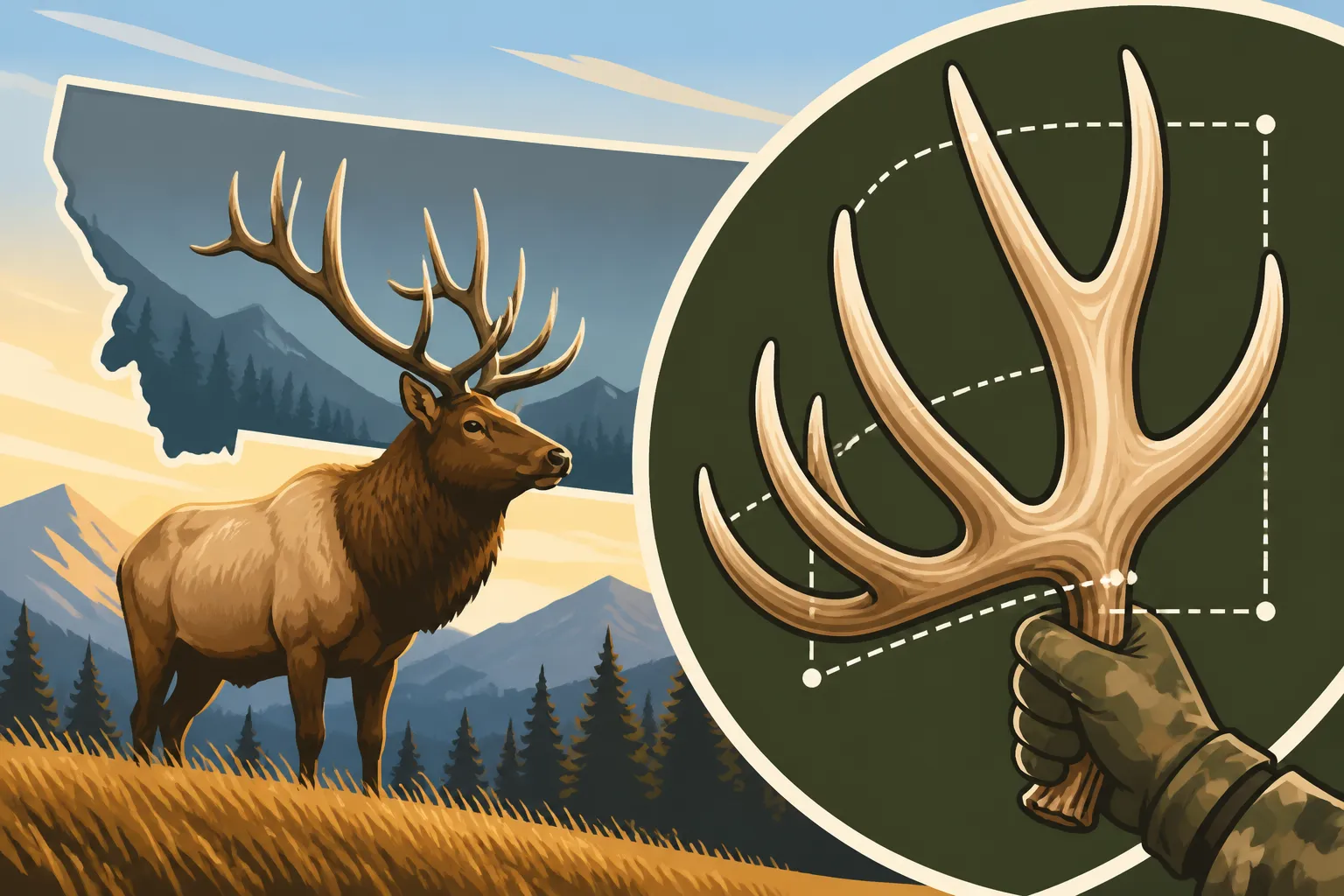
Montana Elk Antler Scoring Explained
You’ve put in the sweat equity, hiked countless miles across some of Montana’s most rugged landscapes, and finally, after what felt like an eternity, you’re standing over a magnificent bull elk. The adrenaline is still pumping, but a question inevitably starts to form in your mind: “How does this giant score?” Understanding elk antler scoring can feel a bit like learning a new language, especially when you start diving into the nuances of typical versus non-typical racks. This guide aims to demystify the Boone and Crockett scoring system, giving you a clear roadmap to appreciate the true dimensions of your hard-earned Montana bull.
The Gold Standard: Understanding the Boone and Crockett System
For serious big game hunters, the Boone and Crockett Club's scoring system is the undisputed benchmark for measuring the size of North American trophies. It’s not just about the longest tines or the widest spread; it's a comprehensive method designed to recognize the overall mass, length, and symmetry of an animal’s antlers. This system brings a sense of standardized comparison to the incredible diversity found in nature, allowing hunters to appreciate the genetic and nutritional factors that contribute to a truly world-class rack. While other organizations like Pope & Young (for archery kills) use a similar methodology, Boone & Crockett sets the standard for all-weaponry entries.
Why Boone and Crockett Matters
The Boone and Crockett Club, established in 1887 by Theodore Roosevelt, isn't just a record-keeping organization; it's a wildlife conservation group dedicated to ethical hunting and habitat preservation. When an elk makes it into the B&C record book, it’s not just a testament to the hunter’s skill but also to the health and vitality of the herd and habitat it came from. For a Montana elk hunter, knowing your bull qualifies for Boone and Crockett recognition is a huge point of pride, signifying that you've harvested an animal that represents the very best of its species. It connects you to a long tradition of conservation and ethical pursuit.
Moreover, understanding this system helps you become a better judge in the field. When you're glassing a distant ridge, trying to decide if that bull is worth the grueling stalk, knowing the B&C parameters helps you quickly assess its potential. Many hunters, even those not strictly aiming for a record book entry, use the B&C score as a personal benchmark. Platforms like GoHunt often include data on historical trophy production in various hunting districts, which can be invaluable when you're planning your Montana Elk Hunting Guide and scouting potential areas.
Typical Versus Non-Typical Categories
One of the first critical distinctions in elk antler scoring is between "typical" and "non-typical" racks. It's not about how common they are, but about their symmetry and point structure relative to a classic, symmetrical growth pattern.
A typical elk rack is one that is largely symmetrical, with points growing upward from the main beams in a relatively balanced fashion on both sides. Think of the classic six-point bull (three points above the main beam junction, plus the brow, bez, and trez tines) with matching or near-matching points on each side. The ideal typical rack exhibits striking symmetry, with deductions occurring when there are differences in length, circumference, or point count between the left and right sides. The goal of the typical score is to reward perfect, or near-perfect, symmetry.
A non-typical elk rack, on the other hand, features abnormal points, drops, or kickers that don't mirror each other, or other significant asymmetries that break the traditional "typical" form. These can be incredibly impressive and often reflect unique genetic traits or even injuries during antler growth. While some hunters might only pursue typical trophies, many find non-typical racks to be even more captivating due to their unique character. For non-typical antlers, the scoring system still measures the typical frame, but then adds the lengths of all abnormal points to the score. This means that a highly asymmetrical rack with lots of character can achieve a much higher non-typical score than its typical frame might suggest. It’s a way to appreciate the uniqueness without penalizing the lack of perfect symmetry.
Deciphering the Measurements for a Montana Elk Antler
The Boone and Crockett system meticulously breaks down an elk's antlers into several key measurements. Each of these components contributes to the final score, and understanding them is crucial, whether you're trying to field judge a bull or officially score a harvested one. It might seem intimidating at first, but once you break it down, it's quite logical.
Main Beam Length
The main beam is the primary structure of the antler, extending from the skull upwards and curving back. To measure the main beam, you start at the burr (the rough bony growth at the base of the antler, just above the skull) and follow the outer curve of the beam to its tip. This measurement needs to be precise, following every twist and turn of the beam. It's often one of the most substantial contributions to the overall score, and a bull with long, sweeping main beams immediately catches the eye. Remember, even a slight miscalculation here can significantly impact the final score.
Length of Points (Tines)
Elk antlers typically have multiple points, often referred to as tines. The Boone and Crockett system specifically identifies six main points on a typical elk rack, although mature bulls can certainly have more. These include:
- Brow Tine (G1): The first point coming off the main beam, closest to the burr, often pointing forward.
- Bez Tine (G2): The second point, usually above and behind the brow tine.
- Trez Tine (G3): The third point, typically the longest, often referred to as the dagger or sword point.
- Fourth Point (G4): The point after the trez, sometimes called the royal tine.
- Fifth Point (G5): The point after the fourth.
- Sixth Point (G6): The point after the fifth, which is often the tip of the main beam itself if it's considered a distinct point.
Each of these points is measured from the nearest edge of the main beam to its tip. The measurement follows the center of the tine, not just the outside edge. For a bull to be a "six-point," it typically needs five distinct points plus the beam tip counting as a point, or commonly, G1-G5 and the main beam tip. Having long, well-defined points adds considerably to a bull's score and is a key characteristic hunters look for when judging Montana Elk Trophy Potential by District.
Circumference Measurements (Mass)
Antler mass is another critical component often overlooked by beginners but highly valued in scoring. The Boone and Crockett system measures four circumferences on each main beam, effectively quantifying the antler's thickness. These measurements are taken at specific points:
- H1: Between the burr and the brow tine (G1).
- H2: Between the brow tine (G1) and the bez tine (G2).
- H3: Between the bez tine (G2) and the trez tine (G3).
- H4: Between the trez tine (G3) and the fourth point (G4).
If a beam doesn't have all these points, the circumference measurements are taken at specific intervals along the beam. A heavy, thick-beamed bull often carries impressive mass throughout its rack, which can add significant inches to its score, even if its points aren't exceptionally long. This is why some bulls that don't look "huge" in terms of length can still carry a very respectable score due to their sheer bulk.
Inside Spread Credit
The inside spread is measured at the widest point between the main beams, perpendicular to the skull. While visually impressive, its contribution to the final score in the Boone and Crockett system is somewhat limited. The inside spread credit can never exceed the length of the longest main beam. So, if your bull has a 60-inch spread but only 55-inch main beams, it will only get credit for 55 inches of spread. This rule ensures that a bull isn't overly rewarded for just having a wide rack if it lacks other desirable attributes like beam length or tine length. Many hunters mistakenly believe a wide spread is the most important factor, but it's just one piece of the puzzle.
Abnormal Points and Deductions
This is where the distinction between typical and non-typical truly comes into play.
Abnormal points are any points that do not follow the typical growth pattern of an elk's antler. This includes kickers, drops, or points that branch off existing points in an unusual way. For a typical score, these abnormal points are measured and deducted from the gross score, as they detract from the ideal symmetry. However, for a non-typical score, these same abnormal points are measured and added to the score after the typical frame is tallied. This means a non-typical score gives credit for all the unique character a rack might possess.
Deductions for asymmetry are also a critical part of the typical scoring system. After all the measurements (main beams, points, circumferences, and spread) are taken for both the left and right sides, the measurements for each corresponding feature are compared. Any difference between a matching typical point on the left side and its corresponding point on the right side (e.g., G3 length on left vs. G3 length on right) is considered an "asymmetry deduction." These differences are summed up and subtracted from the gross typical score. This is why perfect symmetry is so highly prized in the typical category – any deviation costs inches.
Here's a simplified table to help visualize the components:
| Measurement Category | Description | Typical Scoring Impact | Non-Typical Scoring Impact |
|---|---|---|---|
| Main Beam Length | From burr to beam tip, following curve. | Added to gross score. | Added to gross score. |
| Length of Points (G1-G6) | From main beam to point tip. | Added to gross score. | Added to gross score. |
| Circumferences (H1-H4) | Antler mass measurements at specific intervals. | Added to gross score. | Added to gross score. |
| Inside Spread | Widest interior distance between main beams. | Added (cannot exceed longest main beam). | Added (cannot exceed longest main beam). |
| Abnormal Points | Non-symmetrical kickers, drops, etc. | Measured and DEDUCTED from gross. | Measured and ADDED to gross. |
| Asymmetry Deductions | Differences in length/circumference between matching typical points. | DEDUCTED from gross. | N/A (differences are inherent to non-typical definition). |
From the Field to the Official Score Sheet
So, you've got a bull down, and you've tried your hand at some rough field measurements. But how do you get an official score, and what should you expect from the process? It's more than just busting out a tape measure in the backcountry.
Field Judging: Your First Assessment
Many experienced Montana hunters develop a keen eye for How to Field Judge a Montana Bull Elk. This skill involves quickly estimating main beam length, point length, mass, and spread while the animal is still alive, often through a spotting scope or binoculars. Field judging is an art perfected over years of observation and comparing live animals to known scores. You'll learn to use natural benchmarks, like the length of an ear or the width of a body, to help gauge antler size.
For example, a mature bull's ear is roughly 10-12 inches long. If a point looks like two ear lengths, you're looking at a 20-24 inch tine. Similarly, the width of the bull's body can give you a rough estimate of the spread. Many hunters use the height of the back from the ground to estimate overall height. While never as precise as an official measurement, field judging is crucial for making informed decisions on which animals to pursue, especially in units known for producing Best Montana Districts for Trophy Bulls. GoHunt also provides detailed unit information and harvest statistics that can help you understand the potential for trophy animals in different areas, aiding your field judging efforts.
The Drying Period
Once you've harvested your bull, you can't just take it to an official scorer the next day. Antlers contain moisture, and as they dry, they can shrink slightly. Boone and Crockett regulations require a 60-day drying period after the animal is harvested before any official measurements can be taken. This ensures that all antlers are measured under consistent conditions, preventing inflation of scores due to fresh, undried bone. During this time, make sure your antlers are stored in a cool, dry place, away from direct sunlight or extreme heat, which could cause cracking or further shrinkage.
Official Scoring Process
After the 60-day drying period, you can contact an official Boone and Crockett measurer. These individuals are certified experts who have undergone rigorous training to ensure accuracy and consistency in scoring. You can find a list of official measurers on the Boone and Crockett Club's website.
The official scoring session is a methodical process. The measurer will use specialized flexible steel tapes and calipers to take all the required measurements, often double-checking each one. They will carefully identify and measure all typical points, main beams, circumferences, and inside spread. Then, they'll meticulously identify and measure any abnormal points, applying deductions for asymmetry.
The measurer will fill out an official score sheet, which acts as a permanent record of your trophy's dimensions. If your bull meets the minimum entry score (typically 360 for a typical bull and 375 for a non-typical bull, though minimums can vary slightly by species and specific record books), it can then be submitted to the Boone and Crockett Club for potential entry into their record book. This is when all that hard work, from drawing a coveted Montana General vs Permit Tag Strategy to successfully executing your hunt, truly culminates.
Maximizing Your Elk's Score and Avoiding Common Mistakes
While you can't control the genetics of the bull you encounter, understanding the scoring system can influence your hunting strategy and post-harvest care, subtly helping to "maximize" the score or at least avoid common pitfalls that could reduce it.
Hunting Mature Animals
The single biggest factor in achieving a high score is targeting mature animals. Elk antlers grow larger and more complex each year until a bull reaches its prime, typically between 6 and 10 years old, depending on nutrition and genetics. Younger bulls simply haven't had the time to grow their full potential. This is where understanding Montana Elk Herd Size and Population and behavior comes in. Focus on areas known for older age classes or where management practices encourage bulls to reach maturity. Patiently passing on younger bulls is a hallmark of trophy hunting and directly correlates with higher scores.
When you're out there, really focus on the body size and behavior, not just the rack. A young 5×5 might look impressive, but a mature 6×6, even one that doesn't look as wide, will almost always carry more mass and longer beams, giving it a much higher score.
Protecting the Antlers Post-Harvest
Once you've harvested a bull, protecting its antlers is paramount. Damage to the tips of points, breakage of abnormal points, or chips in the main beam during the pack out or transport can reduce the score. Be incredibly careful when handling and transporting your trophy. If you’re executing a How to Pack Out an Elk in Montana in steep terrain, consider wrapping the antler tips in something protective, or even carefully lashing the rack to your pack frame in a way that minimizes contact with rocks and trees. Every inch of unbroken tine or beam counts towards the final score.
Many hunters make the mistake of leaving the skull cap or full skull exposed to the elements, leading to damage. Ensure proper caping and cleaning, and store the antlers securely. If you're using a game processor, make sure they understand your desire to keep the antlers intact for scoring.
Avoiding Common Scoring Mistakes
One of the most frequent mistakes hunters make is trying to score their own antlers without proper knowledge. While it's great to get a rough estimate, a slight error in judgment on where a point starts or ends, or how to measure a circumference, can throw off the entire score. It’s always best to rely on a certified measurer for an official score.
Another common mistake is misidentifying "abnormal" points. What might look like a cool kicker to you might actually be a typical point that simply grew a bit unusually, or vice-versa. An official measurer knows the specific criteria for each. Finally, patience is key. Rushing the drying period can lead to inaccurate measurements and frustration later on. The 60-day rule exists for a reason, and adhering to it is crucial for a legitimate score.
Ultimately, whether your Montana bull makes the record books or not, the experience of the hunt and the memories created are what truly matter. But having a deeper understanding of antler scoring only enhances that appreciation, connecting you more intimately with the magnificent animals we pursue in the wild places of Montana.
Disclaimer
Please remember that hunting regulations and scoring criteria can change. Always consult the official Montana Fish, Wildlife & Parks regulations and the Boone and Crockett Club's official scoring guides for the most current and accurate information. This guide is for informational purposes only and should not replace official sources or professional advice.