Montana Elk Hunting: Ground Blind Tactics
Trying to hunt elk in Montana can feel like you're playing a frustrating game of hide-and-seek, especially when those magnificent animals seem to vanish into thin air or are constantly on the move in open terrain. It's enough to make even the most seasoned hunter pull their hair out! This guide is here to walk you through a powerful, often underestimated strategy: using ground blinds to put you exactly where you need to be for a shot at a Montana bull or cow, even when conditions aren't ideal.
Understanding Ground Blinds for Montana Elk Hunting
When you picture elk hunting in Montana, you probably envision chasing bugling bulls through towering timber or glassing vast, open mountainsides. And while those methods are absolutely essential, sometimes the elk just aren't playing that game, or the terrain itself makes those tactics incredibly challenging. That's where a ground blind can become your secret weapon, offering concealment and comfort in situations that would otherwise be a bust.
Why Ground Blinds Can Be a Game Changer
Imagine trying to stalk a wary elk herd across a wide-open sage flat. It's nearly impossible without them spotting you from a mile away. Or perhaps you're in an area with extremely pressured elk that have learned to avoid human presence like the plague, melting into the thickest timber at the first sign of movement. In these scenarios, traditional spot-and-stalk or even aggressive calling can be a non-starter. A ground blind, whether it's a pop-up blind or a meticulously constructed natural hide, can give you the advantage.
The beauty of a ground blind lies in its ability to offer incredible concealment and often, crucial scent control. When you're tucked away, completely hidden from sight, you can observe, call, and wait out elk movement for hours without them ever knowing you're there. This is especially valuable in areas with high hunter pressure, where elk are constantly being bumped and are hyper-aware of their surroundings. Furthermore, blinds offer protection from the brutal Montana elements—think driving rain, swirling snow, or biting wind—allowing you to stay on stand longer and remain comfortable, which directly translates to increased patience and focus. It’s about creating an unthreatening presence in an area elk frequent, turning a potentially futile hunt into a strategic waiting game.
Types of Ground Blinds Suitable for Elk
When considering a ground blind for elk hunting, you generally have two main categories: manufactured pop-up blinds and natural blinds. Each has its own set of advantages and disadvantages, and the best choice often depends on your specific hunting scenario and personal preference.
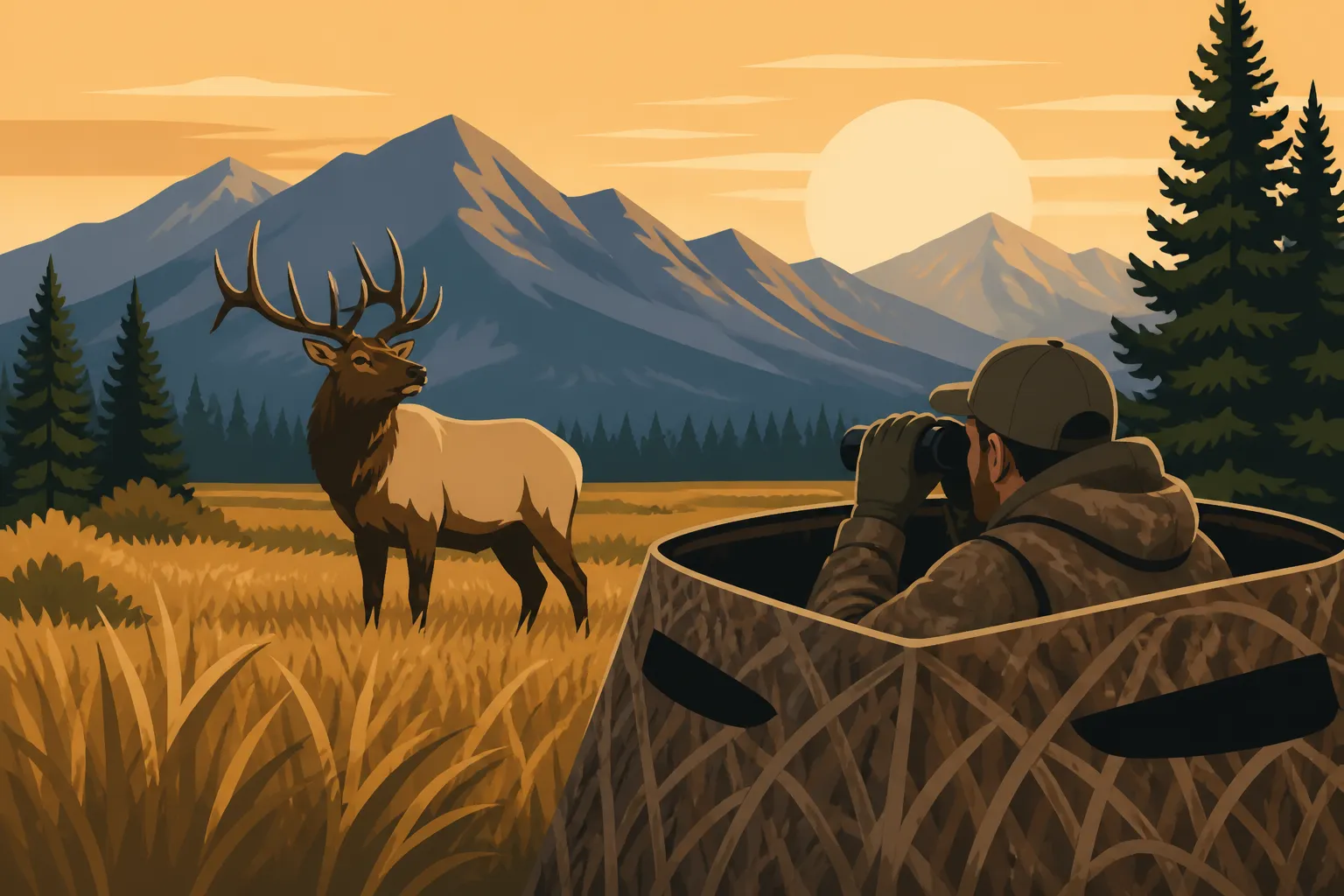
Pop-up blinds, like those from companies such as Primos or Barronett, are highly popular for their portability and quick setup. They fold down into a compact package, making them relatively easy to pack in, though they certainly add weight compared to nothing at all. Once you reach your desired location, most can be set up in mere minutes, providing a fully enclosed, camouflaged structure. These blinds offer excellent concealment, often with black interiors to prevent silhouetting, and multiple window configurations that allow for shooting lanes in various directions. Their main drawback is that they are artificial and require brushing in to blend seamlessly with the environment, and if not brushed in properly, elk can definitely spot them.
Natural blinds, on the other hand, are constructed entirely from materials found in the environment—fallen logs, dense brush, rocks, or even dug-out pits. The biggest advantage here is that they blend in perfectly with the landscape because they are the landscape. They cost nothing but time and effort to build, and they leave minimal impact if disassembled properly. The downside is they take time to construct, might not offer the same level of full enclosure as a pop-up, and won't protect you from the elements quite as effectively. However, for a hunter who values ultralight packing or wants to disappear completely into the habitat, a well-built natural blind is tough to beat. Regardless of the type, consider the blind's size (can you comfortably shoot your bow or rifle inside?), window layout, and durability against the elements. A good blind is one that allows you to remain undetected while giving you a clear shot opportunity when an elk finally steps into range.
Strategic Placement and Setup for Ground Blinds
The success of your ground blind hunt for Montana elk hinges almost entirely on one critical factor: placement. You can have the fanciest blind in the world, but if it's not positioned where elk want to be, it's just a fancy tent. This part of the puzzle requires diligent scouting, an understanding of elk behavior, and a keen eye for terrain features.
Key Locations for Blind Placement
Elk are creatures of habit, driven by food, water, and security. Identifying where these elements intersect is the first step to successful blind placement. One of the most productive locations, especially during dry spells or the early archery season, is near active water sources. Think about those hidden springs, muddy wallows, or small ponds that might not be obvious on a map. Elk, like all animals, need water daily, and a well-placed blind overlooking an active water hole can be deadly. You can learn more about how to capitalize on these spots by checking out our guide on How to Hunt Elk Water Holes in Montana.
Food sources are another prime target. This could be anything from a lush alfalfa field bordering timber, natural clearings with abundant forage, or even a transition zone where different types of vegetation meet. Elk often feed heavily in the evenings and mornings, moving between bedding and feeding areas. Positioning your blind along these travel corridors or at the edge of a feeding area can intercept them during their routine movements. Digital mapping tools, such as GoHunt, are invaluable here. You can use their satellite imagery and topographical maps to e-scout potential feeding grounds, water sources, and natural funnels from the comfort of your home before you even set foot in the field. This also helps you understand Montana Elk Habitat and Elevation and how it dictates where elk will be.
Finally, don't overlook travel corridors. These are natural pinch points, saddles between ridges, narrow timber strips, or creek bottoms that funnel elk movement. These are the highways elk use to get from point A to point B. Setting up your blind along one of these routes, especially where it offers a clear line of sight and shooting lanes, significantly increases your odds. While you should always be cautious around bedding areas to avoid spooking elk, sometimes placing a blind a safe distance away, overlooking a trail leading out of a known bedding thicket, can be effective for catching them as they start their evening movements.
The Art of Concealment and Scent Management
Once you've identified a promising location, the real "art" of blind hunting begins: making your setup completely invisible and odorless to elk. A ground blind, especially a pop-up, sticks out like a sore thumb if it's not properly camouflaged. This is where "brushing in" comes into play. Collect natural vegetation—branches, logs, tall grass, sagebrush—from the immediate area and meticulously weave it into the exterior of your blind. Break up its outline, make it look like just another clump of brush or small thicket. The goal is for an elk to walk right past it and never register it as anything unusual.
Beyond visual concealment, scent management is absolutely paramount, perhaps even more so when you're static in a blind for hours. Elk have an incredible sense of smell, and a single whiff of human odor will send them packing. Always approach your blind from a direction that keeps the wind in your favor, especially during setup and entry. Use scent-free detergents for your hunting clothes, shower with scent-eliminating soaps, and consider using scent-control sprays or even portable ozone generators inside your blind, such as those made by Ozonics, to neutralize any lingering human odor. Check out our detailed article on How to Use the Wind Hunting Montana Elk for more strategies.
Lastly, minimize noise and movement. Everything you do inside that blind—eating a snack, shifting in your chair, reaching for your calls—needs to be done slowly and deliberately. Elk are extremely sensitive to unnatural sounds. Practice opening your blind windows quietly, and make sure any gear you bring in is secured and won't clatter. Remember, the longer you can remain undetected, the higher your chances of success.
Hunting Tactics from a Ground Blind
Once your blind is strategically placed and flawlessly camouflaged, the real test begins: the hunt itself. Hunting from a ground blind requires a different mindset than active stalking or calling from the move. It's a game of patience, subtle communication, and being ready when the opportunity finally arises.
Patience and Persistence
The most critical tactic when hunting from a ground blind is an unwavering commitment to patience. You are essentially waiting for the elk to come to you, which means there will be long stretches of nothing but quiet observation. It's easy to get antsy, check your phone, or fidget, but any unnecessary movement or noise can ruin hours of waiting. Think of it as a meditation, where you are intensely focused on your surroundings, scanning every inch of the landscape within your shooting lanes.
Elk behavior is notoriously unpredictable. They might show up immediately, or they might not appear until the very last minutes of shooting light. They could approach from an unexpected direction, or simply walk through your general area without ever offering a shot. Your job is to be present, observant, and ready for whatever unfolds. This means bringing comfortable gear—a quiet, supportive chair is a must—and snacks and water that can be consumed silently. The more comfortable and still you can be, the longer you can effectively hunt, and ultimately, the better your chances of encountering elk. Remember, a long game from a blind often pays dividends when other methods fail.
Calling and Decoying from a Blind
A ground blind isn't just a hideout; it can also be a fantastic platform for aggressive calling and decoying, particularly during the rut. Being completely concealed gives you a huge advantage when attempting to call in a bull. You can use a variety of calls—from soft cow chirps and mews to aggressive bugles—without worrying about the bull pinpointing your exact location by sight. This allows you to really sell the illusion. Our guide on How to Call Elk in Montana provides excellent techniques to use.
When a bull responds and starts to approach, the blind allows you to continue calling, adjusting your tone and volume as he gets closer, all while preparing for your shot. You can even combine calling with a decoy. Placing an elk decoy, such as a cow or satellite bull, 20-40 yards out in front of your blind can draw an incoming bull right into your shooting lane. He'll focus on the decoy, giving you precious moments to draw your bow or raise your rifle undetected. This combination can be incredibly effective, especially if you're dealing with a hung-up bull who is hesitant to commit. The blind creates a safe zone for you to operate, turning you into a silent, lethal orchestrator of the elk's approach. This tactic is especially potent during the Montana Elk Hunting: Peak Rut.
Shot Opportunities and Ethical Considerations
Hunting from a ground blind introduces unique considerations when it comes to shot opportunities. You'll be shooting through a window or mesh screen, which can limit your field of view and shooting angles. It's absolutely crucial to practice shooting from your blind before the season starts. Set up your blind, get comfortable in your chair, and practice drawing your bow or shouldering your rifle, aiming through the various windows. Pay attention to how your clothing or equipment might snag, or if your broadhead or scope is clearing the window opening.
Knowing your effective range is always important, but even more so from a blind where angles can be deceiving. A rangefinder is an indispensable tool to confirm distances to various landmarks around your blind. When an elk presents itself, prioritize an ethical shot. Wait for the animal to be broadside or slightly quartering away, offering a clear path to the vitals. Don't rush a shot just because the elk is there. Patience, again, is key. If the shot isn't perfect, let the animal pass. The beauty of the blind is you're already concealed, so you might get a second chance, or another elk might come through. Always double-check your surroundings for other elk before and after the shot, and ensure your broadhead or bullet has a clear flight path. This preparation ensures that when the moment arrives, you are ready to make a clean, ethical harvest.
Gear and Preparation for Ground Blind Success
A successful ground blind hunt in Montana requires more than just a blind and a good spot; it demands the right gear and meticulous preparation. Being well-equipped means you can stay comfortable, concealed, and ready for action, no matter how long the wait.
Essential Ground Blind Gear
Beyond the blind itself, there are several pieces of gear that can dramatically enhance your experience and success. First and foremost, a comfortable and quiet hunting chair is non-negotiable. Sitting still for hours on end can be grueling, and a chair that supports your back and allows for minimal, silent movement is vital. Many hunters prefer a low-profile chair that keeps them below the window line of the blind. Don't forget stakes and tie-downs for your pop-up blind; Montana weather can be unforgiving, and a blind that collapses in a gust of wind is no good to anyone.
For those chilly Montana mornings or late-season hunts, a small, portable, scent-free heater can make a world of difference in your comfort and ability to remain on stand. Make sure it's rated for indoor use and that you have proper ventilation. Optics are also essential. High-quality binoculars will help you scan the landscape, pick apart distant cover, and identify elk long before they enter shooting range. A rangefinder is equally important for confirming distances and ensuring ethical shots.
Naturally, your chosen weapon—whether it's a bow, rifle, or muzzleloader—needs to be ready. Ensure it's sighted in and you've practiced shooting from the confines of your blind. Finally, don't forget your calling gear, scent-control products, and a quiet backpack to stash snacks, water, and extra layers. For more ideas on what to pack for extended hunts, refer to our Montana Backcountry Hunting Gear List. Having all these essentials organized and readily accessible but silent within your blind setup will keep you focused on the hunt, not on your discomfort or missing gear.
Scouting and E-Scouting for Blind Locations
Effective scouting is the bedrock of successful ground blind hunting. You can't just throw a blind up anywhere and expect elk to magically appear. Pre-season scouting, both in person and digitally, is absolutely crucial for identifying high-percentage locations.
Physical scouting involves getting boots on the ground long before the season opens. Look for fresh elk sign: tracks, droppings, rubs, and active wallows or bedding areas. Identify well-used game trails that connect bedding, feeding, and watering areas. Set up trail cameras in potential blind locations to confirm elk movement patterns, identify the times they frequent certain spots, and even gauge the age and size of bulls in the area. Pay close attention to prevailing wind directions in potential setups; you'll want to position your blind so that your scent isn't blowing towards where you expect elk to approach.
In conjunction with physical scouting, leverage modern technology for e-scouting. Tools like GoHunt or onX Hunt are incredibly powerful. Use them to analyze topography, identify natural funnels, map out water sources, and pinpoint potential feeding grounds. You can mark waypoints for promising blind locations, plan your approach and exit routes to minimize disturbance, and even assess public land access points. A comprehensive understanding of the terrain, animal behavior, and the movement patterns of elk that you can gain through both e-scouting and on-the-ground investigation, as outlined in guides like How to E-Scout Montana Hunting Units, will significantly increase your chances of placing your ground blind in a high-traffic, high-success area. This preparation not only boosts your odds but also gives you a deeper connection to the land and the animals you pursue.
Ground Blind Comparison for Montana Elk
Choosing between a pop-up and a natural ground blind often comes down to balancing concealment, portability, and protection from the elements. Here's a quick comparison to help you decide which might be best for your next Montana elk hunt:
| Feature | Pop-Up Blind | Natural Blind |
|---|---|---|
| Concealment | Excellent, but requires brushing in | Superior, blends seamlessly with environment |
| Portability | Moderate (folds up, but adds weight/bulk) | High (minimal gear required) |
| Setup Time | Fast (5-10 minutes) | Varies (30 minutes to several hours, depending on size/materials) |
| Cost | Moderate to High ($100 – $400+) | Free (uses natural materials) |
| Weather Protection | Excellent (full enclosure from wind, rain, snow) | Varies (minimal to moderate, less enclosed) |
| Scent Control | Good (can be sealed, some have scent features) | Moderate (more open to air currents) |
| Visibility (Hunter) | Good (multiple windows, black interior) | Varies (depends on construction, can be limited) |
| Flexibility | Can be moved, but setup is loud | Fixed once built |
| Typical Use | Ambush points, water holes, field edges | Anywhere natural cover allows, thick timber, ridges |
Remember, your choice might also depend on the specific type of elk hunt you're planning. For example, a pop-up might be ideal for a quick sit over a water hole in the plains, while a natural blind could be perfect for a multi-day ambush in dense timber.
Disclaimer
Hunting is an inherently dangerous activity. The information provided in this guide is for informational purposes only and is not a substitute for professional instruction, proper training, or adherence to all local, state, and federal hunting regulations. Always prioritize safety, respect wildlife, and obtain the necessary licenses and permits before engaging in any hunting activities. Ensure you are familiar with Montana Fish, Wildlife & Parks regulations and practice ethical hunting at all times.