Montana Elk Habitat and Elevation
It’s a common frustration, isn't it? You scout a promising area in Montana, maybe see some elk sign, but when the season rolls around, they seem to vanish into thin air. A huge part of this puzzle comes down to truly understanding where elk live and how they use the landscape, especially the nuances of their habitat and the critical role elevation plays. This comprehensive guide is here to unravel those mysteries, helping you predict elk movements and find success in Montana’s diverse terrain.
Unpacking Montana's Diverse Elk Habitats
Montana is a mosaic of landscapes, from towering mountain ranges to rolling foothills and sprawling plains. Each offers unique challenges and opportunities, and understanding these different environments is paramount to consistently finding elk. Elk aren't just "mountain animals"; they're incredibly adaptable, and their preferred habitat often shifts with the seasons, hunting pressure, and available resources.
The Timbered High Country
When most people picture Montana elk hunting, they envision dense forests clinging to steep mountainsides. And for good reason! This dark timber is classic elk country, providing essential thermal cover from harsh weather, security from predators (including hunters), and often abundant forage in openings and undergrowth. Elk here often use timbered slopes, saddles, and benches for bedding, moving into adjacent clearings or meadows to feed, especially at dawn and dusk. The thick canopy of lodgepole pine, Douglas fir, and spruce offers them seclusion, making them incredibly difficult to locate without careful scouting and advanced tracking skills. It's not uncommon to walk within a hundred yards of a bedded bull in this kind of cover and never know he's there. This is where learning to move quietly through Montana timber becomes an invaluable skill.
Open Parks and Mountain Meadows
Interspersed within the timbered high country are vital open areas—mountain parks, alpine meadows, and natural clearings. These are often prime feeding grounds, especially during the greener months. Here, elk can graze on a variety of grasses, forbs, and shrubs that thrive with more sunlight. While these areas offer abundant food, they provide little cover. So, elk typically use them cautiously, often feeding during low-light hours or when conditions (like fog or light snow) offer some concealment. During the rut, these open spaces become stages for bugling bulls, where challenges are issued and cows are gathered. Spotting these feeding areas and understanding how elk access them from the timber is a key part of how to glass Montana's big country effectively.
Riparian Zones and Creek Bottoms
Water is life, and elk are no exception. Riparian zones, defined by the presence of water bodies like rivers, creeks, and even small springs, are magnets for elk, particularly during drier times or in areas with limited water sources. These areas often feature lush vegetation, including willows, aspens, and various shrubs, which provide both forage and cover. Elk will utilize these corridors for travel, bedding, and, of course, drinking. In some areas, these creek bottoms can act as critical escape routes or staging areas before moving to higher ground. Hunting elk water holes in Montana can be an incredibly effective tactic, especially during the early season or periods of drought.
Foothills and Sagebrush Steppe
Don't make the mistake of thinking all elk reside in the high mountains! Large populations of elk, particularly in eastern and central Montana, thrive in the rolling foothills and vast sagebrush steppe. Here, the "timber" might be limited to isolated pockets of aspens, cottonwoods along river drainages, or juniper breaks. Elk adapt to these environments by using topography for cover—coulees, draws, and north-facing slopes offer respite from the sun and wind, while the endless sagebrush provides a diverse diet. These areas are often characterized by significant private land holdings, but also include crucial public lands and Block Management Areas that offer excellent opportunities. Understanding how to use Block Management for DIY hunts can unlock access to some fantastic hunting in these zones.
The Critical Role of Elevation in Elk Distribution
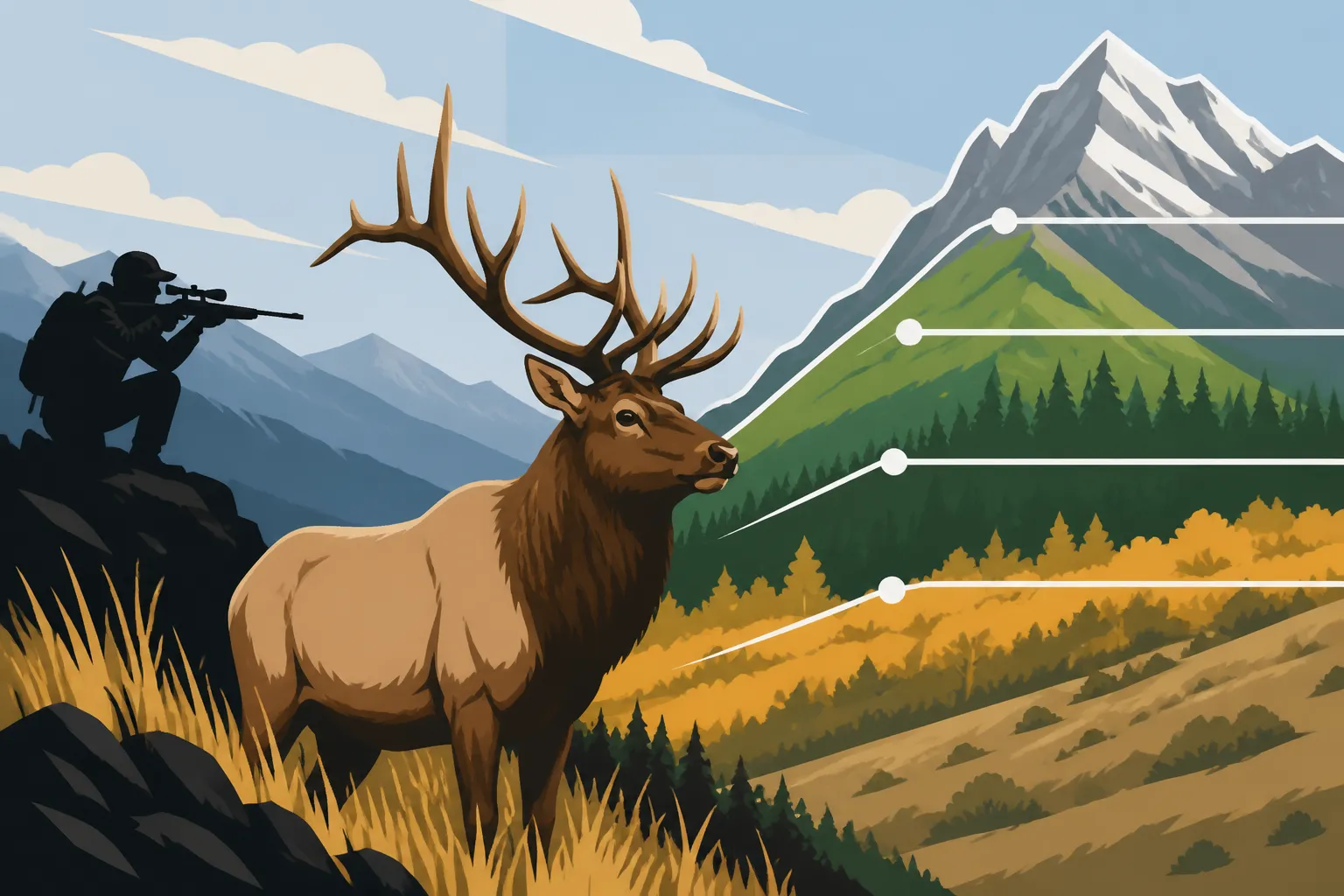
Elevation isn't just a number on a map; it's a dynamic factor that dictates nearly every aspect of an elk's life in Montana, influencing their food sources, cover, and migratory patterns throughout the year. Ignoring the elevation factor is like trying to solve half the puzzle.
Summering Grounds: High and Green
As the snow recedes in late spring and early summer, elk typically follow the green-up, migrating to higher elevations. This high country offers cooler temperatures, fewer biting insects, and a banquet of fresh, nutritious forage. Calving often occurs in these secluded, higher elevation areas, providing cow elk and their newborns safety and plentiful food to regain strength. During this time, you'll find elk in subalpine basins, open alpine meadows, and timbered slopes between 7,000 and 10,000 feet, sometimes even higher depending on the mountain range and snowpack. They are spread out and generally less concentrated than during other times of the year. This is where knowing how to prepare for high-country Montana hunting becomes critical, not just for the hunt, but for understanding elk behavior.
Fall Transition: Following the Feed
As summer wanes and temperatures begin to drop in late August and September, a subtle shift begins. Elk may start to move vertically, sometimes dropping slightly to access prime rutting areas that offer a good mix of feed, water, and cover. This is often dictated by the availability of quality forage. As the high country vegetation browns out and frosts become more frequent, elk will gradually begin their descent. This descent isn't a straight line; it's often a series of stops and starts, influenced by early snows, hunting pressure, and the timing of the rut. Understanding this pre-rut transition is crucial for early archery season success.
Winter Range: Lower and Protected
With the arrival of significant snows and bitter cold, elk undertake their most dramatic elevational migration, moving to designated winter ranges. These are typically lower elevation areas—often south-facing slopes, valley bottoms, or areas with persistent winds that blow snow off crucial forage. Winter ranges are characterized by more accessible food (like browse from shrubs or exposed grasses) and thermal cover (often dense conifers on lower slopes). These lower elevations are critical for their survival through the leanest months. While hunting is often closed or restricted on many designated winter ranges, understanding their location helps predict migratory corridors and late-season staging areas. This knowledge is key to knowing how to hunt Montana's late-season migration.
Seasonal Shifts: Elk Movement Patterns by Elevation
Elk are creatures of habit, but also opportunists. Their reliance on elevation changes dramatically throughout the year, driven by biology, weather, and pressure. Ignoring these seasonal nuances is a surefire way to be hunting in the wrong spot at the wrong time.
Early Season Elk Behavior (Archery)
During the early archery season, typically running from early September into mid-October, Montana elk are often still in their high-elevation summer grounds. They are in bachelor groups (bulls) or cow-calf herds, enjoying the remaining lush feed.
- Higher Elevations (7,000+ feet): Expect to find elk primarily in their summer haunts. Bulls might still be in velvet in the very early days, then moving into hard antler, spending time in high basins, open alpine meadows, and the dark timber adjacent to them. Cows and calves will be in similar areas, focused on feeding and avoiding predation. You might hear the first tentative bugles of the year as bulls begin to test their voices. Learning how to hunt Montana Archery Elk Solo in these high-elevation zones requires top physical conditioning and a mastery of the terrain.
- Mid-Elevations (5,000-7,000 feet): As the season progresses and the rut begins to kick into high gear, elk may start to consolidate and move into mid-elevation areas that offer a better mix of open feeding areas and dense timber for security and breeding activity. This is when you'll find bulls really getting vocal, and the sound carries far across the mountains.
- Hunting Strategy: Focus on covering ground at higher elevations, glassing extensively at dawn and dusk. Pay close attention to north-facing slopes with good timber for bedding. When the rut ignites, listen for bugles and use calling tactics to locate and draw in bulls. Scouting these areas prior to the season with tools like GoHunt can give you a significant advantage, allowing you to pinpoint potential bedding and feeding areas.
Mid-Season Elk Behavior (General Rifle Season)
The general rifle season typically kicks off in late October and runs through November. This period brings increased hunter pressure and often more unpredictable weather, forcing elk to become more wary and adapt their movements.
- Descending Movement: As hunter numbers increase, elk will often start their general migration towards winter ranges. However, this isn't always a direct route down. They may hold in mid-elevation pockets, using thick cover, especially north-facing slopes and dark timber, to avoid detection. They become masters of using topography to their advantage, often staying just over a ridge or on a steep, inaccessible face.
- Pressure Points: Areas with easy access or high hunter traffic will see elk quickly moving to thicker cover or more remote, higher elevations that hunters are less willing to penetrate. This is when you might find elk taking refuge in steep, deep canyons or the densest timber stands.
- Hunting Strategy: Mobility and adaptability are key. Be prepared to hunt multiple elevations. While some elk may still be found at higher elevations, especially early in the season or after a fresh snow, many will be transitioning downwards. Focus on finding untouched pockets of timber, steep terrain, or deep drainages where elk seek refuge. Understanding how to hunt elk in Montana rifle season pressure is crucial, as elk will often become nocturnal or move into seemingly impossible terrain to escape.
- Weather Impact: Early season snow can push elk down quickly, making for excellent hunting. Conversely, a mild fall might keep them higher longer. Always check the forecast and be prepared for anything, from Indian summer days to blizzards.
Late-Season Elk Behavior
Late season, generally in December, is often characterized by significant snowpack, extremely cold temperatures, and elk concentrated on their winter ranges.
- Winter Range Concentration: Elk will be primarily on their traditional winter ranges, which are typically lower elevation, south-facing slopes, and valley bottoms where forage is more accessible and thermal cover is abundant. They will be focused on conserving energy and finding enough food to survive.
- Migration Corridors: Identifying major migration corridors between higher summer ranges and lower winter ranges can be extremely productive. Elk will use the path of least resistance, often following old game trails or natural benches.
- Hunting Strategy: This is often a tough hunt due to harsh conditions, but can be very rewarding. Focus on locating winter range areas where hunting is still allowed. Glassing these lower elevation, exposed slopes from a distance can be effective. Elk will often be grouped up, making them easier to spot once found. However, approaching them in open terrain requires extreme stealth.
- Table: Seasonal Elk Elevation Preferences in Montana
| Season | Typical Elevation Range | Habitat Focus | Key Behavior / Strategy Notes |
|---|---|---|---|
| Early Archery (Sep-Mid Oct) | 6,000 – 10,000+ feet (depending on range) | High alpine meadows, subalpine timber, cool, north-facing slopes, water sources. | Elk spread out, feeding heavily. Bulls in bachelor groups, cows in herds. Rut activity increases mid-season. Focus on glassing high, covering ground, calling to locate. Use tools like GoHunt for mapping historical elk ranges and terrain features. |
| General Rifle (Late Oct-Nov) | 4,000 – 8,000 feet (transitional, pressure-dependent) | Mid-elevation timber, dense canyons, north-facing slopes for thermal/security cover, benches. | Elk reacting to pressure, gradually moving down. Can be found high or low. Focus on thick cover, steep terrain. Be prepared for varied weather. Mobility is crucial. |
| Late Season (Dec) | 3,000 – 6,000 feet (established winter range) | Lower elevation, south-facing slopes, valley bottoms, riparian areas, dense thermal cover. | Elk concentrated on winter ranges, focused on survival. Migration corridors are key. Glassing large areas from a distance. Often grouped up. Expect deep snow and cold. Access may be challenging. |
Practical Strategies for Hunting Elk Based on Habitat and Elevation
Successfully hunting elk in Montana is less about luck and more about applying a deep understanding of their behavior relative to their environment. It’s about being a student of the land and the animals.
E-Scouting and Topographic Analysis
Before you even set foot in the field, modern tools can give you a massive head start. Websites and apps like GoHunt are invaluable for e-scouting, allowing you to analyze topography, identify potential bedding and feeding areas, and map out access routes.
- Elevation Bands: Use the contour lines to define elevation bands that correspond to different seasonal ranges. Look for natural funnels, saddles, and benches within those bands. A saddle at 8,000 feet might be a perfect spot during the early rut, while a bench at 6,000 feet with dense timber could be a mid-season holding spot.
- Aspect and Cover: Identify north-facing slopes, which tend to hold snow longer in spring and provide cooler, denser cover in summer and early fall. South-facing slopes, conversely, warm up faster and offer crucial forage during winter. Look for areas with a mosaic of dense timber and open parks—this provides both food and security. Understanding how to E-Scout Montana Hunting Units can save you days of wasted effort in the field.
- Water Sources: Pinpoint perennial water sources using map layers. Elk will never be far from water, and these spots can be excellent ambush points or indicators of nearby bedding areas.
On-the-Ground Reconnaissance
Nothing beats boots on the ground, but knowing where to focus your efforts is critical.
- Reading Sign: When you're in the field, constantly assess the sign you find. Fresh tracks, droppings, rubs, and wallows tell you not only that elk are in the area, but also what they're doing and which direction they're heading. Are the tracks heading uphill towards timber, or downhill towards water?
- Thermals and Wind: In mountainous terrain, thermals dictate air movement—warm air rises during the day, cool air sinks at night. Elk are masters of using these air currents to detect predators. Plan your approaches to account for thermals and the prevailing wind. On a warm morning, approaching an uphill bedding area from below might blow your scent right to them. Similarly, how to use the wind hunting Montana elk is a skill that takes years to master.
- Adapting to Pressure: Elk are incredibly sensitive to hunter pressure. If you're hunting an area receiving a lot of attention, expect elk to move into the thickest, nastiest timber or the steepest, most remote terrain they can find. This is where your physical fitness and willingness to go the extra mile will pay off. Consider targeting areas with low hunter pressure if possible.
Integrating Habitat and Elevation with Hunting Methods
Your hunting method should always align with the habitat and elevation you're targeting.
- Spot and Stalk: This method shines in open alpine basins, high mountain meadows, and the rolling sagebrush foothills. It requires excellent optics, patience, and the ability to cover ground silently. For example, if you're trying to spot-and-stalk Montana mule deer, you'd be looking at similar open terrain.
- Calling: During the rut, calling is highly effective, especially in timbered areas where visibility is limited. Learning how to call elk in Montana, whether it's bugling or cow calling, can bring a bull right into your lap. Often, bulls respond best in mid-elevation areas where the sound can carry.
- Still Hunting and Ambush: In dense timber, still hunting (moving slowly and deliberately) can be incredibly effective. Pay attention to how to still-hunt Montana timber by taking a few steps, then pausing for several minutes to scan for movement or listen for sounds. Ambush tactics work well along travel corridors, near water sources, or where elk transition between bedding and feeding areas.
- Backcountry Hunts: For the ultimate immersion, a Montana backcountry hunting guide can lead you into remote wilderness areas where elk face minimal pressure and adhere more closely to natural patterns of habitat and elevation use. These hunts require significant physical preparation and specialized gear, but the rewards can be unparalleled.
Remember, every year is different. Snowpack, rainfall, fire activity, and hunting pressure will all influence where elk are found at various elevations. The most successful hunters are those who adapt their strategies based on real-time observations and a deep, intuitive understanding of Montana's incredible elk country.
Disclaimer
Please note that hunting regulations, season dates, and specific unit boundaries in Montana are subject to change annually. Always consult the most current Montana Fish, Wildlife & Parks (FWP) regulations before planning any hunting trip. This guide provides general information and recommendations, but it is the hunter's responsibility to comply with all applicable laws and regulations.