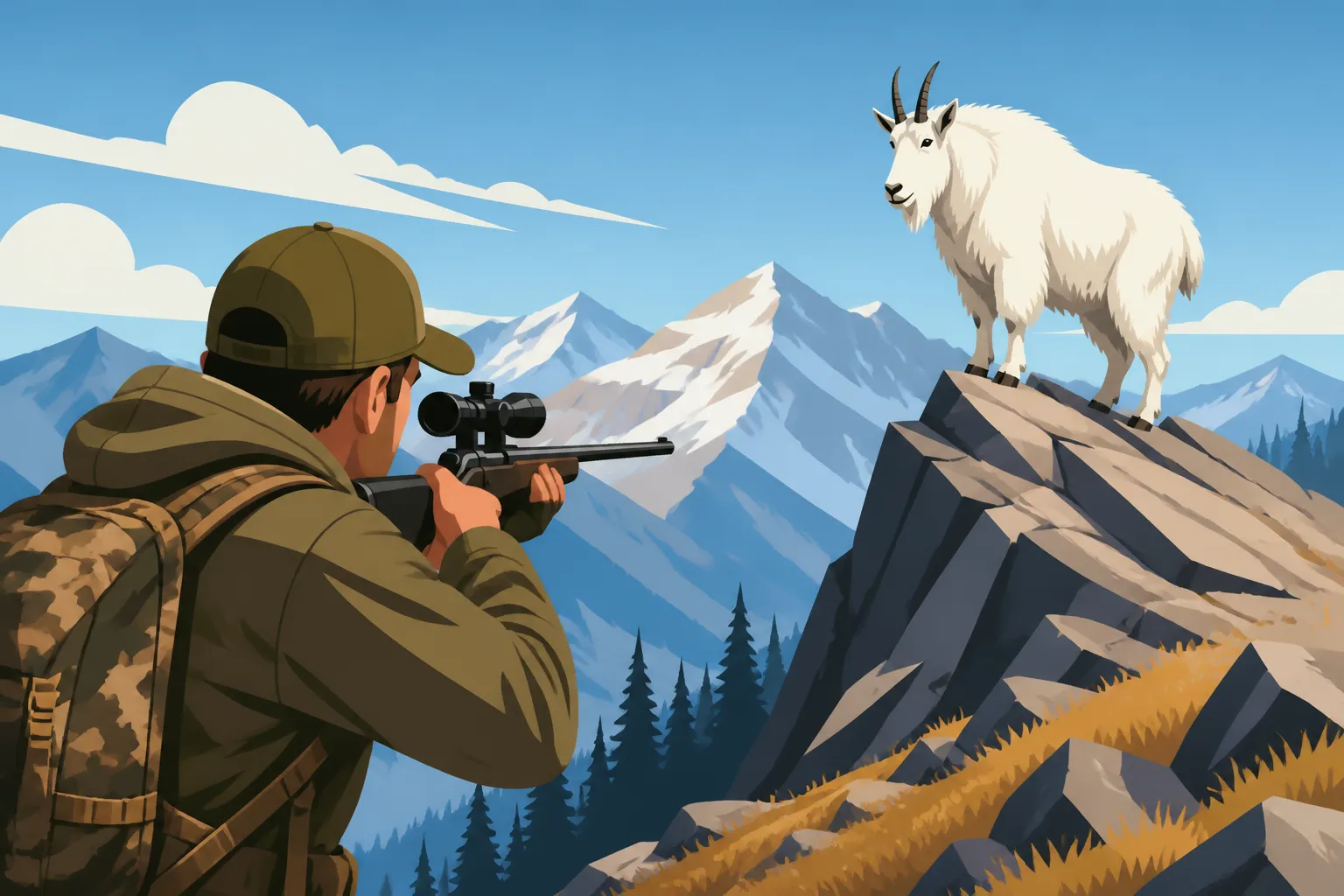
How to Hunt Mountain Goat in Montana
Hunting mountain goats in Montana is an aspiration for many, but it's often viewed as an almost mythical quest due to the incredibly challenging terrain and the extreme difficulty of drawing a tag. If you've ever found yourself staring at a distant, impossibly white speck on a jagged cliff face, wondering how anyone could ever get there, you're not alone. This guide aims to pull back the curtain on what it truly takes to embark on one of the most physically and mentally demanding hunts Montana has to offer, from the draw odds to the demanding stalk.
The Pursuit of a Montana Mountain Goat Tag
Drawing a mountain goat tag in Montana is a monumental achievement in itself, often taking years, if not decades, of dedicated application. These animals inhabit some of the state's most remote and rugged high-alpine environments, and the limited number of tags issued each year reflects both their sensitive populations and the unique challenges of hunting them. It’s not just a hunt; it’s an expedition into the very heart of the Rocky Mountains, requiring meticulous planning, unwavering patience, and a healthy dose of luck in the draw.
Understanding Montana's Mountain Goat Draw System
Montana's mountain goat tags are part of a highly competitive lottery system, making it one of the most coveted permits in the state. Unlike some other species, nonresident hunters face extremely limited quotas, often vying for a single digit number of tags across all districts. The system primarily uses bonus points, which accumulate with each unsuccessful application, theoretically increasing your odds over time. However, it's crucial to understand that even with a significant number of bonus points, the draw remains largely a game of chance. Each point you have simply adds your name to the hat an additional time, but it doesn't guarantee success. Many dedicated hunters apply for a lifetime without ever drawing this coveted tag.
Before you even think about buying specific gear or planning your ascent, you need to understand the application timeline and district specifics. The application period for these highly sought-after permits typically falls in the spring, with results usually announced in early summer. It’s vital to research the specific hunting districts (HDs) you're interested in, as quotas, success rates, and even the physical nature of the terrain can vary significantly. Some districts might offer a slightly better chance than others due to accessibility or lower goat densities, but overall, it's a tough draw. Consulting resources like GoHunt, which compiles historical draw odds and provides detailed unit analyses, can be invaluable for strategizing your application. You can learn more about the overall process in our guide on how to apply for a Montana hunting license.
Physical and Mental Preparation for High-Country Hunting
Even if you beat the odds and secure a tag, the real work has only just begun. Mountain goat hunting is arguably the most physically demanding big game hunt in North America. These animals live at extremely high elevations, often above timberline, in truly unforgiving landscapes of jagged peaks, scree fields, and treacherous cliffs. This isn't a walk in the park; it's a vertical marathon at oxygen-deprived altitudes. Your physical conditioning needs to be top-notch, focusing on cardiovascular endurance, leg strength, and ankle stability. Training should include strenuous hikes with a heavily loaded pack, mimicking the weight you'll carry into and out of the mountains.
Beyond the physical, the mental game is equally critical. You'll face unpredictable weather that can change from sunny and calm to blizzard conditions in minutes, extreme exposure, and the ever-present risk of injury in rugged terrain. The hunt can involve days of intense climbing, glassing for hours on end, and then a brutal stalk over unstable ground. It requires resilience, patience, and a strong will to push through discomfort and potential setbacks. Many hunters find that the experience of a Montana backcountry hunting guide can offer significant advantages for these extreme expeditions, providing both physical and navigational support in such demanding environments.
Essential Gear for Montana Mountain Goat Expeditions
Success in mountain goat country hinges just as much on your gear choices as it does on your physical prowess and hunting skill. The brutal, exposed high-alpine environment demands equipment that is lightweight, durable, and utterly reliable. Cutting corners here can lead to anything from discomfort to life-threatening situations. Think of every item in your pack as a piece of a carefully engineered system designed to keep you safe and effective in some of the wildest places Montana has to offer.
Optics: Your Eyes in the Alpine World
When hunting mountain goats, your optics aren't just an accessory; they are your primary hunting tool. These animals blend remarkably well with their rocky surroundings, and often the only way to find them is to meticulously glass vast expanses of vertical terrain from afar. A high-quality spotting scope is non-negotiable for identifying goats, assessing their size, and determining potential access routes. Look for a scope with a large objective lens (65-85mm) for excellent light gathering, and a magnification range that allows you to scan wide areas (15-20x) and then zoom in for detail (up to 60x or more). Paired with a sturdy, lightweight tripod, a spotting scope will save you countless miles of unnecessary climbing.
Your binoculars are equally important for constant scanning. A 10×42 or 12×50 power is a good balance of magnification and field of view for this type of hunting. Many hunters also swear by binocular harnesses to keep their glass secure and readily accessible, especially when navigating steep, broken ground. Brands like Swarovski, Zeiss, and Vortex are popular choices among serious mountain hunters for their clarity, durability, and low-light performance. It’s a significant investment, but superior optics are a game-changer when you're glassing from distant ridges. Our detailed guide on best optics for Montana big game provides more insights into making the right selection.
| Optic Type | Magnification Range | Key Benefits | Considerations |
|---|---|---|---|
| Binoculars | 8x-12x | Wide field of view, quick scanning, handheld | Less detail at extreme distances |
| Spotting Scope | 15x-80x | Extreme detail at long ranges, precise identification | Requires tripod, heavier, slower to deploy |
| Rangefinder | N/A | Critical for accurate shot placement in steep terrain | Integrated into binoculars or standalone unit preferred |
Clothing and Backpacking Systems
The weather in mountain goat country is famously fickle. You can experience all four seasons in a single day, from scorching sun to freezing rain and snow. Layering is not just a suggestion; it's a survival strategy. Start with a moisture-wicking base layer, add insulating mid-layers like fleece or down, and top it off with a bombproof waterproof and windproof shell. Ensure your shell layers are breathable to prevent sweating out during climbs, which can quickly lead to hypothermia when you stop moving. Merino wool is a fantastic material choice for base and mid-layers due to its warmth-to-weight ratio and odor-resistant properties.
Your backpack is another critical piece of equipment. It needs to be comfortable enough to carry heavy loads over extreme terrain for days on end, yet durable enough to withstand scrapes against rock and abrasive elements. A pack in the 65-80 liter range is generally suitable for multi-day trips. Look for features like an external frame or a robust internal frame system that can effectively transfer weight to your hips, generous lashing points for awkward loads like a spotting scope or a rifle, and easy access to water. Mystery Ranch and KUIU are well-regarded brands among backcountry hunters for their ergonomic designs and rugged construction. Don't forget a sturdy pair of mountain boots with excellent ankle support and stiff soles for traversing rocky, uneven ground. These should be well broken-in long before your hunt begins. A good resource for understanding pack considerations is our guide on the best backpack for a Montana elk hunt, as many principles apply.
Weapon Choice and Considerations
Given the challenging terrain and the often long distances at which goats are spotted, rifle hunters typically favor calibers that offer flat trajectories and sufficient energy for tough game. Calibers like .270 Win, .30-06, 7mm Rem Mag, and .300 Win Mag are common choices. Accuracy is paramount; a precise shot can prevent a goat from falling into an inaccessible chute or off a cliff. Practice shooting from various field positions, including prone, kneeling, and using your pack as a rest, as you’re unlikely to find a perfectly flat bench rest in the mountains. Long-range shooting can be a consideration, but remember ethical shot distances, especially on such a unique and hard-earned tag. Understanding Montana long-range shooting considerations is key.
Archery hunting for mountain goats presents an even greater challenge, pushing the limits of physical and mental endurance. Stalking within bow range on open, vertical terrain is incredibly difficult and often requires superior patience and stealth. Broadhead selection is critical; a sharp, penetrating broadhead is essential for effective energy transfer on a tough, thick-skinned animal. If you plan to archery hunt, be prepared for even more arduous stalks and potentially multiple failed attempts before you get a viable shot opportunity.
Strategies for Locating and Approaching Mountain Goats
Finding a mountain goat in its natural habitat is an exercise in extreme patience and keen observation. Their white coats, while striking against dark rock, can disappear against snowfields or patches of white lichen. Once spotted, the challenge shifts to developing a safe and effective plan to get within range, always prioritizing your safety and the ethical harvest of the animal.
Reading Mountain Goat Habitat
Mountain goats are true high-country specialists, living year-round in alpine and subalpine environments. They prefer steep, rugged cliffs, rocky outcrops, and high basins, often above 8,000 feet in elevation. Look for areas with abundant cliffs, ledges, and rocky escape terrain mixed with pockets of alpine forage. North-facing slopes often hold snow later in the season, providing cooler bedding areas, while south-facing slopes might offer more sun and earlier vegetation growth. During late summer and fall, you might find them feeding on tender grasses, forbs, and lichens in alpine meadows adjacent to their preferred rocky sanctuaries.
E-scouting tools like onX Hunt or GoHunt maps are indispensable for identifying potential goat habitat before you ever step foot in the field. You can analyze topography, look for extreme contours, and mark potential bedding and feeding areas. Understanding the general Montana mountain goat range and districts will also help narrow down your focus areas. However, nothing beats putting boots on the ground and spending time glassing once you're in the unit. Pay attention to water sources, even small seeps on cliffsides, as goats need water just like any other animal, though they can often obtain it from snow and vegetation.
Effective Glassing and Stalking Techniques
Upon arrival in your hunting district, your first priority is to establish a high vantage point that offers expansive views of goat habitat. This could mean climbing to a prominent ridge or peak that overlooks several basins and drainages. Once there, set up your spotting scope and systematically grid the terrain. Start close and work your way out, slowly scanning every rock band, every patch of snow, every tiny green spot. Use your binoculars for quick scans and the spotting scope for detailed examination of anything suspicious. Remember, a goat might just be a tiny white dot initially, so train your eyes to differentiate between rocks, snow patches, and actual animals.
Once you’ve located a goat, the stalking begins. This is where the physical and mental preparation truly come into play. Always assess the wind direction, as goats have an excellent sense of smell. Plan your approach carefully, taking into account the goat's likely escape routes and any potential hazards in your path. This often involves significant elevation changes, traversing loose scree, and climbing steep rock. Move slowly and deliberately, paying close attention to every foot placement. It’s not uncommon for a stalk to take many hours, or even an entire day, to cover relatively short distances in linear terms. The key is to maintain a low profile and use the terrain to conceal your approach. Knowing how to use the wind hunting Montana elk offers transferable skills for any high-country pursuit.
Ethical Shot Placement and Considerations
Mountain goats are incredibly tough animals, built to withstand harsh alpine conditions. Their thick hide, dense muscle, and often deep chest cavity mean they can absorb a lot of punishment if a shot isn't placed perfectly. The ideal shot is a broadside or quartering-away shot targeting the vital organs: heart and lungs. Due to their unique anatomy and often being spotted high on cliffs, a goat that takes a marginal hit can easily disappear over a ledge or into an inaccessible chasm, leading to a lost animal. It's crucial to be absolutely confident in your shot before pulling the trigger or releasing an arrow.
Consider the goat's position relative to its surroundings. If a goat is standing on a narrow ledge above a sheer drop, even a perfectly placed shot might result in it falling into an unrecoverable area. Wait for a goat to move to a safer, more accessible location if possible. This patience can be agonizing, especially after a long, arduous stalk, but it's essential for an ethical harvest and successful recovery. Take your time, control your breathing, and ensure a solid rest.
Post-Harvest and Field Care in Extreme Terrain
You've done it. You drew the tag, endured the climb, made the shot, and your mountain goat is down. Now comes another monumental challenge: caring for your hard-earned trophy and meat in some of the most difficult conditions imaginable. This stage often presents more physical and logistical hurdles than the hunt itself.
Field Dressing and Quartering in the High Country
The moment of truth arrives, and the immediate task is to get to your animal quickly and safely. The terrain around a downed goat can be as treacherous as the climb to get there. Assess the stability of the ground, always prioritize safety, and approach cautiously. Once you reach the animal, your first priority is to field dress it to begin the cooling process. Removing the entrails helps cool the carcass and lightens the load.
Next, you'll need to quarter the animal for packing. This typically involves removing the four legs, backstraps, tenderloins, and neck meat. The hide, especially if you plan to cape it for a life-size or shoulder mount, needs careful attention. The thick, white hide of a mountain goat is a prized trophy, but it's also heavy. Knowing how to quarter an elk in the Montana backcountry provides excellent foundational knowledge, as the principles are similar, though a goat is significantly smaller. Be prepared to work quickly and efficiently, as weather conditions can change rapidly, and leaving meat exposed to the elements or scavengers is not an option.
Packing Out: The Ultimate Test
Packing out a mountain goat is arguably the most physically demanding aspect of the entire hunt. You'll be carrying a significant amount of weight—meat, hide, skull, and your gear—over the same steep, rugged, and potentially unstable terrain you just navigated on the way in. A mature billy goat can weigh over 200-300 pounds live weight, yielding a substantial load of meat and cape. Divide the load among your hunting partners if possible, or be prepared for multiple trips if hunting solo.
Invest in high-quality game bags to protect the meat from dirt, insects, and contamination. Keep the meat cool as much as possible; if temperatures are warm, you might need to find shady spots or use snow if available. The descent is often more dangerous than the ascent, as fatigue sets in and footing becomes even more critical. Take your time, use trekking poles for stability, and be mindful of every step. This is where excellent boots and a well-fitting, sturdy backpack truly earn their keep. Knowing how to pack out an elk in Montana can be an invaluable skill set, given the similar arduous conditions.
Trophy Care and Preservation
The thick, luxurious white cape of a mountain goat is a stunning trophy. Proper field care of the hide is essential for a quality taxidermy mount. If you're doing a shoulder mount, learn how to make the correct cuts to ensure you have enough cape. For a life-size mount, the entire hide will need to be carefully removed. Get the hide off the animal and cooled as quickly as possible. Scrape off any excess flesh or fat from the skin and salt it generously to begin the curing process.
If you are far into the backcountry and unable to get the hide to a freezer quickly, you may need to thoroughly salt it and roll it up to prevent spoilage. Carry a sufficient amount of fine-grained salt specifically for this purpose. The skull, especially with its sharp black horns, also needs careful handling. Ensure you protect the horns from damage during the pack out. This isn't just about bagging an animal; it's about honoring the challenge and the animal by preserving it properly.
Disclaimer
Hunting is an inherently dangerous activity. This guide provides general information and should not replace proper training, local regulations, or professional guidance. Always prioritize safety, adhere to all Montana Fish, Wildlife & Parks regulations, and ensure you have the necessary skills and equipment before venturing into the backcountry. Weather conditions in mountain goat country can change rapidly and unexpectedly, posing significant risks.