How to Hunt Montana Whitetail from a Tree Stand
Hunting Montana whitetail from a tree stand can feel like a completely different world than chasing elk in the mountains or antelope on the plains. Many hunters, especially those new to the state or unfamiliar with whitetail habits here, struggle to pinpoint where these elusive deer hide and how to effectively set up for a shot. This guide will walk you through the nuances of successful tree stand hunting for Montana whitetail, from understanding their habitat to essential safety practices, so you can confidently hang your stand and fill your tag.
Understanding Montana Whitetail Behavior for Tree Stands
Before you even think about hanging a stand, you need to think like a whitetail. These deer are creatures of habit, driven by food, water, security, and the powerful urge to breed during the rut. Montana's diverse landscape means whitetail behavior can vary, but certain principles hold true, especially when considering tree stand placements.
River Bottoms and Agricultural Edges
Montana's whitetail population thrives in very specific types of habitat, far removed from the high-country elk haunts many people associate with the state. The most common and productive areas are the dense, riparian zones along rivers, creeks, and smaller drainages. These "river bottoms" provide everything a whitetail needs: abundant forage, constant water sources, and, critically, thick cover for bedding and escaping predators or pressure. You'll find a labyrinth of willows, cottonwoods, dense brush, and tall grasses that offer perfect sanctuary.
Beyond the river bottoms, whitetails frequently utilize the edges of agricultural fields. Whether it's alfalfa, corn, or winter wheat, these fields are a massive food source. The deer will bed in the adjacent river bottom or wooded cover during the day and move into these fields to feed primarily at dusk and dawn. Understanding these travel corridors between bedding and feeding is absolutely paramount for effective tree stand placement. A good scouting tool like GoHunt's mapping platform can help you identify these transition areas and pinch points by analyzing satellite imagery and terrain features. The key is to find those hidden trails and crossings where deer are funnelled into a predictable path. To dive deeper into these specific habitats, check out our guide on how to hunt whitetail in Montana river bottoms.
Rutting Behavior and Timing
The whitetail rut is arguably the most exciting — and often the most productive — time to be in a tree stand. During this period, bucks, normally extremely cautious and nocturnal, throw caution to the wind as they actively search for receptive does. This heightened activity makes them more susceptible to patterned movements, especially around known doe bedding and feeding areas. In Montana, the peak of the whitetail rut typically falls from late October through mid-November, though significant activity can stretch a couple of weeks on either side, depending on localized weather and herd dynamics.
Before the rut truly kicks off, you'll see a "pre-rut" phase where bucks are laying down rubs and scrapes, marking their territory, and flexing their dominance. This is an excellent time to target scrapes and rub lines from a stand, as bucks will frequently check these signposts. Once the does come into estrus, bucks become even more erratic and mobile, constantly moving. Positioning your stand along major travel corridors, especially those connecting multiple doe groups or bedding areas, can be incredibly effective. Bucks will cruise these areas hoping to intercept a hot doe. Understanding when to hunt Montana whitetail during the rut can make all the difference, transforming a slow hunt into a memorable encounter. Our detailed article on Montana whitetail rut timing provides more specific insights into these critical windows.
Choosing the Right Tree Stand Location in Montana
Choosing where to hang your tree stand is arguably more important than the stand itself. A poorly placed stand, no matter how comfortable or expensive, will yield little success. Conversely, a well-placed stand in a high-traffic area can turn an average hunter into a successful one. It all comes down to careful observation, strategic thinking, and leveraging the landscape.
Key Elements of an Effective Stand Site
When scouting for a tree stand location, you're looking for natural bottlenecks that concentrate deer movement. Think about pinch points, where two pieces of cover narrow, forcing deer through a tight corridor. Funnels, such as fences, distinct terrain features, or dense lines of trees between open fields, also serve this purpose. Transition zones, where different habitat types meet (like a river bottom meeting a crop field), are goldmines. Deer will often travel these edges for security while moving between food and bedding.
Don't forget rub lines and scrape lines. While a single rub might not mean much, a series of fresh rubs indicating a buck's travel path can be a prime spot. Scrapes, particularly large, active community scrapes, are like deer bulletin boards and warrant a stand nearby.
Crucially, you must consider wind and thermals, especially in Montana's often-unpredictable conditions. Even in relatively flat river bottoms, cool air sinks (down-drafts) in the morning and warm air rises (up-drafts) in the evening. Your stand needs to be positioned so your scent is carried away from known deer travel routes and bedding areas. A common mistake is setting up where the wind is right now rather than where it will be when the deer are moving. Always aim to hunt with the wind in your face or quartering away from where you expect deer to approach. GoHunt mapping tools, with their wind direction overlays, can be incredibly helpful for planning approaches and stand placements that account for these variables. Even for elk hunters, understanding how to use the wind hunting Montana elk offers transferable lessons for deer.
Scouting and Pre-Season Preparation
Successful tree stand hunting for whitetail starts long before the season opener. Pre-season scouting is absolutely critical, but it must be done carefully to avoid disturbing the deer. Focus on glassing from a distance, using binoculars and spotting scopes to observe deer entering and exiting fields, identifying bedding areas, and noting travel patterns without leaving your scent. Once you've identified potential areas, a more intrusive ground scout might be necessary to confirm trails, rubs, and scrapes, but keep these visits brief and strategic, ideally after a rain to wash away your scent.
Trail cameras are an invaluable asset. Place them on well-used trails, near scrapes, or at the edges of food sources. They act as your eyes in the woods, providing intelligence on what deer are using the area, when they're moving, and even helping you identify specific bucks. Be patient and disciplined with trail camera checks, only visiting when the wind is favorable and ideally during the middle of the day when deer activity is minimal. Identifying thick cover for bedding and attractive food sources (like alfalfa, clover, or mast crops if available) will guide your stand placement. Your stand should be along the most likely travel route between these two critical areas. For more general scouting tips, our guide on how to locate Montana elk before opening day offers principles that apply equally well to deer.
Types of Stands and Access
When it comes to tree stands, you have a few main types, each with pros and cons for Montana whitetail hunting:
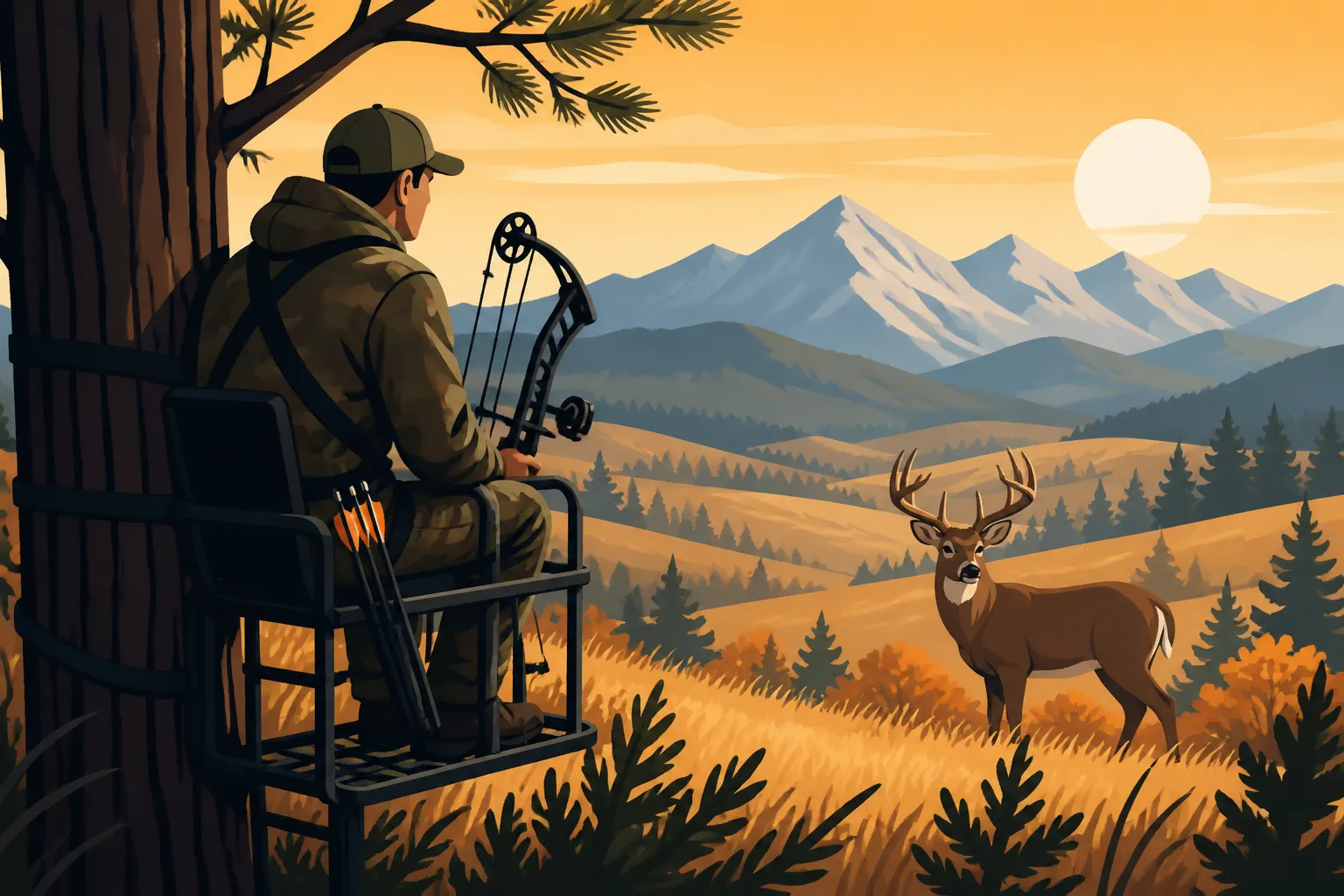
- Hang-On Stands: These are popular for their versatility. You hang them with straps or chains and often use climbing sticks or screw-in steps to get up. They are relatively lightweight and can be left in place (if permitted on public land) or moved. They offer flexibility for precise placement on specific trees.
- Climbing Stands: Ideal for mobile hunters, these stands allow you to climb specific trees with a relatively clear trunk, making them excellent for run-and-gun tactics or hunting different spots daily. They require a specific type of tree, which might limit options in some Montana whitetail habitats.
- Ladder Stands: These offer unmatched stability and comfort, making them great for long sits. They are heavier and more cumbersome to set up, usually requiring two people. Once placed, they are fixed, so they're best for proven, high-traffic spots you plan to hunt repeatedly.
Regardless of the stand type, your entry and exit routes are critical. Deer are highly sensitive to pressure. A great stand location is useless if you spook deer on your way in or out. Plan a route that avoids known bedding areas, uses natural cover for concealment, and leverages terrain to mask your presence. Often, this means taking a longer, roundabout way to your stand. GoHunt's detailed maps can assist in identifying the most discreet routes to and from your chosen stand location, ensuring minimal disturbance.
| Stand Type | Mobility | Setup Effort | Ideal Use Case | Pros | Cons |
|---|---|---|---|---|---|
| Hang-On | High | Moderate | Pre-scouted, specific trees | Lightweight, versatile, precise placement | Requires climbing sticks/steps, can be noisy if not secured |
| Climbing | Very High | Fast (once mastered) | Mobile hunting, adapting to changing patterns | Quick setup, self-contained, no extra steps | Limited to straight, limb-free trees |
| Ladder | Low | High | Fixed, long-term spots, comfort | Very stable, comfortable, easy access | Heavy, bulky, limited to accessible trees, less stealthy |
Setting Up and Hunting from Your Tree Stand
Once you’ve done your homework and picked a spot, the actual setup and execution from the stand need careful attention. This isn't just about hanging a stand; it's about making yourself an invisible, quiet, and effective hunter.
Optimal Stand Height and Shooting Lanes
The age-old question for tree stand hunters: how high is high enough? Generally, 15 to 20 feet off the ground is a good starting point for most whitetail hunting in Montana. This height provides a good vantage point, helps keep your scent above the deer's nose, and puts you above their direct line of sight. However, the optimal height depends heavily on the specific tree, the surrounding cover, and the terrain. If you're in a dense river bottom with a lot of undergrowth, you might need to go a bit higher to see over the brush. In more open woods, 15 feet might suffice if the canopy breaks up your silhouette well.
Once at your desired height, you need to meticulously trim shooting lanes. This should always be done before the season, ideally during summer or early fall, to allow deer to get used to the changes and for your scent to dissipate. Trim only what's necessary to give you clear, ethical shots from all angles you anticipate deer approaching. Focus on lanes directly beneath your stand for close encounters, and lanes out to your maximum ethical shooting distance (e.g., 30-40 yards for archery, further for rifle). Remember, the angle from a tree stand is steep; what looks like a clear shot from the ground might be obstructed by branches or the deer's back from above. Always err on the side of caution.
Scent Control and Concealment
Whitetails have an incredible sense of smell, far superior to ours. Effective scent control is not an option; it's a requirement. Start with laundry detergent specifically designed for hunting clothes, avoid using scented soaps or deodorants, and shower with unscented products. Store your hunting clothes in airtight bags or containers with natural elements like pine needles or cedar. When heading to your stand, spray down with a quality scent eliminator.
However, the most important aspect of scent control is playing the wind. No amount of spray or carbon clothing will completely eliminate your scent. Always check the wind direction before heading out and ensure your stand is positioned downwind of where you expect deer to approach or bed. If the wind shifts unfavorably, it's often better to move to another stand location or even call off the hunt rather than risk spooking deer. For a deeper understanding of this critical aspect, consider our article on how to use the wind hunting Montana elk, as the principles are identical for deer.
Beyond scent, visual concealment is key. Choose a tree with natural cover, like heavy foliage or multiple trunks, to break up your silhouette. Wear camouflage that matches your environment (e.g., leafy patterns for early season, more drab for late fall). Minimize movement in the stand; even small movements can catch a deer's eye, especially if they are looking in your direction.
Calling and Decoying Strategies from a Stand
While often associated more with elk, calling can be a highly effective tactic for whitetail from a tree stand, especially during the rut.
- Grunts: A buck grunt can simulate a buck cruising for does or a younger buck challenging a dominant one. Short, sharp grunts can stop a deer for a shot, while longer, trailing grunts can pique a buck's curiosity and draw him closer.
- Bleats: Doe bleats, especially a fawn distress bleat, can often draw in does, and where there are does, bucks will follow. An estrus bleat can directly signal a receptive doe to a nearby buck.
- Rattling: Simulating two bucks fighting can be incredibly effective during the pre-rut and peak rut. Bucks are often eager to assert dominance or check out a potential fight. Start with light rattling and increase intensity if there's no response. Be ready for a quick shot, as bucks can charge in fast. Our guide on how to rattle for Montana whitetail offers more specialized advice. For general calling techniques, even how to call in a silent Montana bull can provide transferable insights.
Decoys can also play a role, particularly in open-country Montana whitetail hunting where deer can see them from a distance. A buck decoy can challenge a dominant buck or attract a cruising one. A doe decoy can lure in bucks searching for a mate. Positioning is crucial: place the decoy downwind of your stand, facing towards you, allowing an approaching buck to present a broadside shot as he confronts the decoy. Always be aware of other hunters when using decoys, especially during rifle season.
Key Gear and Safety Considerations
No matter how well you scout or how precisely you place your stand, an unsuccessful or, worse, unsafe hunt can quickly overshadow all your efforts. Having the right gear and, most importantly, prioritizing safety are non-negotiable for tree stand hunting in Montana.
Essential Tree Stand Gear
Beyond the tree stand itself, a few pieces of gear are absolutely critical for a successful and comfortable hunt:
- Full-Body Safety Harness: This is not optional. Every single time you leave the ground in a tree stand, you should be wearing a full-body harness and be connected to the tree. Accidents happen, and falls from tree stands can be catastrophic or fatal. Stay tethered from the moment your feet leave the ground until you're back down.
- Haul Rope: Use a strong rope to pull up your bow or rifle once you are safely in your stand. Never climb with your weapon in hand.
- Optics: Good binoculars (e.g., 10×42) are essential for identifying deer in thick cover and judging antler size. A rangefinder is crucial for accurately determining distances, especially from an elevated position where distances can be deceiving.
- Warm Clothing Layers: Montana weather is notoriously unpredictable. Dress in layers that can be added or removed as temperatures change. Quality base layers, an insulating mid-layer, and a waterproof/windproof outer shell are a must. Staying warm and dry is key to enduring long sits. Check out our recommendations for the best boots for Montana elk hunting, as the principles for warmth and durability apply across species. For a broader gear perspective, our Montana backcountry hunting gear list has many items relevant to extended tree stand hunts.
- Backpack: A good daypack to carry your gear, snacks, water, and extra layers.
- Headlamp: Crucial for safe navigation in the dark before dawn and after dusk.
- Communication Device: A fully charged cell phone (if you have service) or a satellite messenger like a Garmin inReach is vital for emergencies.
Tree Stand Safety Protocols
This cannot be stressed enough: safety first, always. Tree stand accidents are the leading cause of serious injury and death in hunting.
- Always Wear a Full-Body Harness: This is the golden rule. Ensure it fits properly and that you're connected to the tree via a tree strap from the moment your feet leave the ground until you're back on solid earth. Use a lifeline or an attached rope system.
- Inspect Your Equipment: Before each season, and regularly throughout, inspect your stand, straps, ropes, and harness for any signs of wear, cracks, frays, or damage. Replace anything suspect immediately.
- Use a Haul Rope: Never carry your bow or rifle up or down the stand. Use a haul rope to raise and lower your equipment safely after you are secured in the stand or before you descend.
- Tell Someone Your Plans: Always inform a trusted friend or family member exactly where you are going, what time you expect to be back, and when to call for help if you don't check in.
- Maintain Three Points of Contact: While climbing up or down, always maintain three points of contact (two hands and one foot, or two feet and one hand) with the ladder or climbing sticks.
- Avoid Compromised Trees: Never hang a stand in a dead, decaying, or unstable tree. Always choose a healthy, sturdy tree that can safely support your weight and the stand.
Ethical Shot Placement and Recovery
Hunting from a tree stand changes your shooting angle significantly. Instead of a broadside shot, you'll be shooting at a downward angle. This means your aim point needs to be adjusted to ensure a clean pass-through of the vitals (heart and lungs). For archery, aim for the "crease" behind the shoulder, but mentally adjust for the angle. The arrow or bullet will enter higher on the deer's body than if you were shooting from the ground, exiting lower. Practice shooting from an elevated position before your hunt to truly understand these angles.
After the shot, patience is paramount. If you see or hear a clean hit, still give the deer time (e.g., 30-60 minutes for a heart/lung hit) before beginning tracking. For a questionable hit or if you don't see the deer go down, wait even longer, often 4-6 hours or until morning, to avoid pushing a wounded animal. Mark your last seen and shot locations with landmarks or flagging tape. Then, slowly and methodically follow the blood trail. Montana's river bottoms can be incredibly dense, making tracking difficult. Having a good game recovery plan and utilizing GoHunt's mapping to mark blood trails and the direction of travel can significantly improve your chances of recovering your animal.
Hunting whitetail from a tree stand in Montana is a rewarding experience, combining patience, precision, and a deep understanding of deer behavior. By focusing on smart scouting, strategic stand placement, diligent scent control, and unwavering safety practices, you’ll be well on your way to a successful hunt.
Disclaimer
Hunting involves inherent risks, including but not limited to those associated with tree stand use, navigating challenging terrain, and adverse weather conditions. Always prioritize safety, adhere to all Montana Fish, Wildlife & Parks regulations, and ensure you are properly trained and equipped for any hunting activity. This guide is for informational purposes only and should not replace professional instruction or official regulations.