Spot-and-Stalk Antelope Tactics
The expansive plains and rolling badlands of Montana hold a unique challenge for hunters: the notoriously wary antelope. If you've ever found yourself belly-crawling for what felt like miles, only for a buck to stand up 800 yards away and trot off, you know the frustration. Their incredible eyesight and open habitat make traditional "sit-and-wait" tactics nearly impossible in many areas. This guide is all about mastering the spot-and-stalk approach, providing you with the detailed strategies, gear considerations, and nuanced understanding of antelope behavior you need to close the distance and fill your tag in Big Sky Country.
Understanding Antelope Behavior and Habitat for Spot-and-Stalk
Hunting antelope in Montana is a game of wits, and the first step to winning is truly understanding your quarry. These prairie speedsters are built for survival in wide-open country, and their behaviors are finely tuned to detect and evade threats. You can't just stumble into an antelope hunt and expect success; you need a foundational understanding of what makes them tick and where they choose to live.
Antelope Senses and Adaptations
Antelope possess truly astonishing senses, primarily their eyesight, which is often likened to that of an 8x binocular. They can spot movement and detect danger from incredible distances, making them one of the most challenging big game animals to approach unnoticed. Their large eyes are set high on their heads, giving them an almost 300-degree field of view without turning their heads much, constantly scanning the horizon for any anomaly. This keen vision means that any slight movement, an unnatural color against the landscape, or even the glint of sunlight off an optic can betray your position from a mile or more away.
Beyond their unparalleled vision, antelope also have excellent hearing and a decent sense of smell, though these are secondary to their eyesight in their open habitats. While a strong crosswind might help mask your scent from an elk in the timber, on the open plains, antelope are more likely to see you long before they smell you. This combination of highly developed senses dictates your entire approach. You must respect their ability to see everything and plan every move as if they already know you're there, even when you think you're perfectly hidden. The margin for error is razor-thin when you're dealing with an animal that can bolt at 60 miles an hour.
Their physical adaptations are also key. Pronghorn antelope are the fastest land animals in North America, capable of sustaining incredible speeds over long distances. This speed isn't just for show; it's their primary defense mechanism. When they detect danger, their first instinct is to flee, putting vast distances between themselves and the perceived threat in mere seconds. Understanding this flight response helps you anticipate their movements once they've been spooked and, crucially, how to avoid spooking them in the first place by minimizing any sudden, rapid movements during your stalk.
Preferred Terrain and Cover
Antelope thrive in arid to semi-arid grasslands, sagebrush flats, and rolling plains, which Montana has in abundance, particularly in its eastern and central regions. Think of the vast expanses stretching from the Missouri Breaks down to the Powder River Country; this is prime antelope habitat. Unlike deer or elk that seek dense timber or thick cover, antelope prefer open areas where their phenomenal eyesight is most effective, allowing them to spot predators from afar. They feel most secure when they have a clear line of sight in all directions.
While they favor open country, they aren't exclusively found on billiard-table flat ground. They utilize subtle changes in topography, like shallow coulees, small draws, rolling hills, and even low-lying sagebrush clumps, for bedding down, feeding, and yes, for escaping or hiding from threats. These seemingly insignificant terrain features are goldmines for the spot-and-stalk hunter. A slight dip in the land that you can barely discern on a map might be enough to conceal your approach for hundreds of yards. Learning to identify these topographical nuances, whether scouting in person or through tools like GoHunt's mapping features, is critical for successful stalking.
Water sources are also magnets for antelope, especially during dry periods. Stock ponds, small reservoirs, and even isolated puddles can concentrate animals, offering predictable locations to spot them. Knowing where these water sources are and how antelope might approach or leave them can help you predict their movements and intercept them, or set up a stalk when they are distracted by drinking. During the heat of the day, they might also seek the sparse shade offered by a lone tree or a cut bank, which can provide a valuable opportunity for a careful stalk. For a broader understanding of where these animals live, check out our Montana Antelope: Where to Find Them guide.
Antelope Rut and Seasonal Movement
Antelope typically rut from mid-September into early October, which often coincides with portions of Montana's archery and general rifle seasons. During the rut, dominant bucks will gather and defend harems of does, becoming more visible and often somewhat distracted. While their guard is never fully down, a rutting buck might be slightly more preoccupied with chasing off rival males or herding does than constantly scanning for human threats. This can present unique opportunities for a stalk, as their attention might be divided.
However, the rut also means more antelope movement across the landscape. Bucks might push their does long distances, and rival bucks will constantly be on the move, challenging dominant males. This increased activity can work both for and against the hunter. More animals might be visible, but their erratic movements can also make planning a long stalk more challenging. Knowing the timing of the rut can help you anticipate these behaviors and adjust your tactics accordingly, whether you're trying to call in a buck or planning an aggressive stalk.
Outside of the rut, antelope movements are primarily dictated by food, water, and security. They are grazers and browsers, constantly seeking out palatable grasses and forbs. Their seasonal movements are usually localized, often staying within a relatively small home range unless driven by extreme weather or lack of resources. Understanding these patterns, combined with knowledge gleaned from How to Hunt Antelope on Montana's Plains, helps in selecting the right area and time for your hunt. Early season often finds them in predictable feeding patterns, while late-season can see them grouped up in larger herds, making stalks even more challenging due to the sheer number of eyes. Checking the Montana Antelope Season Dates is always the first step in planning.
Essential Gear for a Successful Spot-and-Stalk Antelope Hunt
Your gear selection for an antelope hunt in Montana, particularly when planning a spot-and-stalk, needs to be precise. Unlike hunting in dense timber where weight and bulk might be secondary to ruggedness, out on the open plains, every piece of equipment plays a critical role in your ability to spot game, execute a silent approach, and make an ethical shot. Cutting corners here can easily lead to a frustrating and unsuccessful hunt.
Optics: The Foundation of Spotting
Without exceptional optics, your spot-and-stalk antelope hunt is severely handicapped from the start. Antelope are typically hunted in expansive, open terrain where the ability to spot animals from miles away is paramount. A good pair of binoculars, a high-quality spotting scope, and a reliable rangefinder are not just helpful; they are absolutely essential.
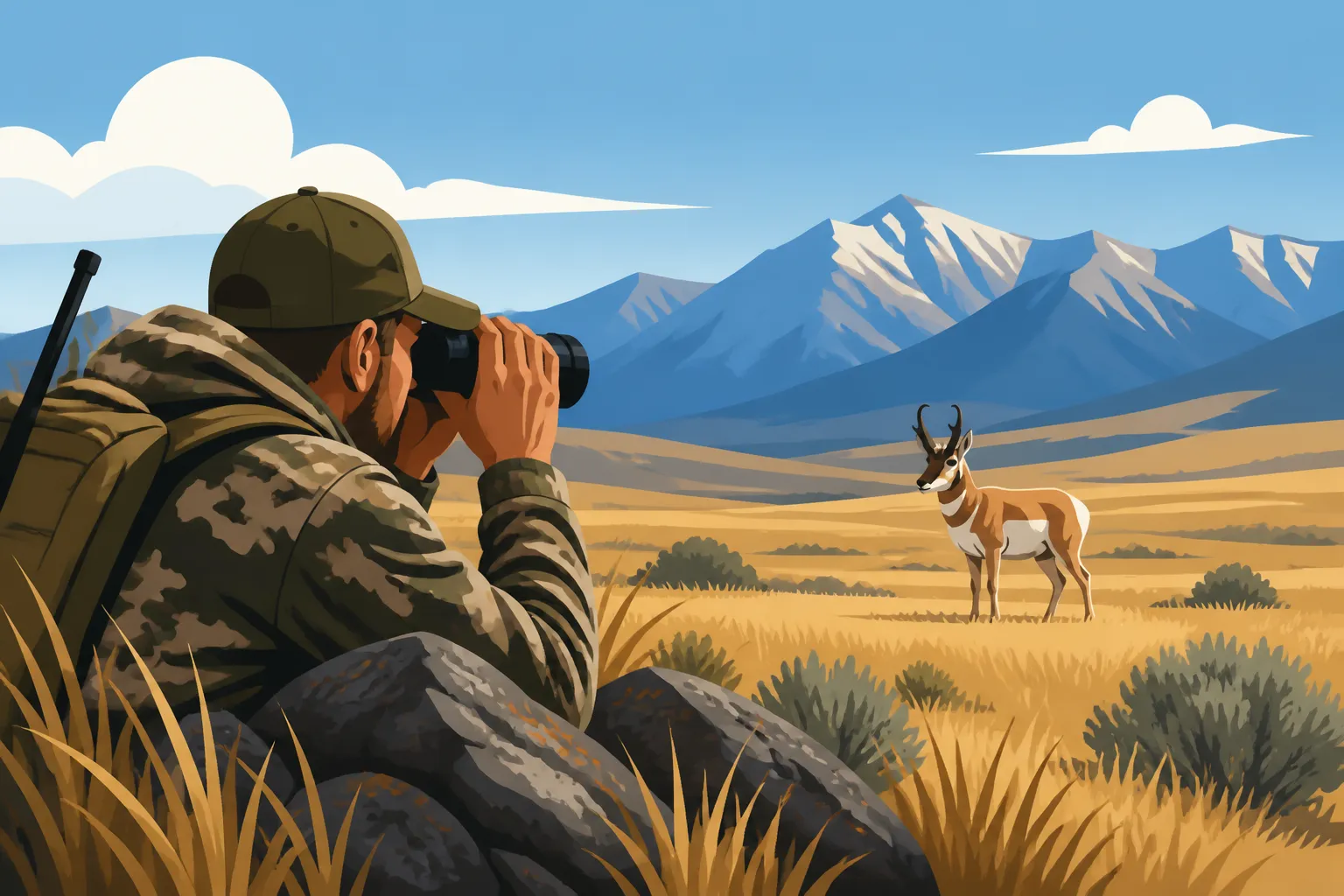
For binoculars, look for something in the 10x or 12x magnification range. These offer a good balance of power and field of view, allowing you to scan broad areas efficiently. Brands like Vortex, Leupold, and Maven offer excellent glass that won't break the bank. You'll be spending hours behind these, so clarity, edge-to-edge sharpness, and low-light performance are key. Many hunters choose to mount their binoculars on a tripod for extended glassing sessions, which significantly reduces fatigue and allows for much steadier viewing, revealing animals you might otherwise miss.
A spotting scope, ideally a 20-60x or 25-75x, is your secret weapon for identifying bucks from does, assessing horn size, and confirming that a distant speck is indeed an antelope, not a rock. You'll use this to "pick apart" distant hillsides and sagebrush flats, evaluating potential targets before committing to a grueling several-mile stalk. This is where you really need top-tier clarity. Remember, that little shimmer you see from heat waves can make judging horn length incredibly difficult, so the best glass you can afford will pay dividends. Paired with a sturdy tripod, a spotting scope allows for detailed observation, helping you determine if a stalk is even warranted. For more on this, consider our guide on How to Use Optics for Montana Mule Deer, as many principles apply.
Finally, a reliable rangefinder is non-negotiable. With antelope, judging distance in flat, featureless terrain is notoriously difficult. What looks like 300 yards can easily be 450, and missing your target due to an incorrect range estimation is a heartbreaking mistake. Look for a rangefinder with a maximum range well beyond your intended shooting distance, ideally one that can accurately range out to 1000+ yards. Modern rangefinders with angle compensation are also beneficial, though less critical on the mostly flat antelope country compared to mountainous elk hunting. Using a rangefinder before, during, and after your stalk will instill confidence in your shot placement.
Clothing and Footwear Considerations
When hunting antelope, your clothing needs to serve multiple purposes: camouflage, protection from the elements, and quiet movement. The open country demands effective camouflage patterns that blend with the dry grasses, sagebrush, and broken earth. Earth tones, tans, and browns, or specialized open-country patterns, are far more effective than dark, dense forest patterns. Your clothing should break up your silhouette and allow you to melt into the landscape.
Layering is crucial. Montana weather on the plains can be unpredictable, swinging from frosty mornings to scorching afternoons, sometimes with sudden thunderstorms or strong winds. Start with a moisture-wicking base layer, add insulating layers like fleece or puffy jackets, and top it with a windproof and water-resistant outer shell. You'll be shedding and adding layers throughout the day, so easy-to-pack options are best. Consider brands like Sitka or Kuiu that specialize in technical hunting apparel designed for such conditions, though more affordable options from Cabela's or Bass Pro Shops can also work. The key is quietness; avoid noisy fabrics that will give you away during those final, tense yards of a stalk.
Footwear is equally important. You'll be covering significant ground, often over uneven terrain, rocky areas, and prickly pear cactus. A comfortable, supportive pair of hiking boots with good ankle support is essential. They should be broken in well before your hunt to prevent blisters. While waterproof boots are always a good idea in general, in the typically dry antelope country, breathability might be a higher priority to keep your feet comfortable during long walks. Gaiters can also be a game-changer, protecting your lower legs and boots from burrs, stickers, and blowing dust or snow, keeping you more comfortable and focused on the hunt.
Rifles, Ammunition, and Shooting Aids
For antelope, precision and flat trajectory are your best friends. Shots can often be long, ranging from 200 to 400 yards, sometimes even further depending on the situation and your comfort level. Therefore, a flat-shooting rifle caliber is highly recommended. Popular choices include the .243 Winchester, 6.5 Creedmoor, .270 Winchester, .25-06 Remington, and .300 Winchester Magnum. These calibers offer the necessary velocity and energy retention for ethical kills at extended ranges, while also being relatively mild in recoil, which helps with follow-up shots.
Pair your chosen rifle with high-quality, consistent ammunition. Practice extensively at various distances, especially at those longer ranges you anticipate shooting. Knowing your rifle's capabilities and your personal limitations is paramount. Many hunters opt for bullets designed for long-range accuracy and controlled expansion, such as Hornady ELD-X, Berger VLD Hunting, or Nosler AccuBond, which perform well on the lighter-bodied antelope. Remember that velocity and wind drift are major factors in the open country; understanding bullet drop and wind compensation is critical. This is where tools like a ballistic calculator, sometimes integrated into a rangefinder, become invaluable. For discussions on specific calibers, you might find our Best Rifle Calibers for Montana Elk article useful, as many principles of long-range shooting apply across species.
Finally, shooting aids are crucial for stability. Laying prone is often the steadiest position for long shots in flat country, so a good bipod attached to your rifle is highly recommended. Brands like Harris or Atlas make excellent, durable bipods. Additionally, a shooting bag or backpack can be used as a front rest, offering flexibility in different terrain. For those who prefer to shoot from a kneeling or sitting position, a shooting stick or tripod can provide much-needed stability. The goal is to eliminate as much movement as possible to ensure a precise, ethical shot, especially when your heart is pounding after a long stalk. Do not underestimate the need for practice and solid support when dealing with the conditions of an antelope hunt.
The Art of Spotting Antelope in Big Country
Spotting antelope in Montana's vast, open country isn't like finding a deer in the woods. It's a skill that combines patience, meticulous technique, and an intimate understanding of the landscape. You're looking for a needle in a haystack, and the haystack can span thousands of acres. This is where your high-quality optics truly shine, and your approach must be methodical and disciplined.
Effective Glassing Techniques
The first and most critical step in a spot-and-stalk hunt is, well, spotting the animal. You'll spend far more time glassing than walking. Start your day early, often before first light, getting to a high vantage point that offers expansive views of potential antelope habitat. This could be a small rise, a butte, or the edge of a plateau. The first and last hours of daylight are typically the most productive, as antelope are often actively feeding and moving.
Once at your vantage point, set up your spotting scope and binoculars on a sturdy tripod. This stability is non-negotiable for long periods of intense glassing. Begin by systematically scanning the entire landscape. Don't just haphazardly sweep the horizon. Instead, pick a distant point and grid the area, working from left to right, then dropping your field of view slightly and sweeping back from right to left, much like reading a book. Pay close attention to subtle details: a patch of white that isn't snow, a horizontal line that doesn't fit the natural contours of the land, or a flicker of movement. Remember, you're not looking for an entire antelope initially; you're looking for a piece of one, a distinct shape or color that stands out.
Take frequent breaks from the glass to rest your eyes, then resume. The human eye can only absorb so much detail at once, and sometimes a fresh look will reveal something missed before. Use both your binoculars and your spotting scope. Binoculars are excellent for broad, initial sweeps and locating general areas of interest, while the spotting scope allows you to zoom in and pick apart those areas for specific animals and assess their trophy potential. Remember that heat shimmer, especially midday, can make long-distance glassing challenging, so adjust your strategy to focus on earlier or later hours when conditions are clearer. Consider our How to Glass Montana's Big Country guide for more general insights into effective glassing.
Identifying Shooter Bucks
Once you spot antelope, the next challenge is to identify if it's a shooter buck and, if so, to size it up from a distance. Antelope bucks are characterized by their unique, backward-curving horns with a forward-pointing prong. Their horns are shed annually, unlike true horns, making them unique among North American big game. Does also have horns, but they are typically much smaller, often just nubs or short spikes, though some older does can grow surprisingly respectable headgear.
Key characteristics to look for when identifying a shooter buck include the length of the main horn, the length of the prong, and the mass (circumference) of the horns. Generally, a good buck will have horns that extend noticeably above its ears and an easily identifiable prong. The mass is often harder to judge from afar but is a significant component of scoring. Also, observe the buck's behavior. Dominant bucks during the rut will often be actively herding does, chasing off smaller bucks, and generally exhibiting more assertive behavior. They might also appear larger-bodied than the does they are with.
Don't be afraid to spend considerable time evaluating a buck through your spotting scope before committing to a stalk. A long, arduous stalk only to discover the buck isn't what you thought it was can be incredibly disheartening. Take photos or videos through your scope if possible to review and get a second opinion if you're hunting with a partner. Pay attention to how the buck holds its head, how its horns compare to its ears, and the overall symmetry. With practice, you'll develop an eye for what constitutes a good Montana antelope buck.
Reading the Terrain for Stalking Opportunities
Once you've spotted your target buck, the real game begins: planning the stalk. This is where reading the terrain becomes a critical skill. Antelope country, while appearing flat, is rarely truly flat. It's often characterized by subtle dips, rolls, shallow coulees, dry washes, sagebrush flats, and gradual rises. These are your friends. Every contour, every patch of cover, no matter how small, offers a potential avenue of approach.
Use your maps – whether paper or digital like those offered by GoHunt – to identify potential cover between you and the antelope. Look for washes, dry creek beds, ravines, or even just the backside of a small ridge or hill that might hide your approach. Even a 2-foot rise can conceal a low-crawling hunter. Pay attention to the direction of the wind (more on that later) and plan your route to minimize exposure. Sometimes the longest path is the best path if it keeps you out of sight.
Consider what kind of cover is available: tall grasses, sagebrush, scattered rocks, or even fences and old homesteads can offer crucial concealment. Visualize your route, anticipating where you might need to crawl, where you can walk low, and where you might have to temporarily expose yourself to move from one piece of cover to the next. The goal is to move deliberately and out of sight for as long as possible, inching closer to your target while the antelope remain unaware of your presence. This meticulous planning is the difference between success and a spooked herd.
Mastering the Stalk: Getting Within Range
The stalk is the heart of antelope hunting. It's a grueling, often frustrating, but ultimately rewarding endeavor that requires immense patience, physical endurance, and tactical precision. Getting from where you spotted the antelope to within shooting range, without being seen, is arguably the most difficult part of the hunt.
Using Topography and Cover to Your Advantage
Once you've identified your target and planned your route, it's time to execute. This means utilizing every single natural feature the landscape offers. As you embark on your stalk, keep a constant mental or visual link to your target. Frequently peek over a rise or around a sagebrush clump to confirm the antelope's position and ensure it hasn't moved. If it has moved, reassess and adjust your plan immediately. Flexibility is key; antelope rarely stay put for long.
Your approach should be as low to the ground as possible. Often, this means belly crawling or using a low, army-style crawl for hundreds of yards, sometimes even over a mile. It's physically demanding, dirty, and can be slow, but it's often the only way to beat their incredible eyesight. Wear knee pads and gloves to protect yourself from rocks, cactus, and rough terrain. Even when you think you're behind a rise, remember that antelope are often on elevated ground, giving them an advantage. Any exposed part of your body can give you away, so keep your profile as low as possible.
When moving between cover, choose your moments wisely. Move when the antelope are feeding with their heads down, when they are bedding, or when their attention is diverted by something else, like another antelope or even a passing vehicle far in the distance. Freeze instantly if a head pops up, even if you think you're hidden. If they stare in your direction, stay absolutely still, holding your position until they resume their normal activity. This requires immense patience and mental fortitude. Success in Spot-and-Stalk Antelope Tactics hinges on your ability to use the terrain like a ghost, appearing and disappearing without a trace.
Wind Direction and Thermals
While antelope eyesight is their primary defense, completely ignoring wind direction and thermals would be a rookie mistake. A sudden shift in wind can carry your scent directly to the herd, even if they haven't seen you. Their sense of smell might not be as acute as an elk's, but it's certainly good enough to detect human scent at close range, especially in still air or when they're downwind.
Always approach antelope from downwind, or at least with a strong crosswind. This means you need to constantly monitor the wind direction throughout your stalk. Carry a small wind checker (like a puff bottle or a piece of string) and use it frequently. Wind on the open plains can be notoriously shifty, swirling around coulees and draws, so what seems like a steady wind might change suddenly. If the wind shifts and puts you upwind, you have two choices: either adjust your approach to regain the wind advantage, which might mean a significant detour, or abandon the stalk and try another day or another animal. Getting busted by scent after a long, difficult stalk is a cruel lesson in humility.
Thermals are less of a concern on the generally flat antelope plains compared to the mountains, but they can still play a role in areas with significant topographical changes, like river breaks or steep coulees. In the morning, thermals typically rise as the ground warms, carrying scent upwards. In the evening, they fall as the air cools, carrying scent downhill. Pay attention to these subtle air currents, especially if you're hunting in broken country or near a water source where thermals might be more pronounced.
Patience, Pace, and Stealth
These three words define the successful antelope stalk. Impatience is the downfall of many antelope hunters. You might spend hours on a single stalk, moving only a few hundred yards. This slow, deliberate pace is necessary. Rushing will almost certainly result in being spotted. Each step needs to be calculated, quiet, and deliberate. Scan the ground ahead of you for loose rocks, crunchy vegetation, or anything that might create noise.
Stealth isn't just about moving quietly; it's about moving naturally. Antelope are highly attuned to unnatural movements. Avoid sudden, jerky motions. If you need to raise your head, do it slowly, gradually, mimicking the movements of an animal rather than a human. If you're belly crawling, distribute your weight to avoid making deep depressions that alert their sensitive eyesight. Blend with your surroundings as much as possible, using the terrain to break up your silhouette.
Sometimes, the best move is no move at all. If the antelope are active and constantly moving, or if they are in an impossibly exposed position, it might be better to wait them out. They will eventually move to feed, water, or bed down, potentially putting them in a more favorable position for a stalk. Waiting for the right opportunity, even if it means sitting for hours, is a sign of a seasoned antelope hunter. Sometimes, you might even consider a decoy, a tactic discussed in How to Decoy Antelope in Montana, but typically the spot-and-stalk relies on pure stealth and terrain use.
Here's a quick table to summarize key stalking considerations:
| Stalking Element | Key Consideration | Best Practice | Common Pitfall to Avoid |
|---|---|---|---|
| Visibility | Antelope's keen eyesight, open terrain | Stay low, use all available cover (even minor dips) | Moving upright, exposing silhouette, quick movements |
| Wind Direction | Scent detection, especially at closer ranges | Always approach from downwind or crosswind, use wind checker | Ignoring wind, moving directly upwind, sudden shifts |
| Pace | Antelope's wariness, human endurance | Slow, deliberate, methodical; take breaks | Rushing the stalk, getting fatigued and sloppy |
| Movement | Antelope detect unnatural motion | Smooth, fluid, quiet movements; freeze if stared at | Jerky motions, loud footsteps, scraping gear |
| Terrain Use | Utilizing natural features for concealment | Identify washes, coulees, ridges; visualize approach | Underestimating cover needs, trying to go straight line |
| Patience | Antelope constantly shift, long waits are common | Be prepared for hours of waiting, adapt to changes | Giving up too early, forcing a stalk that isn't there |
| Re-evaluate | Antelope move, conditions change | Constantly check target position, adjust plan as needed | Sticking to a plan even when conditions dictate a change |
Executing the Shot and Post-Shot Procedure
After hours of glassing, crawling, and meticulous maneuvering, the moment of truth arrives. Getting within range is only half the battle; executing a clean, ethical shot and properly handling your animal are the crucial final steps to a successful spot-and-stalk antelope hunt.
Setting Up for the Shot
As you approach your maximum comfortable shooting distance, typically 200-400 yards for most rifle hunters, you need to transition from stalking to shooting. This transition must be as smooth and silent as possible. Your goal is to get into the steadiest shooting position available without alerting the antelope. For most long-range shots in open country, prone is the most stable position. If you've been crawling, you might already be in a low position, making the transition easier.
Deploy your bipod or shooting sticks carefully. Don't scrape them on rocks or make sudden movements that might draw attention. Once in position, take a moment to breathe, calm your nerves, and range the animal one last time. Even if you ranged it a few minutes ago, antelope can cover ground quickly, and a 50-yard difference can mean a significant change in bullet drop at these distances. Confirm your target, ensure no other animals or obstacles are behind it, and check for any obstructions in your line of fire. If hunting with a partner, they can help spot for you and provide range calls.
If the antelope is bedded, you might have to wait for it to stand up for a better shot opportunity. Never rush a shot. Wait for a broadside or slightly quartering-away shot when the animal is calm and unaware. If it stands and stares in your direction, hold your shot until it turns or presents a better angle, or settles back down. A standing, alert animal is much more likely to react unpredictably to the shot. Ensure you have a clear, unobstructed view of the vitals.
Antelope Shot Placement
Antelope are relatively small-bodied animals compared to elk or even mule deer, so precise shot placement is paramount for a quick, ethical kill. The primary target area is the lung-heart region, located behind the shoulder and low on the body. A bullet placed here will incapacitate the animal quickly.
Aim for the front half of the body, just behind the front leg, about one-third of the way up from the belly line. This will put you into the heart and lungs. Avoid aiming for the shoulder bone directly, as it can be dense and potentially cause bullet deflection or stop lighter bullets, though a clean shoulder shot will often drop them in their tracks. A shot too far back will result in a gut shot, leading to a prolonged, difficult, and often unsuccessful tracking job, which is especially challenging in vast, open country. A neck or head shot can be lethal, but the target area is much smaller, and the risk of wounding is significantly higher. Unless you are an extremely proficient marksman at close range, stick to the vitals.
Account for wind drift and bullet drop, especially on those longer shots. Even a slight breeze can push a bullet several inches off target at 300+ yards. Use your ballistic data, hold for wind, and make a clean break on the trigger. Follow through on your shot, watching the animal's reaction. Did it drop? Did it run? If it ran, note its last known direction and any visible signs of a hit.
Tracking and Field Care
Even with a perfectly placed shot, antelope often run, sometimes for a considerable distance, before succumbing. This is where patience and meticulous tracking become vital. If the antelope runs after the shot, immediately reload your rifle and keep your eyes fixed on it, watching its direction of travel and observing any visible reactions or stumbles. If it disappears from sight, mark the exact spot where it was standing at the time of the shot. This is your "point of impact" and the starting point for your tracking.
Wait a minimum of 15-30 minutes, or even longer if you suspect a marginal hit, before beginning to track. Antelope are fast, and a wounded animal can cover a surprising amount of ground if pushed too quickly. Once you begin tracking, move slowly and methodically, looking for blood, hair, disturbed earth, or broken vegetation. Antelope often run in a relatively straight line, but they can also circle back or seek out cover in draws. Look for any sign, no matter how small. If you're struggling, expand your search pattern in ever-widening circles around the last known location. For more detailed tracking advice, consider our How to Pack Out an Elk in Montana guide, as many concepts about following a blood trail are universal.
Once you locate your antelope, the real work begins. Field dress the animal quickly to allow the carcass to cool, especially in the often-warm Montana antelope season. Gutting the animal and getting the body cavity open will help prevent spoilage. If the weather is warm, consider quartering the animal and placing the meat in game bags, hanging them in the shade, or even packing them out to a cooler as quickly as possible. Antelope meat is delicious but can spoil rapidly if not handled properly. Pack out all edible meat and adhere to Montana FWP regulations regarding carcass transport and tagging. A successful antelope hunt isn't just about the shot; it's about respecting the animal and ensuring every ounce of meat is properly cared for.
Disclaimer
Please note that hunting regulations, season dates, and license requirements for Montana can change frequently. Always consult the official Montana Fish, Wildlife & Parks (FWP) regulations for the current year before planning any hunt. This guide is for informational purposes only and should not replace official FWP resources or professional guidance. Stay safe and hunt ethically.